
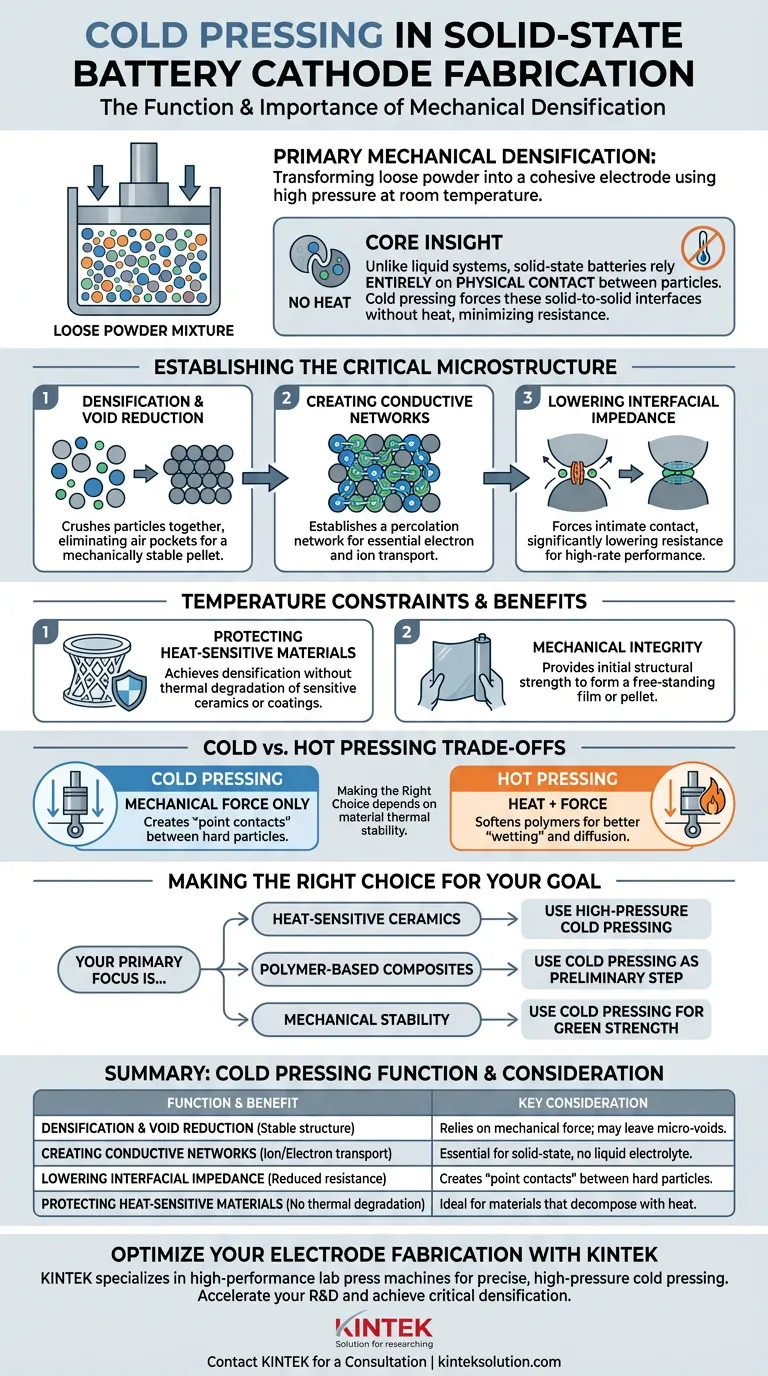
The cold pressing process serves as the primary mechanical densification step in fabricating solid-state battery composite cathodes, specifically designed to transform a loose powder mixture into a cohesive, functional electrode.
By applying high pressure (often hundreds of megapascals) at room temperature, this process forces active materials, solid electrolytes, and conductive agents into intimate physical contact. This eliminates internal voids and creates the continuous pathways required for ion and electron transport, which are essential for the battery to store and release energy.
Core Insight: Unlike liquid electrolyte batteries where the fluid naturally fills gaps, solid-state batteries rely entirely on physical contact between particles to function. Cold pressing provides the mechanical force necessary to establish these solid-to-solid interfaces without using heat, creating a dense network that minimizes resistance and maximizes capacity.
Establishing the Critical Microstructure
To understand why cold pressing is non-negotiable for composite cathodes, you must look at the microscopic requirements of the electrode.
Densification and Void Reduction
The starting material for a composite cathode is a mixture of powders, which naturally contains a significant amount of empty space (porosity).
Cold pressing utilizes high uniaxial pressure to crush these particles together, effectively eliminating air pockets. This results in a mechanically stable pellet or sheet with high packing density.
Creating Conductive Networks
A battery cannot function if the electrons and ions are stranded on isolated islands of material.
The pressure applied during cold pressing establishes a percolation network. This ensures that conductive additives touch the active materials (for electron flow) and that solid electrolyte particles touch the active materials (for ion flow).
Lowering Interfacial Impedance
The resistance encountered at the boundary between two materials is known as interfacial impedance.
In a loose powder, this resistance is incredibly high. By forcing particles into a tightly packed arrangement, cold pressing increases the effective contact area, significantly lowering this impedance and allowing for high-rate performance.
The Role of Temperature Constraints
While densification is the goal, the method of achieving it depends heavily on your material properties.
protecting Heat-Sensitive Materials
Many high-performance ceramic electrolytes or specific active material coatings are sensitive to thermal degradation.
Cold pressing allows you to achieve necessary densification without exposing the composite to high temperatures. It is the ideal fabrication method for systems that would chemically decompose or undergo unwanted phase changes if subjected to sintering or hot pressing.
Mechanical Integrity
Beyond electrochemical performance, the electrode must be physically robust to withstand handling and cell assembly.
Cold pressing provides the initial mechanical strength required to form a free-standing film or a pellet that maintains its structural integrity during the lifecycle of the battery.
Understanding the Trade-offs: Cold vs. Hot Pressing
While cold pressing is effective, it relies solely on mechanical force. Understanding its limitations compared to thermal methods is vital for process optimization.
Lack of Polymer "Wetting"
In systems containing polymers (like PEO), cold pressing does not soften the material.
Hot pressing, by contrast, utilizes heat to soften the polymer, allowing it to "wet" and encapsulate the active material particles (Ref 6). This can lead to lower impedance than cold pressing alone in polymer-based systems.
The Limits of Mechanical Contact
Cold pressing creates "point contacts" between hard ceramic particles.
Even at high pressures, tiny voids may remain between irregular shapes. Sintering or hot pressing can sometimes achieve higher relative densities by promoting diffusion or flow, which cold pressing cannot simulate.
Making the Right Choice for Your Goal
The decision to use cold pressing usually hinges on the thermal stability of your materials and the nature of your electrolyte.
- If your primary focus is Heat-Sensitive Ceramics: Rely on high-pressure cold pressing (hundreds of MPa) to achieve density without degrading your material structure.
- If your primary focus is Polymer-Based Composites: Consider that cold pressing acts as a preliminary step, but heat may be required to fully optimize the electrode-electrolyte interface.
- If your primary focus is Mechanical Stability: Use cold pressing to establish the initial structural framework and "green strength" of the electrode sheet before any secondary processing.
Ultimately, cold pressing is the fundamental bridge that turns a non-conductive powder mixture into a high-performance, electrochemically active solid.
Summary Table:
| Function | Key Benefit | Key Consideration |
|---|---|---|
| Densification & Void Reduction | Creates a mechanically stable, high-density electrode structure. | Relies solely on mechanical force; may leave micro-voids compared to thermal methods. |
| Creating Conductive Networks | Establishes continuous pathways for ion and electron transport (percolation). | Essential for battery function as solid-state systems lack liquid electrolytes. |
| Lowering Interfacial Impedance | Increases contact area between particles, reducing resistance for high-rate performance. | Creates 'point contacts' between hard particles. |
| Protecting Heat-Sensitive Materials | Enables densification without thermal degradation of sensitive ceramics/coatings. | Ideal for materials that would decompose or change phase with heat. |
Ready to Optimize Your Solid-State Battery Electrode Fabrication?
KINTEK specializes in high-performance lab press machines, including automatic and isostatic presses, designed to deliver the precise, high-pressure cold pressing required for your R&D and production of composite cathodes.
Our equipment helps researchers and battery developers like you achieve the critical densification and microstructural control needed for next-generation batteries. Contact us today to discuss how our solutions can enhance your lab's capabilities and accelerate your development timeline.
Contact KINTEK for a Consultation
Visual Guide
Related Products
- Warm Isostatic Press for Solid State Battery Research Warm Isostatic Press
- Electric Lab Cold Isostatic Press CIP Machine
- Carbide Lab Press Mold for Laboratory Sample Preparation
- Manual Cold Isostatic Pressing CIP Machine Pellet Press
- Electric Split Lab Cold Isostatic Pressing CIP Machine
People Also Ask
- Why must composite cathodes be sealed in vacuum lamination bags for WIP? Ensure Battery Stability and Density
- How do sacrificial volume materials (SVM) maintain microchannels in isostatic pressing? Ensure Structural Integrity
- What is the function of elastic molds in warm isostatic pressing? Achieve Uniform Density in Composite Particles
- What is the role of the flexible material in warm isostatic pressing? Key to Uniform Density & Precision
- What is the process involved in warm isostatic pressing? Mastering Uniform Density with WIP Technology











