
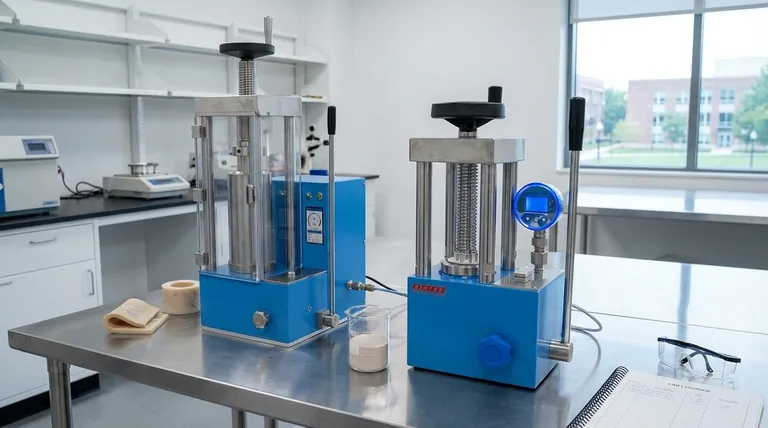
At its core, an Electric Lab Cold Isostatic Press (CIP) functions based on Pascal’s Law. This physical principle states that pressure applied to an enclosed fluid is transmitted equally in all directions without diminishing in magnitude. In a CIP system, this omnidirectional hydraulic force is used to compress powdered materials—sealed within a flexible mold—uniformly from every angle, creating a dense, structurally consistent component at room temperature.
By utilizing uniform hydrostatic pressure, CIP eliminates the internal density gradients common in uniaxial pressing, producing "green" parts with superior uniformity and structural integrity prior to sintering.
The Mechanics of Isostatic Compaction
The Role of Hydrostatic Pressure
Unlike traditional pressing, which uses a mechanical ram to apply force from a single direction, CIP utilizes a fluid medium. This medium—typically water, oil, or a glycol mixture—surrounds the material within a pressure vessel.
When the electric pump pressurizes this fluid, it exerts force evenly on the target object from all sides. This allows the system to achieve high theoretical densities, often reaching approximately 95% for ceramic powders and near 100% for metals.
The Function of the Flexible Mold
To prevent the liquid medium from contaminating the powder, the material is encapsulated in a flexible elastomeric mold.
Made from materials like rubber or plastic, this mold acts as a hermetic barrier. It deforms under the hydrostatic pressure, transferring the force directly to the powder while maintaining the shape integrity of the part.
Achieving Uniform Green Density
The primary output of a CIP cycle is a "green" part—a raw, compacted solid with sufficient strength for handling but requiring further processing (like sintering).
Because pressure is applied from every direction simultaneously, the friction between particles is minimized. This results in a uniform microstructure throughout the part, avoiding the weak spots or density variations often found in parts pressed in rigid dies.
Precision in the Laboratory Setting
An "Electric Lab" CIP differentiates itself through precise automation and control features.
These systems allow researchers to customize depressurization profiles and control pressurization rates. This level of control is essential for preventing cracks during the release of pressure and ensuring high green strength in experimental materials.
Understanding the Trade-offs
Dimensional Precision and Post-Processing
While CIP excels at density uniformity, the use of flexible molds sacrifices geometric precision.
Because the mold compresses along with the powder, the final dimensions of the green part can vary slightly. Consequently, parts produced via CIP frequently require post-machining to achieve tight final tolerances.
Cycle Time Considerations
The nature of the process, particularly in a "wet-bag" laboratory setup, leads to longer cycle times compared to automated mechanical pressing.
A typical wet-bag cycle can take between 5 to 30 minutes. While automated dry-bag processes are faster (under 1 minute), laboratory contexts often prioritize the versatility of the slower wet-bag method.
Making the Right Choice for Your Goal
Whether you are developing advanced ceramics or prototyping powder metallurgy components, understanding the intent of the equipment is vital.
- If your primary focus is material uniformity: CIP is the superior choice for eliminating density gradients and internal voids in complex shapes.
- If your primary focus is geometric precision: Be prepared to integrate a secondary machining step, as the flexible mold will not yield net-shape accuracy.
- If your primary focus is experimental control: Leverage the programmable pressure profiles of an electric lab unit to optimize the microstructure of sensitive materials.
Ultimately, the Electric Lab CIP is a tool for prioritizing internal structural integrity over raw production speed or immediate dimensional perfection.
Summary Table:
| Key Principle | Key Component | Primary Advantage | Typical Application |
|---|---|---|---|
| Pascal's Law (Uniform Fluid Pressure) | Flexible Elastomeric Mold | Eliminates Density Gradients | Advanced Ceramics R&D |
| Hydrostatic Compaction | Pressure Vessel & Fluid Medium | High Green Density (~95-100%) | Powder Metallurgy Prototyping |
| Programmable Pressure Control | Electric Pump System | Superior Microstructural Integrity | Experimental Material Development |
Ready to achieve unparalleled density and uniformity in your lab's powder compaction process?
KINTEK specializes in precision lab press machines, including automatic lab presses, isostatic presses, and heated lab presses, designed to meet the exacting demands of laboratory research and development. Our Electric Lab Cold Isostatic Presses (CIP) provide the controlled, uniform pressure essential for developing advanced ceramics and metal components without internal flaws.
Contact our experts today to discuss how a KINTEK CIP can enhance your material integrity and research outcomes!
Visual Guide

Related Products
- Electric Lab Cold Isostatic Press CIP Machine
- Electric Split Lab Cold Isostatic Pressing CIP Machine
- Automatic Lab Cold Isostatic Pressing CIP Machine
- Manual Cold Isostatic Pressing CIP Machine Pellet Press
- Lab Isostatic Pressing Molds for Isostatic Molding
People Also Ask
- What role do electric lab cold isostatic presses play in industrial contexts? Bridge R&D and Manufacturing with Precision
- What are the applications of electric lab cold isostatic presses in research settings? Advance Material R&D with High-Pressure CIPs
- How does electrical Cold Isostatic Pressing (CIP) contribute to cost savings? Unlock Efficiency and Reduce Expenses
- What are some research applications of electric lab CIPs? Unlock Uniform Powder Densification for Advanced Materials
- What are the characteristics of standard off-the-shelf electric lab CIP solutions? Achieve Immediate, Cost-Effective Processing



















