
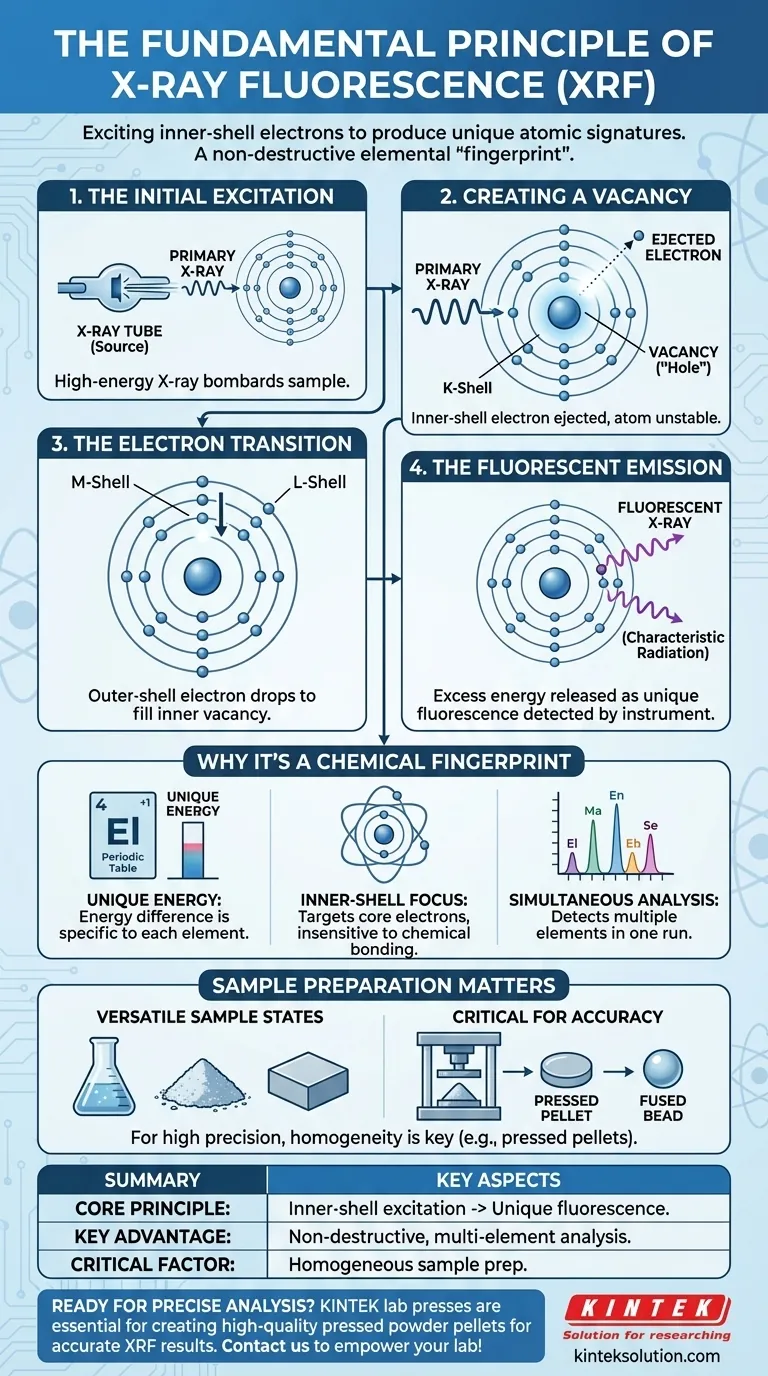
The fundamental principle of X-ray fluorescence (XRF) is the excitation of inner-shell electrons to produce unique atomic signatures. This process begins when high-energy primary X-rays bombard a sample, ejecting electrons from their stable inner atomic shells. As outer-shell electrons drop down to fill these vacancies, they release excess energy in the form of secondary X-rays—known as fluorescence—which identify the specific elements present.
XRF functions as a non-destructive atomic fingerprinting technique. Because the energy released during electron transitions is unique to each element, XRF allows you to simultaneously identify and quantify multiple elements in a sample without altering its chemical composition.
The Anatomy of an XRF Interaction
To understand why XRF is accurate, you must understand the chain reaction occurring at the atomic level.
The Initial Excitation
The process starts with an excitation source, typically an X-ray tube. This source shoots a primary X-ray at the sample material.
Creating a Vacancy
When this primary X-ray strikes an atom, it dislodges an electron from an inner atomic shell. This ejection leaves the atom in an unstable, excited state with a "hole" or vacancy in its structure.
The Electron Transition
Nature seeks stability. To correct the vacancy, an electron from a higher energy outer shell immediately drops down to fill the empty space in the inner shell.
The Fluorescent Emission
An electron in an outer shell holds more energy than one in an inner shell. As the electron transitions downward, it must shed that excess energy. This energy is released as fluorescence radiation, which is detected by the instrument.
Why XRF Acts as a Chemical Fingerprint
The value of XRF lies not just in the emission of radiation, but in the specificity of that radiation.
Characteristic Radiation
The energy difference between atomic shells is fixed and unique for every element in the periodic table. Consequently, the fluorescent energy released is characteristic of the specific element that produced it.
Differentiation from Optical Spectroscopy
Unlike optical spectroscopy, which analyzes valence electrons (the outer electrons involved in bonding), XRF targets inner shell electrons. This makes XRF generally insensitive to chemical bonding, providing a direct reading of the elemental composition.
Simultaneous Analysis
Because the detector can read various energy levels at once, XRF allows for the simultaneous analysis of multiple elements. You obtain a complete profile of the material in a single test run.
Understanding the Trade-offs and Prerequisites
While XRF is powerful, the quality of your results relies heavily on how the physical sample interacts with the X-rays.
Sample State Versatility
XRF is highly adaptable. It can analyze samples in various forms, including small particles, powders, liquids, and solids.
The Reality of "Non-Destructive" Testing
Technically, the XRF process does not destroy the sample. However, obtaining high-precision results often requires altering the sample physically, such as pulverizing it into a powder or blending it with a binder.
The Critical Role of Surface Preparation
X-rays must interact cleanly with the material. For solid samples, you may need to machine or polish the surface to remove oxides and coatings that could skew the data.
Advanced Preparation for Homogeneity
For the highest accuracy, simple powders may not suffice due to particle size effects. In these cases, creating fused beads (melting the sample with a flux like lithium-tetraborate) or pressed powder pellets is necessary to ensure a homogeneous testing surface.
Making the Right Choice for Your Goal
The physics of XRF remains constant, but your approach to sample preparation should dictate your workflow.
- If your primary focus is rapid screening or preserving the sample: Utilize sample cups for liquids and loose powders, or simply clean the surface of solids to maintain the non-destructive benefit.
- If your primary focus is high-precision quantitative analysis: Invest time in creating pressed powder pellets or fused beads to eliminate surface irregularities and ensure homogeneity.
- If your primary focus is distinguishing elemental composition from chemical structure: Rely on XRF's interaction with inner-shell electrons rather than optical methods that measure valence bonding.
XRF provides a direct, measurable link between the atomic structure of your material and the data you need to characterize it.
Summary Table:
| Key Aspect | Description |
|---|---|
| Core Principle | Excitation of inner-shell electrons to produce unique, element-specific fluorescent X-rays. |
| Process | Primary X-rays eject inner-shell electrons; outer-shell electrons fill the vacancy, releasing fluorescent energy. |
| Key Advantage | Non-destructive, simultaneous multi-element analysis, largely insensitive to chemical bonding. |
| Sample Forms | Solids, powders, liquids, small particles. |
| Critical Factor | Sample preparation (e.g., pressed pellets, fused beads) is key for high-precision results. |
Ready to achieve precise and reliable elemental analysis in your lab?
The fundamental principles of XRF make it a powerful tool for quality control, research, and material verification. KINTEK specializes in providing robust and efficient lab press machines, including automatic lab presses and heated lab presses, which are essential for creating high-quality pressed powder pellets—a cornerstone of accurate XRF sample preparation.
Whether you are in mining, pharmaceuticals, environmental testing, or academia, our equipment ensures your samples are homogenous and perfectly prepared, leading to dependable XRF results. Enhance your analytical capabilities and streamline your workflow.
Contact us today to discuss your specific needs and discover how KINTEK's solutions can empower your laboratory's success!
Visual Guide
Related Products
- XRF KBR Steel Ring Lab Powder Pellet Pressing Mold for FTIR
- Lab XRF Boric Acid Powder Pellet Pressing Mold for Laboratory Use
- XRF KBR Plastic Ring Lab Powder Pellet Pressing Mold for FTIR
- Automatic Laboratory Hydraulic Press for XRF and KBR Pellet Pressing
- Laboratory Hydraulic Pellet Press for XRF KBR FTIR Lab Press
People Also Ask
- What considerations are important regarding the die size of an XRF pellet press? Optimize for Your XRF Spectrometer and Sample
- Why are pellets used in XRF analysis, and what is their limitation? Boost Accuracy and Speed in Your Lab
- What is the general process for preparing a sample pellet for XRF? Master Consistency for Accurate Analysis
- What are the differences between manual and automatic XRF pellet presses? Choose the Right Press for Your Lab's Needs
- What are the different types of XRF pellet preparation methods available? Manual, Hydraulic, and Automated Presses Explained









