
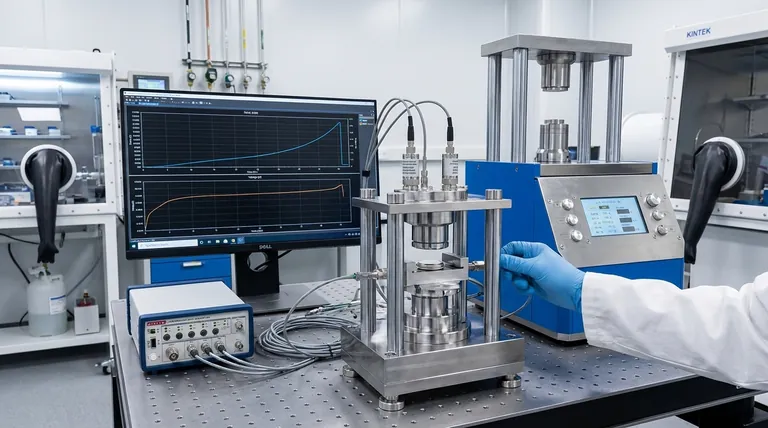
In-situ compression is the fundamental enabler of performance in solid-state batteries (SSBs), serving as the mechanical substitute for the wetting action found in liquid electrolytes. By applying continuous, controlled pressure—ranging from operational levels of 1-17 MPa up to assembly pressures of 80 MPa—this setup ensures that rigid solid components maintain the intimate physical contact necessary for ion transport and structural integrity.
The Core Reality: Unlike liquid electrolytes that naturally fill voids, solid-state materials possess rigid, rough surfaces that create microscopic gaps. Without an in-situ compression setup to mechanically force these layers together, interfacial resistance skyrockets and the battery fails to function efficiently or withstand the physical stress of cycling.
The Challenge of the Solid-Solid Interface
Overcoming Surface Roughness
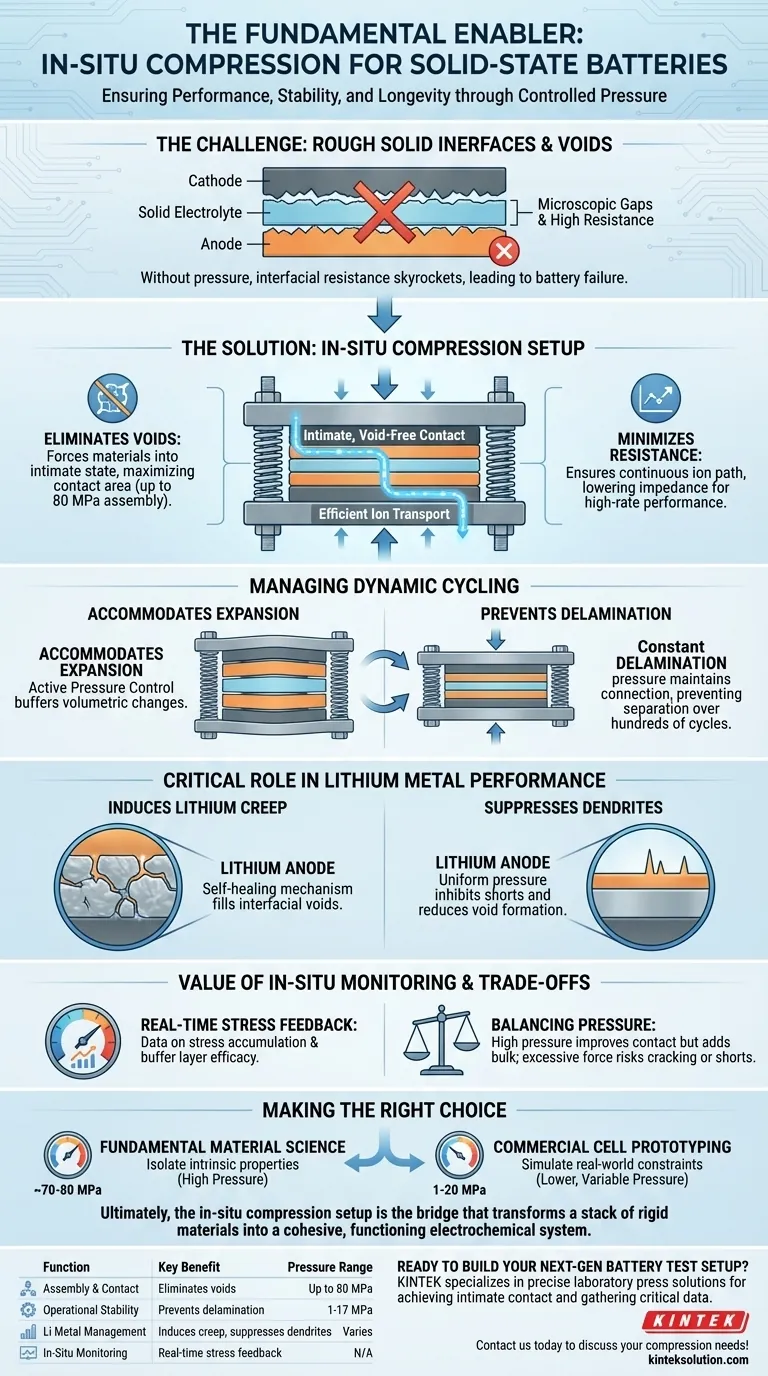
On a microscopic level, the surfaces of cathodes, anodes, and solid electrolytes are rough and uneven. In-situ compression eliminates the voids created by this roughness.
By applying high external pressure (often around 74 MPa during assembly), you force the materials into an "intimate," void-free state. This maximizes the active contact area between layers.
Minimizing Interfacial Resistance
The primary enemy of SSB performance is high impedance at the interface. Gaps between layers act as barriers to ion flow.
Compression ensures a continuous path for lithium ions. This effectively lowers the ionic transport resistance, which is a prerequisite for activating the battery and achieving high-rate performance.
Managing Dynamic Changes During Cycling
Accommodating Volumetric Expansion
Solid-state batteries are not static; they "breathe" during operation. Electrode materials, particularly in anode-free configurations, experience significant volume changes during charge and discharge.
A testing fixture with active pressure control compensates for these fluctuations. It acts as a mechanical buffer, maintaining stability even as the internal volume expands and contracts.
Preventing Delamination
Without constant pressure, the expansion and contraction of materials would lead to physical separation (delamination) of the layers.
Continuous stack pressure prevents this separation. It ensures that even after hundreds of cycles of expansion, the electrode particles remain electrically and ionically connected to the electrolyte.
The Critical Role in Lithium Metal Performance
Inducing Lithium Creep
One of the unique advantages of applied pressure is its effect on lithium metal. Appropriate pressure induces creep behavior in lithium.
This allows the lithium to plastically deform and actively fill interfacial voids that form during operation. This "self-healing" mechanism is vital for maintaining a low-impedance interface over time.
Suppressing Dendrites and Voids
In anode-free designs, pressure helps regulate the deposition of lithium. It ensures the newly formed lithium layer stays tight against the electrolyte.
This suppression creates a uniform current distribution, which inhibits the penetration of lithium dendrites (which cause shorts) and reduces void formation during the stripping (discharge) phase.
The Value of In-Situ Monitoring
Real-Time Stress Feedback
Advanced in-situ setups do not just apply pressure; they monitor it. They provide data on stress accumulation within the cell.
This feedback allows researchers to see exactly how much force the battery generates during cycling. It is indispensable for evaluating how well buffer layers (like elastic carbon felt) absorb volumetric expansion.
Understanding the Trade-offs
The Pressure Magnitude Dilemma
While the references note that assembly pressures can reach 80 MPa to establish contact, maintaining such high pressures in a commercial application is engineeringly difficult.
High pressure improves performance but adds weight and bulk. In a lab setting, a hydraulic press creates ideal conditions (70+ MPa). However, practical testing fixtures often target lower ranges (1-17 MPa) to simulate more realistic operating environments.
Balancing Flow vs. Short Circuits
While pressure induces beneficial lithium creep, excessive or uneven pressure can be detrimental.
If the pressure is too high or applied unevenly, it may force electrolyte materials to crack or accelerate dendrite penetration through soft separators. The setup must provide controlled, uniform pressure, not just brute force.
Making the Right Choice for Your Goal
The specific configuration of your in-situ compression setup should depend on whether you are characterizing basic material properties or testing commercial viability.
- If your primary focus is Fundamental Material Science: Use high pressures (approx. 70-80 MPa) to eliminate all physical variables and isolate the intrinsic electrochemical properties of your materials.
- If your primary focus is Commercial Cell Prototyping: Utilize lower, variable pressure ranges (1-20 MPa) to simulate the constraints of a real-world battery pack and test the efficacy of expansion-buffering interlayers.
Ultimately, the in-situ compression setup is the bridge that transforms a stack of rigid materials into a cohesive, functioning electrochemical system.
Summary Table:
| Function | Key Benefit | Typical Pressure Range |
|---|---|---|
| Assembly & Initial Contact | Eliminates voids from surface roughness | Up to 80 MPa |
| Operational Stability | Maintains contact during cycling, prevents delamination | 1 - 17 MPa |
| Lithium Metal Management | Induces creep, suppresses dendrites | Varies by design |
| In-Situ Monitoring | Provides real-time stress feedback | N/A |
Ready to Build Your Next-Generation Battery Test Setup?
Accurate and reliable stack pressure is non-negotiable for developing functional solid-state batteries. KINTEK specializes in laboratory press solutions, including automated and heated lab presses, that provide the precise, uniform pressure control essential for your R&D.
Our equipment helps you:
- Achieve intimate interfacial contact to minimize resistance.
- Simulate real-world operating conditions with variable pressure control.
- Gather critical data on material behavior under stress.
Let KINTEK's expertise in lab press machines support your laboratory's mission to overcome the challenges of solid-state interfaces.
Contact us today to discuss your specific compression needs!
Visual Guide
Related Products
- Warm Isostatic Press for Solid State Battery Research Warm Isostatic Press
- Carbide Lab Press Mold for Laboratory Sample Preparation
People Also Ask
- Why must composite cathodes be sealed in vacuum lamination bags for WIP? Ensure Battery Stability and Density
- What is the function of elastic molds in warm isostatic pressing? Achieve Uniform Density in Composite Particles
- How do sacrificial volume materials (SVM) maintain microchannels in isostatic pressing? Ensure Structural Integrity
- What is the function of hydraulic pressure in warm isostatic pressing? Achieve Uniform Material Density
- How does Warm Isostatic Pressing differ from traditional pressing methods? Unlock Uniform Density for Complex Parts

