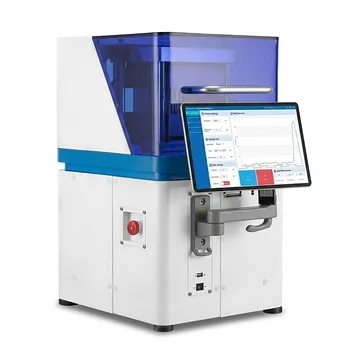
Laboratory presses serve as the critical gateway between theoretical research and scalable production. They provide a strictly controlled environment for testing materials and prototypes, ensuring that products meet rigorous standards before manufacturing begins. By enabling high-precision testing, these tools directly improve accuracy and quality control while significantly reducing development time and costs.
By isolating variables under high heat and pressure, laboratory presses allow organizations to validate material strength and durability early in the development cycle. This pre-production rigor prevents costly manufacturing errors and ensures consistent product quality.
Bridging the Gap Between R&D and Manufacturing
Prototyping in a Controlled Environment
The primary role of a laboratory press is to create a bridge between the lab and the factory floor. It allows researchers to test prototypes in an environment that simulates production conditions without the expense of a full manufacturing run.
Ensuring Material Integrity
In industrial settings, presses are essential for compacting and testing materials such as rubber, plastic, and laminates. By subjecting these materials to stress, engineers can verify they meet specific strength and durability standards before they are approved for mass production.
Cost and Time Efficiency
Catching material failures during the research phase is exponentially cheaper than fixing them during production. Using a lab press for early quality control minimizes waste and accelerates the time-to-market for new products.
Achieving Scientific Accuracy
Mastering Research Variables
To ensure the accuracy of study results, researchers must maintain consistent control over every variable. Laboratory presses are engineered to withstand and regulate high temperatures and pressures, eliminating environmental fluctuations that could skew data.
Long-Term Reproducibility
Reliability is just as important as accuracy. As noted in supplementary documentation, these presses feature robust construction designed for the rigorous demands of continuous use. This ensures that test results remain reproducible and reliable over many years of operation.
Understanding the Trade-offs
Simulation vs. Production Volume
While laboratory presses are powerful, it is important to remember they are simulation tools, not mass-production machines. They are designed for precision and data gathering on small batches, not for the high-volume throughput of a factory line.
Calibration Dependencies
The value of a laboratory press lies entirely in its precision. If the machine is not maintained or calibrated correctly to handle the high pressures and temperatures, the resulting data may be misleading, potentially allowing flawed materials to pass quality control checks.
Making the Right Choice for Your Goal
To maximize the value of a laboratory press, align the equipment's capabilities with your specific operational needs.
- If your primary focus is Research and Development: Prioritize a press with the widest range of temperature and pressure controls to experiment with diverse variables and material limits.
- If your primary focus is Quality Control: Prioritize a machine known for robust construction and repeatability to ensure consistent verification of material standards over years of continuous use.
Invest in a laboratory press that guarantees not just the creation of a sample, but the integrity of the data behind it.
Summary Table:
| Feature | R&D Focus | Quality Control Focus |
|---|---|---|
| Primary Goal | Material Discovery & Prototyping | Standard Verification & Durability |
| Key Requirement | High Variable Control (Temp/Pressure) | Robust Repeatability & Reliability |
| Value Added | Reduced Development Time | Prevention of Costly Batch Failures |
| Output | Small-Scale Samples & Data | Validated Material Integrity |
Elevate Your Research Precision with KINTEK
Don't let material uncertainty stall your production. KINTEK specializes in comprehensive laboratory pressing solutions, offering manual, automatic, heated, multifunctional, and glovebox-compatible models, as well as cold and warm isostatic presses tailored for demanding applications like battery research.
Whether you are refining prototypes or enforcing rigorous quality control, our expert-engineered presses provide the accuracy and long-term reproducibility your lab demands.
Ready to optimize your material testing? Contact us today to find the perfect press for your industrial application.
Related Products
- Laboratory Hydraulic Press Lab Pellet Press Button Battery Press
- Laboratory Hydraulic Press Lab Pellet Press Machine for Glove Box
- Laboratory Split Manual Heated Hydraulic Press Machine with Hot Plates
- Laboratory Hydraulic Pellet Press for XRF KBR FTIR Lab Press
- Laboratory Hydraulic Split Electric Lab Pellet Press
People Also Ask
- How is a laboratory hydraulic press used for HAP composite gels? Master Mineral Substrate Standardization
- What role does a laboratory hydraulic press play in the preparation of piezoelectric ceramic discs for DC-PG? | KINTEK
- What role does a laboratory hydraulic press play in reaction pellets? Optimizing Lunar Soil and Metal Fuel Density
- Why is a laboratory hydraulic press required for PBAT and PLA sample preparation? Achieve Flawless Characterization
- What role does a laboratory hydraulic press play in the assembly of all-solid-state battery test cells? Expert Guide