
Optimal sample preparation is the absolute foundation of creating a high-quality pellet. It is the critical process that ensures your sample is homogeneous, free of clumps, and structurally sound, which directly dictates the accuracy of your final analytical results.
Sample preparation is not merely a preliminary step; it is the determining factor for data reliability. By ensuring a uniform particle size distribution through mixing and sieving, you create the density required for accurate analysis.
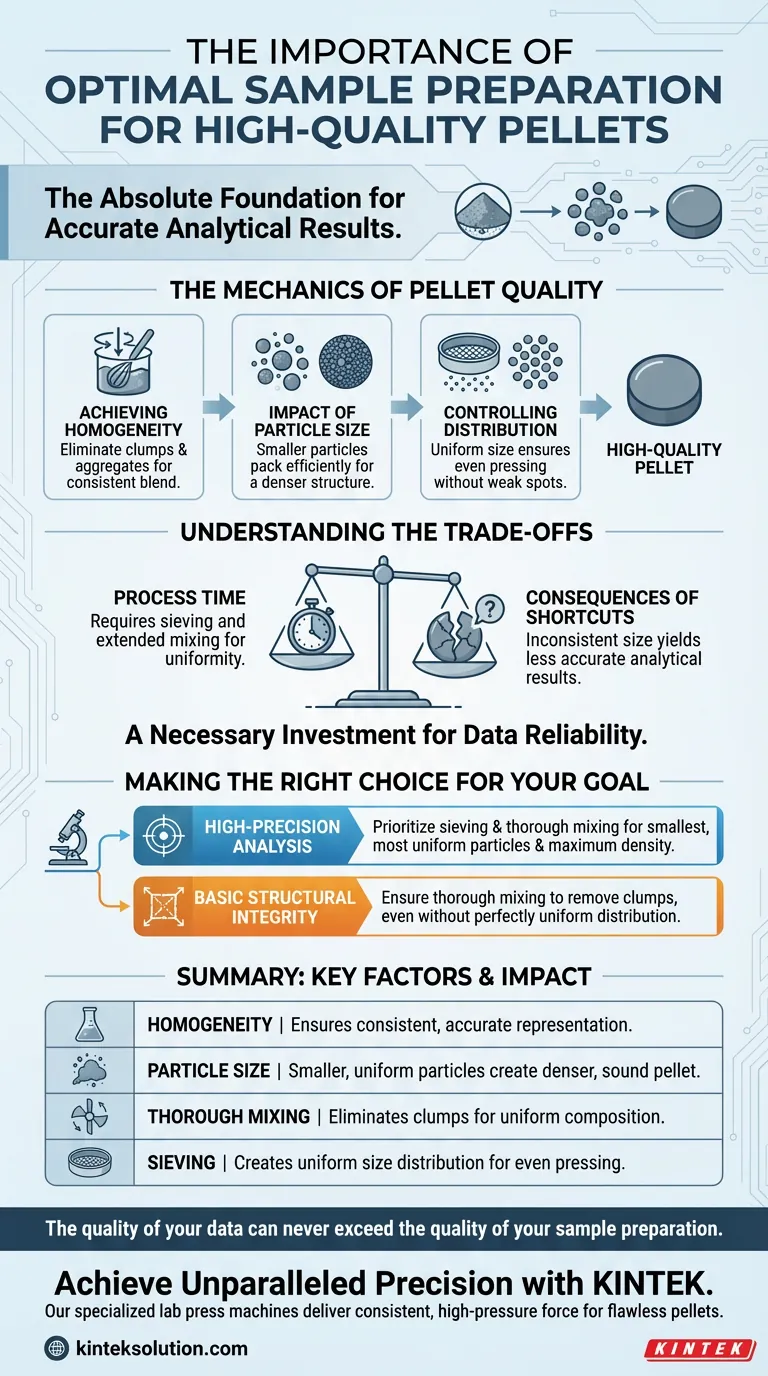
The Mechanics of Pellet Quality
Achieving Homogeneity
The primary objective of sample preparation is to ensure the material is completely homogeneous. You must eliminate any clumps or aggregates within the sample. Thorough mixing creates a consistent blend, ensuring that the pellet represents the material accurately at every point.
The Impact of Particle Size
Smaller particle sizes generally result in superior pellets. Fine particles pack together more efficiently than coarse ones. This efficient packing creates a denser, more uniform structure that holds together reliably under pressure.
Controlling Distribution
Uniformity is just as important as size. A uniform particle size distribution ensures the pellet presses evenly without weak spots or gradients. Sieving is often necessary to achieve this standard, removing irregularities that could compromise the pellet's integrity.
Understanding the Trade-offs
Process Time vs. Data Accuracy
Achieving a truly uniform particle size often requires additional steps, such as sieving and extended mixing. While this increases the time required for sample preparation, it is a necessary investment.
Consequences of Shortcuts
Skipping these steps to save time leaves the sample with inconsistent particle sizes and potential clumps. This results in a less dense pellet. A low-density or non-uniform pellet will inevitably yield less accurate analytical results, rendering the entire test less valuable.
Making the Right Choice for Your Goal
To determine the level of preparation required, consider your end goal for the analysis.
- If your primary focus is high-precision analysis: Prioritize sieving and thorough mixing to achieve the smallest, most uniform particle size possible for maximum density.
- If your primary focus is basic structural integrity: Ensure, at a minimum, that the sample is thoroughly mixed to remove clumps, even if a perfectly uniform distribution is not fully achieved.
The quality of your data can never exceed the quality of your sample preparation.
Summary Table:
| Key Factor | Impact on Pellet Quality |
|---|---|
| Homogeneity | Ensures the pellet is a consistent, accurate representation of the sample. |
| Particle Size | Smaller, uniform particles create a denser, more structurally sound pellet. |
| Thorough Mixing | Eliminates clumps and aggregates for uniform composition. |
| Sieving | Creates a uniform particle size distribution for even pressing. |
Achieve unparalleled precision in your sample preparation with KINTEK.
Our specialized lab press machines, including automatic lab presses, isostatic presses, and heated lab presses, are engineered to deliver the consistent, high-pressure force required to transform your perfectly prepared samples into flawless pellets. Don't let subpar equipment compromise your data integrity.
Contact our experts today to find the ideal press for your laboratory's specific needs and ensure your analysis starts on a solid foundation.
Visual Guide
Related Products
- Laboratory Hydraulic Split Electric Lab Pellet Press
- Manual Laboratory Hydraulic Pellet Press Lab Hydraulic Press
- Laboratory Hydraulic Pellet Press for XRF KBR FTIR Lab Press
- Automatic Laboratory Hydraulic Press Lab Pellet Press Machine
- Automatic Laboratory Hydraulic Press for XRF and KBR Pellet Pressing
People Also Ask
- What are the emerging trends in the design and materials of lab pellet presses? Modernize Your Lab Efficiency
- How do lab pellet presses support customization and flexibility? Optimize Your Sample Prep for Any Material
- What are common lab pellet press issues? Expert Troubleshooting Guide for Reliable Material Research
- What are the common operational types of lab pellet presses? Choosing the Right Manual, Automatic, or Hydraulic System
- Why use a laboratory pellet press for solid-state battery evaluation? Ensure Accuracy in Interface Stability Testing



















