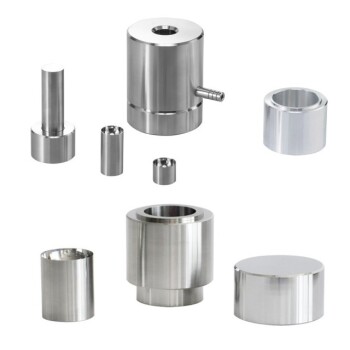
The design of the mold wall thickness is the primary regulator of deformation mechanics. It dictates how strictly the external hydraulic pressure is transferred to the internal ceramic powder. By balancing the stiffness of the mold across its geometry, optimized wall thickness ensures that pressure is applied uniformly, preventing the structural inconsistencies that lead to part failure.
Optimizing wall thickness is a strategic method to regulate local strain levels during compression. It ensures the mold deforms predictably, translating isostatic pressure into uniform powder density and enabling the production of precise, near-net-shape components.
The Mechanics of Pressure Transfer
Regulating Local Strain and Stiffness
The fundamental role of the wall thickness is to control local stiffness. The mold acts as the interface between the hydraulic fluid and the powder.
If the wall thickness varies unintentionally, the mold’s resistance to deformation changes across its surface. This imbalance causes the mold to compress the powder more aggressively in some areas than others, defeating the purpose of isostatic pressing.
Ensuring Uniform Force Distribution
An elastomeric mold is designed to act as a sealed container that transfers pressure from all directions.
However, the fluid pressure is only truly uniform if the container transmits it evenly. Consistent wall thickness ensures that the external force is not dampened or amplified irregularly before it reaches the powder surface.
Achieving Near-Net-Shape Accuracy
The ultimate goal of isostatic pressing is to create a "near-net-shape" component that requires minimal machining.
Non-uniform wall thickness leads to unpredictable shrinkage and warping. By optimizing the wall design, you ensure the powder compacts evenly, maintaining the geometric fidelity of the original design.
The Role in Demolding and Stress Relief
Creating an Even Stress Release Path
The role of wall thickness extends beyond the compression phase; it is critical during the demolding stage.
When pressure is released, the elastic mold attempts to return to its original shape. If the walls are uneven, the mold will relax at different rates, creating erratic stress paths.
Protecting the Compacted Part
A uniform wall thickness ensures that the mold releases its grip on the compacted part simultaneously across all surfaces.
This prevents the generation of shear forces that could crack or delaminate the fragile "green" (unfired) ceramic body as it is being removed from the mold.
Common Pitfalls to Avoid
The Danger of Inconsistent Thickness
The primary failure mode in mold design is inconsistent wall thickness.
As noted in standard technical guidelines, this inconsistency leads directly to non-uniform deformation. The result is a part with variable density gradients, which introduces internal stresses that may cause the part to fail during sintering or use.
Misunderstanding Stiffness Balancing
It is a mistake to view the mold merely as a bag for the powder. It is a mechanical component with specific stiffness properties.
Designers must view thickness as a variable that tunes the stiffness of the mold. Ignoring this relationship results in a loss of control over the local strain levels applied to the powder.
Making the Right Choice for Your Goal
To ensure the success of your isostatic pressing process, you must align your mold design with your specific production targets:
- If your primary focus is Geometric Precision: Prioritize perfectly uniform wall thickness to ensure the powder compresses evenly, achieving near-net-shape results.
- If your primary focus is Part Integrity: Ensure the design balances stiffness to provide a smooth, simultaneous stress release path during demolding.
Uniform wall thickness is the key to transforming raw hydraulic force into precise, defect-free ceramic components.
Summary Table:
| Design Factor | Role in Isostatic Pressing | Impact on Final Component |
|---|---|---|
| Wall Thickness | Regulates local strain and stiffness | Ensures uniform force distribution and density |
| Consistency | Balances deformation mechanics | Prevents warping and structural inconsistencies |
| Stiffness Tuning | Controls hydraulic force transfer | Achieves high-precision near-net-shape accuracy |
| Elastic Recovery | Provides even stress release path | Protects green parts from cracking during demolding |
Elevate Your Material Research with KINTEK
Precision in isostatic pressing starts with the right equipment and mold design. KINTEK specializes in comprehensive laboratory pressing solutions, offering a versatile range of manual, automatic, heated, and multifunctional models, as well as cold and warm isostatic presses (CIP/WIP) tailored for battery research and advanced ceramics.
Don't let inconsistent mold mechanics compromise your results. Partner with KINTEK to achieve superior density uniformity and geometric fidelity in every sample.
Ready to optimize your pressing workflow? Contact us today to find the perfect solution!
References
- Yu Qin Gu, H.W. Chandler. Visualizing isostatic pressing of ceramic powders using finite element analysis. DOI: 10.1016/j.jeurceramsoc.2005.03.256
This article is also based on technical information from Kintek Solution Knowledge Base .
Related Products
- Lab Isostatic Pressing Molds for Isostatic Molding
- Lab Anti-Cracking Press Mold
- Lab Cylindrical Press Mold for Laboratory Use
- Lab Round Bidirectional Press Mold
- Lab Polygon Press Mold
People Also Ask
- What is the purpose of incorporating cartridge heaters into a lab press mold for MLCC block compression? Optimize Results
- What is the function of an isostatic lab press in energy storage research? Achieve Superior Material Standardization
- How do laboratory press machines resolve increased impedance in solid-state batteries? Achieve Low-Resistance Interfaces
- How does controlling the parameters of a laboratory isostatic press contribute to reducing deformation in LTCC channels?
- Why is a laboratory isostatic press preferred for zeolite A ceramic green bodies? Achieve 95%+ Density Today