
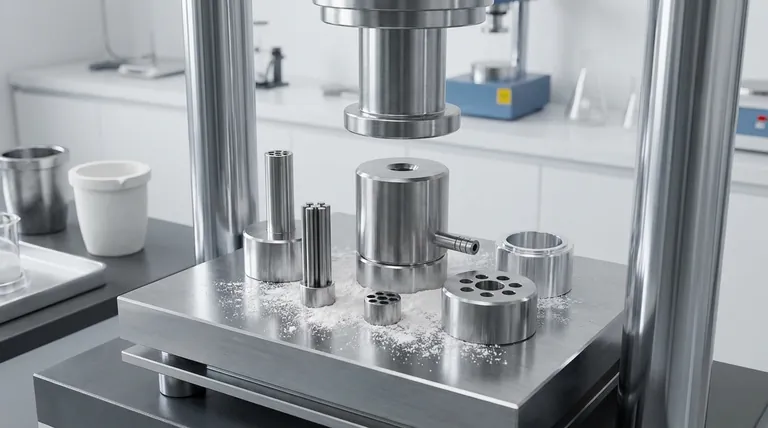
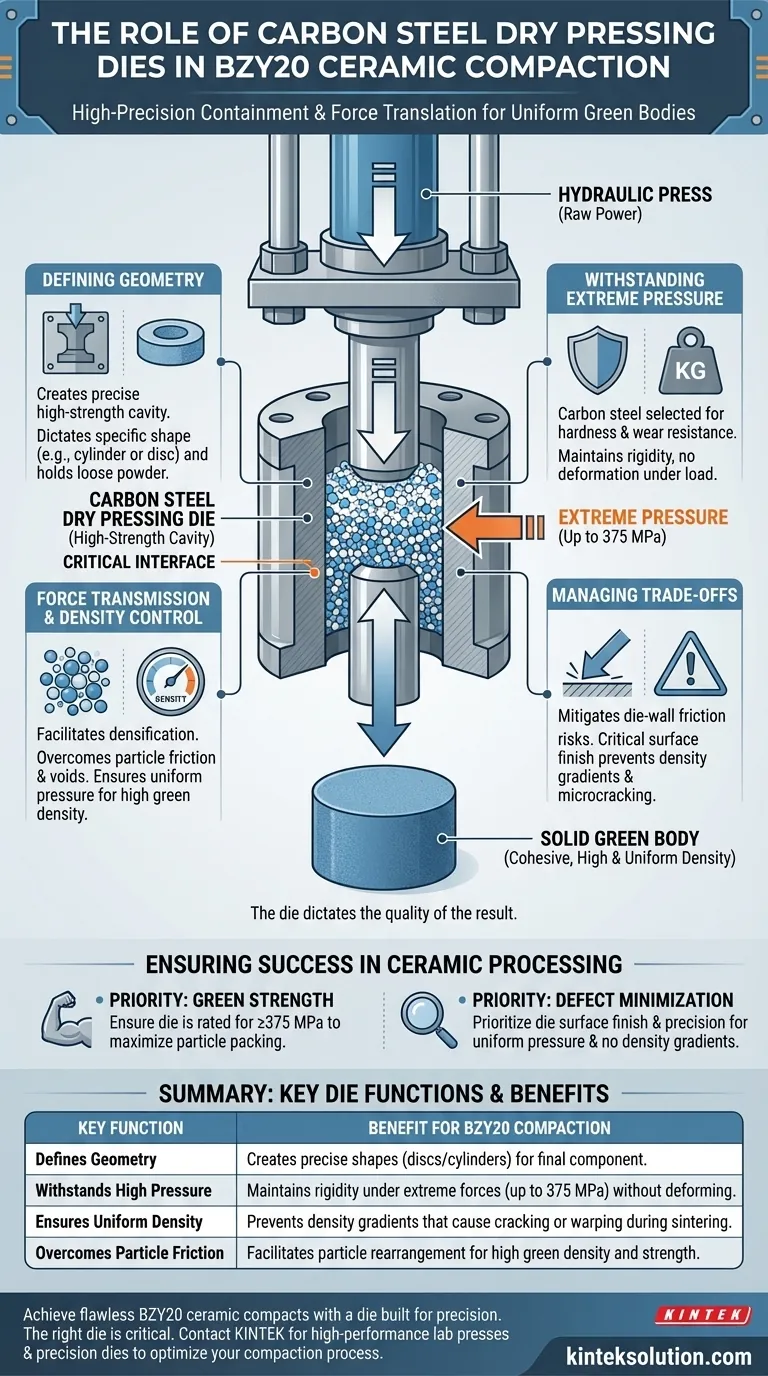
The primary function of a carbon steel dry pressing die is to act as a high-precision containment vessel that defines the geometry of BZY20 ceramic powder during compaction. It is the critical interface that translates the macroscopic force of a hydraulic press into the powder, converting loose material into a solid, cohesive "green body" capable of withstanding handling.
The hydraulic press provides the raw power, but the die dictates the quality of the result. By maintaining rigidity under extreme pressures (up to 375 MPa), the die ensures the high and uniform green density required to prevent cracking and uneven shrinkage during the subsequent sintering phase.
The Mechanics of Shaping and Containment
Defining the Component Geometry
The die creates a high-strength cavity that dictates the specific shape and size of the final ceramic component, typically a cylinder or disc.
This constraint is necessary to hold the loose BZY20 powder in place before pressure is applied.
Withstanding Extreme Pressure
To compact BZY20 effectively, the system often requires pressures as high as 375 MPa.
The carbon steel material is selected for its hardness and wear resistance. It must endure this immense load without deforming or yielding, ensuring the dimensions of the cavity remain constant throughout the pressing cycle.
Force Transmission and Density Control
Overcoming Particle Friction
The die facilitates the densification process by allowing the hydraulic force to overcome inter-particle friction and voids.
This forces the powder particles to rearrange and pack densely, significantly increasing the "green density" of the unfired body.
Preventing Density Gradients
The rigidity and precision of the die set are essential for the uniform distribution of pressure across the sample.
If the die deforms or has a poor surface finish, pressure becomes uneven. This leads to density gradients—areas of high and low density within the same pellet—which are a primary cause of microcracking and warping.
Understanding the Trade-offs
The Risk of Die-Wall Friction
While the die confines the powder to increase density, friction between the powder and the inner walls of the die can be detrimental.
This friction acts against the pressing force. If the die surface is not perfectly finished, it can result in a sample that is dense on the ends but porous in the center.
Material Limits vs. Process Needs
Carbon steel is robust, but it is not infinitely hard.
Under repeated cycles at 375 MPa, the die surface can wear. Any loss of precision or surface smoothness will directly degrade the uniformity of the green body, potentially causing defects that only become visible after high-temperature sintering.
Ensuring Success in Ceramic Processing
To achieve the best results with BZY20 powder and a hydraulic press, consider these specific priorities:
- If your primary focus is Green Strength: Ensure your die is rated to withstand pressures of at least 375 MPa without elastic deformation to maximize particle packing.
- If your primary focus is Defect Minimization: Prioritize the surface finish and precision of the die cavity to ensure uniform pressure distribution and prevent density gradients.
The quality of your die is the single biggest predictor of whether your BZY20 ceramic will survive the sintering process intact.
Summary Table:
| Key Function | Benefit for BZY20 Compaction |
|---|---|
| Defines Geometry | Creates precise shapes (e.g., discs/cylinders) for the final ceramic component. |
| Withstands High Pressure | Maintains rigidity under extreme forces (up to 375 MPa) without deforming. |
| Ensures Uniform Density | Prevents density gradients that cause cracking or warping during sintering. |
| Overcomes Particle Friction | Facilitates particle rearrangement for high green density and strength. |
Achieve flawless BZY20 ceramic compacts with a die built for precision. The right die is critical for maximizing green density and minimizing sintering defects. KINTEK specializes in high-performance lab press machines—including automatic, isostatic, and heated lab presses—and the precision dies that ensure their success. Our expertise helps laboratories like yours overcome die-wall friction and pressure inconsistencies to produce reliable, high-quality ceramic components. Contact us today to discuss how our solutions can optimize your compaction process. #ContactForm
Visual Guide
Related Products
- XRF KBR Steel Ring Lab Powder Pellet Pressing Mold for FTIR
- Lab Ball Press Mold
- XRF KBR Plastic Ring Lab Powder Pellet Pressing Mold for FTIR
- Lab Ring Press Mold for Sample Preparation
- Lab Cylindrical Press Mold with Scale
People Also Ask
- What considerations are important regarding the die size of an XRF pellet press? Optimize for Your XRF Spectrometer and Sample
- Why are pellets used in XRF analysis, and what is their limitation? Boost Accuracy and Speed in Your Lab
- What is the general process for preparing a sample pellet for XRF? Master Consistency for Accurate Analysis
- What are the differences between manual and automatic XRF pellet presses? Choose the Right Press for Your Lab's Needs
- What are the different types of XRF pellet preparation methods available? Manual, Hydraulic, and Automated Presses Explained




