
Beyond basic shaping, a graphite die for hot pressing Li6SrLa2Bi2O12 (LSLBO) must function as a high-strength pressure vessel and a chemical barrier. Specifically, the die requires excellent high-temperature mechanical properties to stably transmit 10 MPa of pressure at 750°C. Additionally, it must remain chemically inert within a vacuum environment to prevent any reaction with the ceramic powder, ensuring the final electrolyte retains its purity and performance.
Core Takeaway: The success of LSLBO densification relies on a graphite die that balances structural rigidity under extreme heat (750°C) with absolute chemical neutrality to prevent sample contamination.

Critical Mechanical Properties
To successfully densify LSLBO powder, the die must endure rigorous physical conditions without deformation or failure.
High-Temperature Structural Integrity
The die must maintain its mechanical strength at elevated temperatures. Specifically, it must withstand operating conditions of 750°C without losing structural coherence.
Stable Pressure Transmission
The die is not passive; it is the active medium for force application. It must stably transmit 10 MPa of pressure to the powder.
Any weakness in the graphite at this pressure point could lead to uneven densification or catastrophic die failure.
Chemical Compatibility Requirements
The chemical properties of the die are just as vital as its mechanical strength, particularly when processing sensitive electrolytes like LSLBO.
Chemical Inertness
The graphite must be chemically unreactive with the LSLBO sample.
If the die reacts with the ceramic powder at high temperatures, it introduces impurities that compromise the final performance of the ceramic electrolyte.
Stability in Vacuum Environments
The hot pressing process typically occurs in a vacuum.
The graphite used must be compatible with these conditions, ensuring that the protective, inert environment prevents oxidation or other unwanted chemical interactions.
Understanding the Trade-offs
While graphite is generally robust, failing to select a die with the correct specifications for these specific parameters creates significant risks.
Mechanical Failure vs. Process Limits
If the graphite grade chosen cannot handle the specific combination of 750°C and 10 MPa, the die may fracture during the press.
This not only ruins the sample but can damage the hot pressing equipment.
Reactivity vs. Purity
If the graphite is not sufficiently inert or high-purity, carbon diffusion or chemical reactions may occur at the interface.
This results in a contaminated sample surface, requiring extensive post-processing or rendering the electrolyte unusable for testing.
Making the Right Choice for Your Goal
When selecting a graphite die for your LSLBO hot pressing experiment, prioritize the failure points most critical to your outcome.
- If your primary focus is Structural Safety: Ensure the graphite grade is rated specifically for mechanical stability at temperatures exceeding 750°C and pressures above 10 MPa.
- If your primary focus is Electrolyte Performance: Prioritize high-purity, chemically inert graphite to guarantee the vacuum environment effectively preserves the sample's composition.
Select a die that treats temperature resistance and chemical inertness as requirements, not features, to ensure a successful fabrication.
Summary Table:
| Property | Requirement for LSLBO Hot Pressing | Critical Function |
|---|---|---|
| High-Temperature Strength | Maintains structural integrity at 750°C | Prevents die deformation/failure under heat and pressure |
| Pressure Transmission | Stably transmits 10 MPa pressure | Ensures uniform powder densification |
| Chemical Inertness | Non-reactive with LSLBO powder in a vacuum | Preserves electrolyte purity and performance |
| Vacuum Compatibility | Stable in vacuum environment | Prevents oxidation and unwanted chemical interactions |
Achieve flawless LSLBO electrolyte fabrication with a purpose-built graphite die from KINTEK.
Selecting the wrong die risks mechanical failure, sample contamination, and ruined experiments. KINTEK specializes in high-performance lab press machines and consumables. Our graphite dies are engineered for demanding applications, offering the high-temperature strength and chemical inertness required for sensitive materials like LSLBO.
Let us provide the reliable foundation for your R&D success. Contact our experts today to discuss your specific hot pressing parameters and ensure your die meets all critical property requirements.
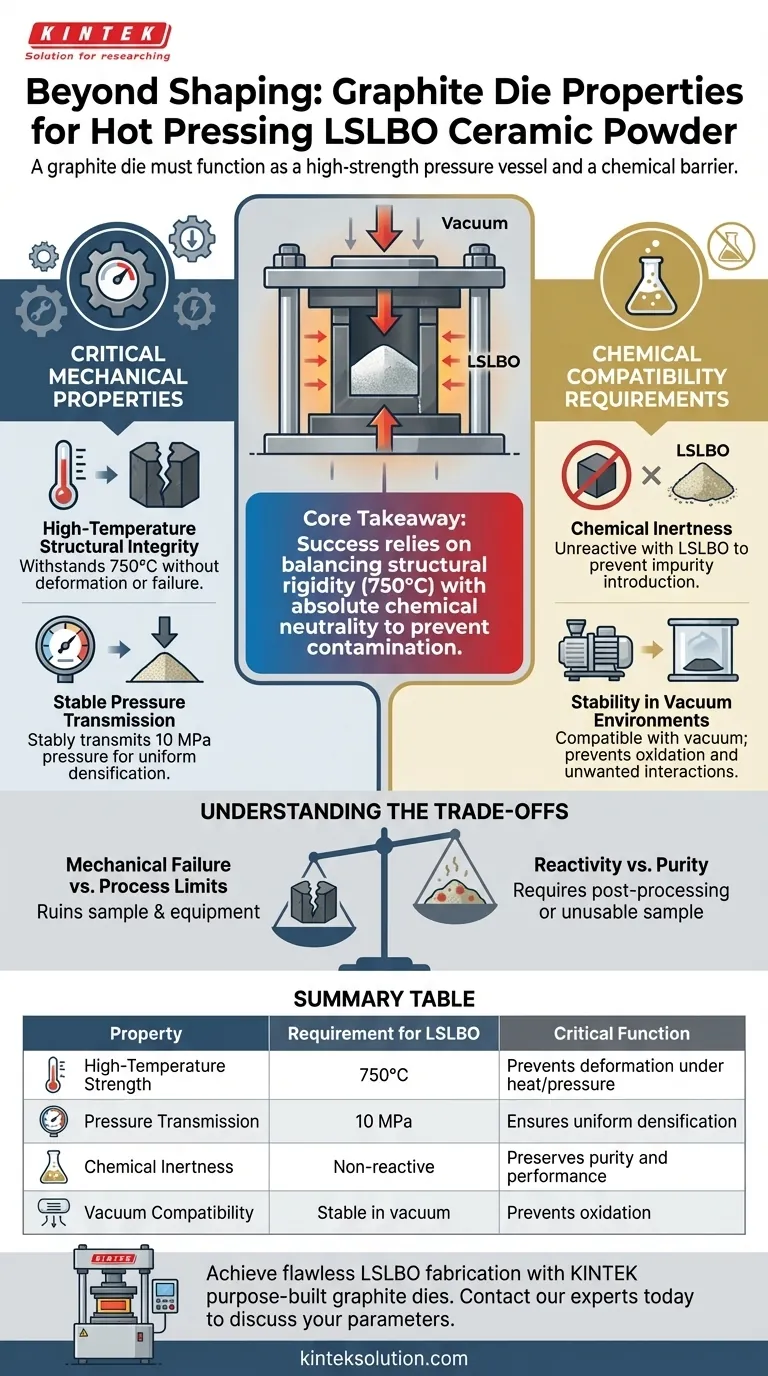
Visual Guide
Related Products
- Lab Heat Press Special Mold
- Lab Ring Press Mold for Sample Preparation
- Lab Infrared Press Mold for No Demolding
- Lab XRF Boric Acid Powder Pellet Pressing Mold for Laboratory Use
- Lab Cylindrical Press Mold with Scale
People Also Ask
- How is a laboratory heat press used to evaluate bio-based aliphatic polyesters? Prepare Reliable Samples for Analysis
- How is a laboratory heat press utilized in MEA preparation? Achieve High-Efficiency Iron-Chromium Redox Flow Batteries
- Why is a laboratory heat press necessary for biodegradable films? Unlock Precision Bonding and Barrier Performance
- What is the purpose of incorporating cartridge heaters into a lab press mold for MLCC block compression? Optimize Results
- How do laboratory heated presses ensure performance of flexible electrolytes? Boost Wearable Battery Durability



















