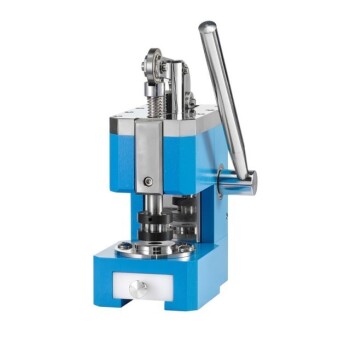
Precision in electrode preparation is the difference between valid data and experimental noise. A laboratory precision punching machine or small lab press is primarily used to cut coated copper foils into disk electrodes with exact diameters and clean, burr-free edges. This mechanical precision is a prerequisite for reliable battery testing, ensuring that physical defects do not skew electrochemical results.
Core Takeaway The use of precision equipment is not merely for aesthetics; it is a critical control measure to prevent internal short circuits and ensure consistent active material loading. Without the uniform edge quality and density provided by these machines, researchers cannot distinguish between intrinsic material performance and artifacts caused by poor assembly.
The Critical Role of Physical Integrity
Preventing Internal Short Circuits
Burr formation is one of the most significant risks during the manual cutting of electrodes. A laboratory punching machine utilizes precise mold alignment and controlled pressure to create a clean cut.
If burrs remain on the edge of the current collector, they can pierce the separator during cell assembly. This leads to internal short circuits, rendering the coin cell useless or dangerous.
Preserving Coating Adhesion
Manual cutting or using low-quality tools often causes the active material coating to detach or crumble at the edges.
Precision punching prevents this delamination, ensuring the structural integrity of the electrode remains intact. This is particularly important for silicon-graphite anodes, which are often brittle before electrolyte wetting.
Ensuring Accurate Capacity Data
To calculate specific capacity ($mAh/g$), you must know the exact mass of the active material.
Precision punching ensures every disk has a consistent diameter, which allows for strict control over mass loading. If the edge crumbles or the diameter varies, your mass calculations will be incorrect, invalidating your charge/discharge capacity data.
Managing Silicon-Graphite Expansion via Compaction
Controlling Electrode Density
While the "press" is often used for punching, a lab press is also essential for compacting (calendering) the electrode material.
Silicon-graphite anodes undergo significant volume expansion during cycling. By applying precise pressure, you regulate the compaction density and porosity of the electrode.
Balancing Porosity and Conductivity
The pressure applied determines the connectivity of the conductive network.
You must create a structure dense enough to establish efficient electron transport paths but porous enough to accommodate silicon expansion. A lab press allows you to tune this balance to improve rate performance.
Eliminating Experimental Variables
removing "Human Error" from the Equation
Inconsistent manual assembly introduces external interference.
By using precision clamping and punching devices, you ensure that any observed performance degradation (such as lithium plating) is due to material aging, not poor contact or assembly artifacts.
Uniform Contact Pressure
A lab press ensures uniform mechanical pressure across the electrode stack.
This eliminates local polarization caused by poor contact between the current collector, active materials, and separator. Uniform pressure is vital for consistent internal resistance and reproducibility across multiple test cells.
Understanding the Trade-offs
The Risk of Over-Compaction
While increasing density improves volumetric energy, applying too much pressure with a lab press can be detrimental.
Over-compaction reduces porosity to the point where silicon particles have no room to expand, leading to particle pulverization and rapid capacity fade. It can also crush the separator if applied during final assembly.
Tooling Maintenance
Precision machines rely entirely on the quality of their dies.
Even the most expensive punching machine will produce burrs if the cutting die is dull. Regular maintenance and inspection of the mold alignment are as important as the machine itself.
Making the Right Choice for Your Goal
To maximize the reliability of your silicon-graphite coin cell testing, align your equipment usage with your specific experimental needs:
- If your primary focus is Cycle Life Stability: Prioritize precision punching to eliminate edge burrs that cause micro-shorts over long-term cycling.
- If your primary focus is Rate Performance: Use a lab press to finely tune compaction density, optimizing electron transport paths while maintaining electrolyte accessibility.
- If your primary focus is Reproducibility: Rely on automated punching and pressing to standardize mass loading and internal contact pressure across all samples.
Ultimately, precision equipment transforms battery fabrication from a manual art into a controllable science.
Summary Table:
| Feature | Impact on Silicon-Graphite Anodes | Benefit to Research |
|---|---|---|
| Precision Punching | Eliminates edge burrs and delamination | Prevents internal shorts and ensures structural integrity |
| Controlled Compaction | Regulates porosity and electrode density | Optimizes electron transport and manages silicon expansion |
| Consistent Diameter | Uniform mass loading across samples | Enables accurate specific capacity (mAh/g) calculations |
| Mechanical Pressure | Uniform contact between cell components | Reduces local polarization and improves reproducibility |
Elevate Your Battery Research with KINTEK Precision Solutions
Don't let experimental noise undermine your breakthrough. KINTEK specializes in comprehensive laboratory pressing solutions designed specifically for the rigorous demands of battery research. From manual and automatic presses to heated, multifunctional, and glovebox-compatible models, our equipment ensures your silicon-graphite anodes achieve the perfect balance of density and integrity.
Whether you need cold or warm isostatic presses or high-precision punching dies, KINTEK provides the tools to transform your fabrication from a manual art into a controllable science.
Ready to standardize your cell assembly?
Contact KINTEK Today to Find Your Perfect Lab Press
References
- Pedro Alonso Sánchez, María Valeria Blanco. Mitigating Silicon Amorphization in Si–Gr Anodes: A Pathway to Stable, High‐Energy Density Anodes for Li‐Ion Batteries. DOI: 10.1002/smll.202504704
This article is also based on technical information from Kintek Solution Knowledge Base .
Related Products
- Automatic Laboratory Hydraulic Press Lab Pellet Press Machine
- Lab Polygon Press Mold
- Laboratory Hydraulic Press Lab Pellet Press Machine for Glove Box
- Laboratory Split Manual Heated Hydraulic Press Machine with Hot Plates
- Automatic Heated Hydraulic Press Machine with Heated Plates for Laboratory
People Also Ask
- What is the primary purpose of manual lab hydraulic pellet presses? Achieve High-Precision Sample Preparation for Spectroscopy
- What is the primary purpose of a manual lab hydraulic pellet press? Ensure Accurate Sample Prep for XRF and FTIR
- What are the technical advantages of an automatic laboratory hydraulic press for biomimetic surfaces?
- Why are high-precision automatic hydraulic presses required for Martian ISRU? Ensure Reliable Regolith Forming
- How does an automatic laboratory hydraulic press improve KBr pellet preparation? Achieve Precision IR Spectroscopy