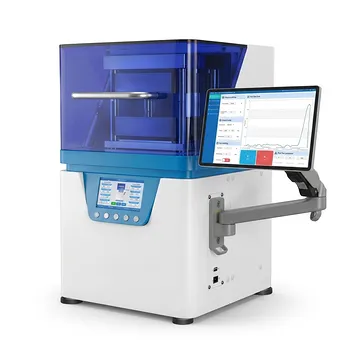
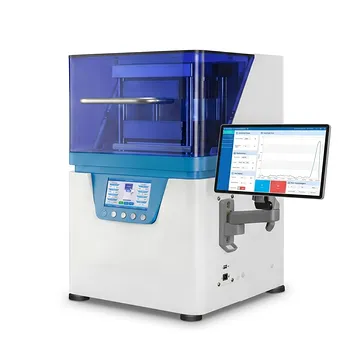
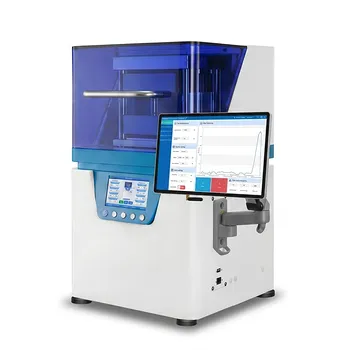
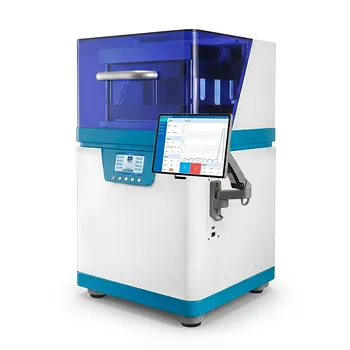
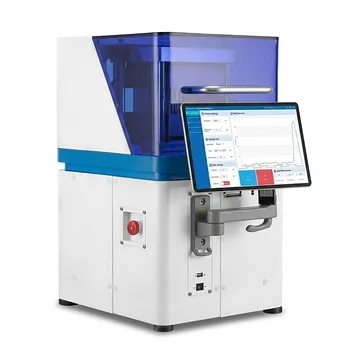
The primary function of a laboratory hydraulic press is to consolidate powdered chemical substances into dense, uniform pellets or solid blocks through high-precision axial pressure. This pretreatment step eliminates internal porosity and increases material density, which is essential for obtaining stable, repeatable data during physical property tests like conductivity measurements and spectroscopic analysis.
Core Takeaway: By transforming loose powders into structured solids with specific geometric shapes, the hydraulic press removes physical inconsistencies that would otherwise cause measurement errors or signal interference in analytical equipment.
Achieving Structural Integrity and Density
Eliminating Internal Voids and Porosity
During sample pretreatment, the press applies controlled force to expel air trapped between particles. This process creates a dense green body where particles are tightly arranged, preventing air pockets from distorting experimental results.
Ensuring Geometric Uniformity
The press uses specialized dies to mold powders into pellets or thin flakes with a fixed shape and consistent thickness. This uniformity is vital for comparative studies, as it ensures that every sample has the same volume and surface area during testing.
Increasing Material Density
By compressing the sample into a solid block, the hydraulic press maximizes the contact area between particles. This is particularly critical for electrochemical testing, where high density is required to ensure proper electrical contact and charge transport.
Enhancing Analytical Precision
Optimizing Spectroscopic Clarity
For techniques like Fourier-Transform Infrared Spectroscopy (FT-IR), the press creates samples thin and dense enough to be transparent or translucent. This allows for uniform light transmission and significantly improves the signal-to-noise ratio by reducing light scattering.
Standardizing Surface Flatness for XRF
In X-ray Fluorescence (XRF) analysis, a perfectly flat and smooth sample surface is non-negotiable. The hydraulic press ensures that the X-ray beam interacts with a consistent surface, preventing detection inaccuracies caused by shadows or uneven particle distribution.
Validating Mechanical and Physical Properties
Beyond chemical analysis, the press is used to investigate how materials respond to high-pressure environments. Researchers can test the mechanical strength and durability of synthesized materials by observing their behavior under specific load thresholds.
Understanding Trade-offs and Pitfalls
Risks of Over-Pressurization
Applying excessive pressure can lead to sample deformation or unintended phase changes in the chemical structure. If the pressure exceeds the material's limits, the resulting pellet may crack or exhibit internal stresses that skew physical property data.
Sample Contamination Issues
The surfaces of the pressing dies must be meticulously cleaned and maintained. Any residual material or oxidation on the die can lead to cross-contamination, which is particularly problematic in sensitive spectroscopic applications.
Inconsistent Packing Effects
If the powder is not distributed evenly within the die before pressing, the resulting pellet may have non-uniform density. This inconsistency can cause the pellet to shatter upon ejection or lead to erratic readings during conductivity tests.
Applying Precision Pressure to Your Workflow
How to Apply This to Your Project
Selecting the right pressure and duration depends entirely on your specific analytical goal and the nature of your chemical sample.
- If your primary focus is FTIR Spectroscopy: Use a high-precision press to create ultra-thin, translucent KBr pellets that allow maximum light penetration.
- If your primary focus is XRF Analysis: Prioritize surface flatness and edge stability by using a consistent pressure that ensures a smooth, mirror-like finish on the sample disc.
- If your primary focus is Electrochemical Testing: Focus on achieving maximum material density to ensure optimal particle-to-particle contact for accurate conductivity measurements.
By mastering the application of axial pressure, you transform volatile powders into reliable, high-fidelity subjects for rigorous scientific inquiry.
Summary Table:
| Function | Key Benefit | Primary Applications |
|---|---|---|
| Consolidation | Eliminates porosity; increases density | Electrochemical/Conductivity tests |
| Geometric Uniformity | Standardizes surface area & volume | Comparative material studies |
| Surface Flattening | Reduces light scattering & shadows | FTIR and XRF Spectroscopy |
| Material Densification | Enhances particle-to-particle contact | Battery research & synthesis |
Optimize Your Sample Prep with KINTEK Precision
Achieve superior analytical accuracy with KINTEK’s comprehensive laboratory pressing solutions. From battery research to spectroscopy, we provide the high-precision tools needed for dense, uniform, and repeatable sample pellets.
- Versatile Models: Manual, automatic, heated, and multifunctional presses.
- Specialized Systems: Glovebox-compatible, cold isostatic (CIP), and warm isostatic presses.
Ready to eliminate measurement errors and enhance your lab's efficiency? Contact KINTEK today to find the perfect pressing solution for your project!
References
- Kwati Leonard, Hiroshige Matsumoto. Tailored and Improved Protonic Conductivity through Ba(Z<sub><i>x</i></sub>Ce<sub>10−<i>x</i></sub>)<sub>0.08</sub>Y<sub>0.2</sub>O<sub>3−δ</sub> Ceramics Perovskites Type Oxides for Electrochemical Devices. DOI: 10.1002/celc.202101663
This article is also based on technical information from Kintek Solution Knowledge Base .
Related Products
- Laboratory Hydraulic Press Lab Pellet Press Machine for Glove Box
- Laboratory Hydraulic Press 2T Lab Pellet Press for KBR FTIR
- 24T 30T 60T Heated Hydraulic Lab Press Machine with Hot Plates for Laboratory
- Laboratory Hydraulic Press Lab Pellet Press Button Battery Press
- Laboratory Hydraulic Pellet Press for XRF KBR FTIR Lab Press
People Also Ask
- How does a laboratory hydraulic press contribute to the preparation of Li3-3xScxSb samples? Optimize Ionic Conductivity
- What is the function of a laboratory hydraulic press in FT-IR of curcumin-coated MWCNTs? Achieve Optical Clarity.
- Why is a laboratory hydraulic press required for compression molding boron-siloxane? Solve High-Loading Density Challenges
- What role does a laboratory hydraulic press play in reaction pellets? Optimizing Lunar Soil and Metal Fuel Density
- What role does a laboratory hydraulic press play in the preparation of piezoelectric ceramic discs for DC-PG? | KINTEK