
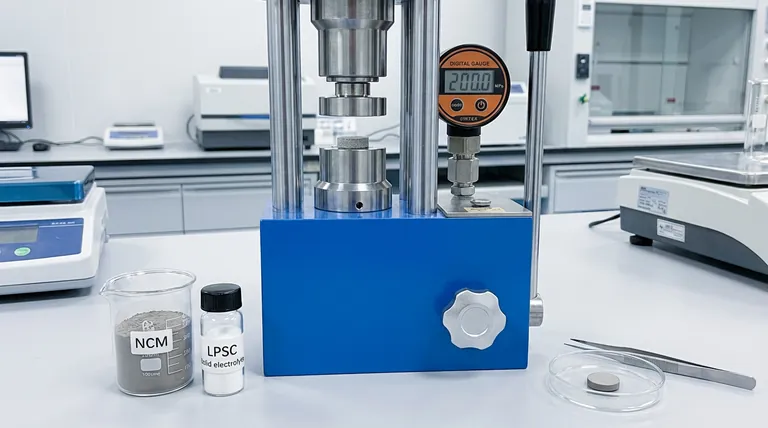
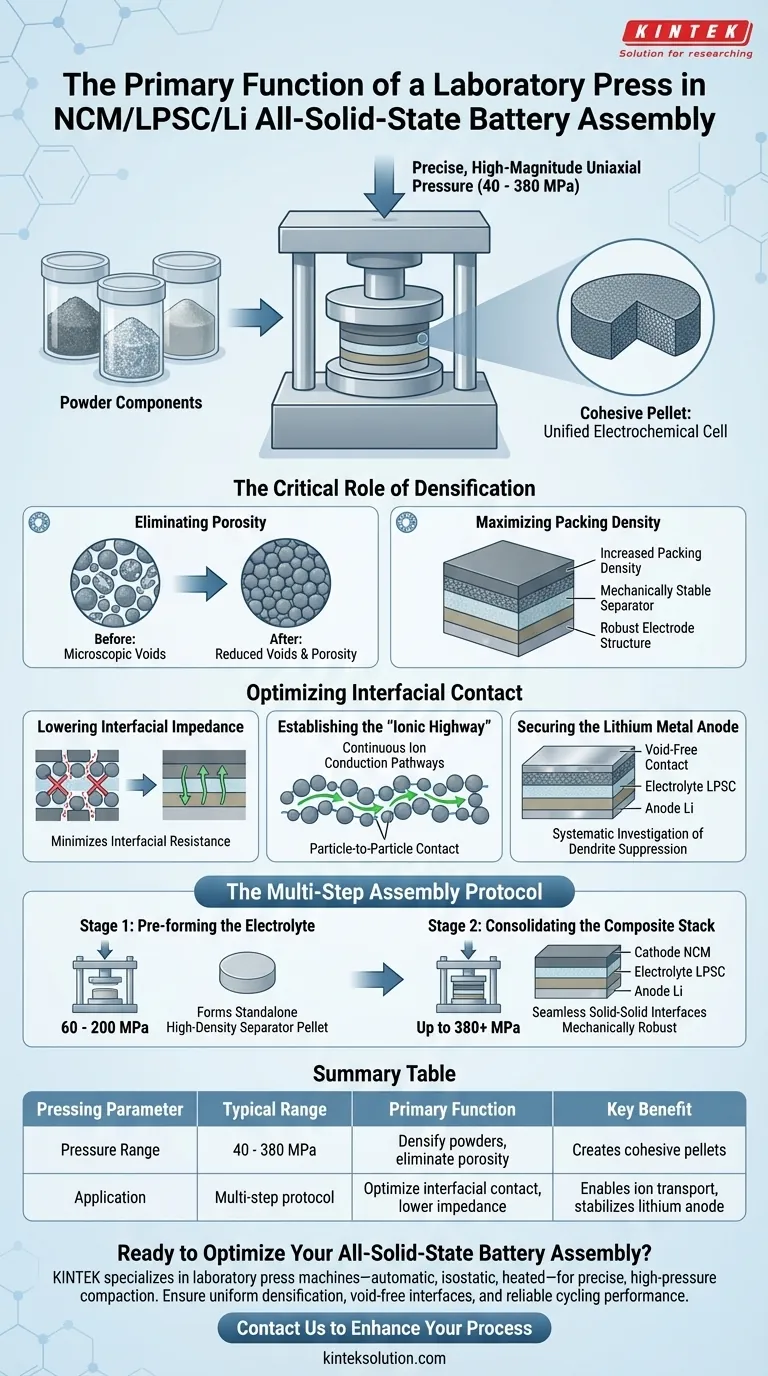
The primary function of a laboratory press in the assembly of NCM/LPSC/Li all-solid-state batteries is to apply precise, high-magnitude uniaxial pressure to cold-press powder components into dense, cohesive pellets. By exerting pressures typically ranging from 40 to 380 MPa, the press eliminates microscopic voids within the solid electrolyte and electrode layers. This mechanical compaction is essential to create the physical contact required for ion transport, transforming loose powders into a unified, functional electrochemical cell.
In liquid batteries, the electrolyte naturally wets the electrode surfaces; in solid-state batteries, this "wetting" must be forced mechanically. A laboratory press bridges the physical gap between particles, serving as the critical tool that lowers interfacial impedance enough to allow the battery to cycle.
The Critical Role of Densification
Eliminating Porosity
The immediate physical goal of the press is to compact the NCM (cathode) and LPSC (sulfide electrolyte) powders. High pressure acts to significantly reduce the voids and porosity inherent in the raw powder materials.
Maximizing Packing Density
By removing these air gaps, the press increases the packing density of the active materials and the solid electrolyte. This densification is necessary to form a mechanically stable separator membrane and electrode structure that can withstand handling and cycling.
Optimizing Interfacial Contact
Lowering Interfacial Impedance
For lithium ions to move from the NCM cathode through the LPSC electrolyte to the Lithium anode, the materials must be in intimate physical contact. The hydraulic press forces these solid layers together, minimizing the interfacial resistance that otherwise blocks ion flow.
Establishing the "Ionic Highway"
The press creates continuous ion conduction pathways by ensuring particle-to-particle contact. Without this high-pressure consolidation, the internal resistance of the cell would be too high for meaningful electrochemical measurements or operation.
Securing the Lithium Metal Anode
The press bonds the lithium metal anode securely to the electrolyte stack. This void-free contact is fundamental for allowing the systematic investigation of lithium dendrite suppression and ensuring stable cycling.
The Multi-Step Assembly Protocol
Pre-forming the Electrolyte
Often, the process begins by applying a specific initial pressure (e.g., 60 to 200 MPa) to the LPSC powder. This forms the solid electrolyte into a standalone, high-density separator pellet or layer.
Consolidating the Composite Stack
Subsequent steps involve adding the NCM cathode and Lithium anode materials and applying higher pressures (up to 380 MPa or more depending on the protocol) to consolidate the full stack. This step-wise application ensures that the final solid-solid interfaces are seamless and mechanically robust.
Understanding the Trade-offs
Pressure Magnitude vs. Material Integrity
While high pressure is required for density, it must be precise and controllable. Excessive or uneven pressure can damage the structural integrity of the cell components, while insufficient pressure leaves voids that result in high resistance and poor performance.
Step-Wise Processing Requirements
Using a laboratory press is rarely a "one-and-done" action; it requires a distinct multi-step approach. You must balance lower pressures for pre-forming delicate layers against the significantly higher pressures needed for final consolidation to prevent internal short circuits or layer delamination.
Making the Right Choice for Your Goal
To maximize the effectiveness of your laboratory press in NCM/LPSC/Li assembly, align your pressing parameters with your specific experimental objectives.
- If your primary focus is optimizing ionic conductivity: Prioritize higher compaction pressures to maximize density and eliminate particle-to-particle voids within the LPSC layer.
- If your primary focus is cycle life and stability: Focus on the precision of the multi-step pressing sequence to ensure a uniform, void-free interface between the Lithium anode and the electrolyte.
Ultimately, the laboratory press is not merely a shaping tool, but the fundamental enabler of the solid-solid interfaces that define the battery's electrochemical success.
Summary Table:
| Pressing Parameter | Typical Range | Primary Function |
|---|---|---|
| Pressure Range | 40 - 380 MPa | Densify powders, eliminate porosity |
| Application | Multi-step protocol | Optimize interfacial contact, lower impedance |
| Key Benefit | Creates cohesive pellets | Enables ion transport, stabilizes lithium anode |
Ready to Optimize Your All-Solid-State Battery Assembly?
KINTEK specializes in laboratory press machines—including automatic, isostatic, and heated lab presses—designed to deliver the precise, high-pressure compaction required for NCM/LPSC/Li battery research. Our equipment ensures uniform densification, void-free interfaces, and reliable cycling performance for your lab's most demanding solid-state battery projects.
Contact us today to discuss how a KINTEK lab press can enhance your battery development process!
Visual Guide
References
- Zhan Wu, Jun Zhang. Lithium Difluorophosphate Additive Engineering Enabling Stable Cathodic Interface for High‐Performance Sulfide‐Based All‐Solid‐State Lithium Battery. DOI: 10.1002/eem2.12871
This article is also based on technical information from Kintek Solution Knowledge Base .
Related Products
- Warm Isostatic Press for Solid State Battery Research Warm Isostatic Press
- Lab Infrared Press Mold for Laboratory Applications
- Laboratory Hydraulic Press Lab Pellet Press Button Battery Press
- Button Battery Sealing Press Machine for Lab
- Assemble Square Lab Press Mold for Laboratory Use
People Also Ask
- Why must composite cathodes be sealed in vacuum lamination bags for WIP? Ensure Battery Stability and Density
- What is the function of elastic molds in warm isostatic pressing? Achieve Uniform Density in Composite Particles
- How do sacrificial volume materials (SVM) maintain microchannels in isostatic pressing? Ensure Structural Integrity
- What is the role of the flexible material in warm isostatic pressing? Key to Uniform Density & Precision
- What is the significance of temperature control in Warm Isostatic Pressing? Unlock Uniform Densification and Process Stability



















