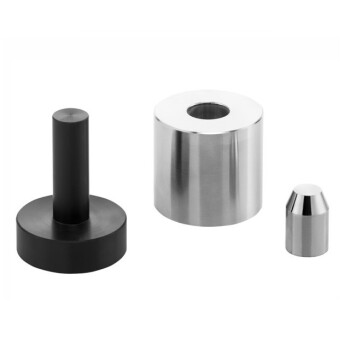
Airtight press cells act as a critical stabilization environment by performing two simultaneous functions: applying continuous mechanical pressure and ensuring rigorous environmental isolation. During long-cycle and Electrochemical Impedance Spectroscopy (EIS) testing, these devices are the primary mechanism for maintaining the physical integrity of solid-solid interfaces while preventing chemical degradation of sensitive components.
By combining constant stacking pressure with hermetic sealing, airtight press cells minimize interfacial resistance and protect reactive electrolytes from moisture, ensuring that measured data reflects true battery performance rather than environmental contamination or contact failure.
The Necessity of Mechanical Stabilization
Ensuring Continuous Stacking Pressure
Solid-state batteries lack the liquid electrolytes that naturally fill voids in traditional cells. Therefore, airtight press cells are engineered to provide continuous and constant stacking pressure. This external force is required to maintain optimal physical contact between the various solid layers throughout the duration of a test.
Minimizing Interfacial Impedance
The application of precise mechanical compression is fundamental to minimizing interfacial impedance. By forcing the solid electrodes and electrolytes together, the press cell eliminates microscopic voids at the interface. This creates the high-quality contact necessary for stable and accurate electrochemical measurements.
Inhibiting Physical Degradation
Beyond immediate contact, constant pressure helps maintain the structural integrity of the cell over time. Proper compression helps inhibit crack propagation within the solid electrolyte and reduces the risk of delamination. Furthermore, this mechanical pressure is a key variable in suppressing the growth of lithium dendrites, which can short-circuit the cell.
Environmental Isolation for Chemical Stability
Shielding Sensitive Electrolytes
Many high-performance solid electrolytes, particularly sulfide-based variants, are highly reactive. The superior sealing performance of airtight press cells provides physical isolation from environmental moisture and oxygen. Without this barrier, these electrolytes would rapidly degrade, rendering any collected data invalid.
Enabling Reliable Long-Cycle Testing
Long-cycle testing requires the battery environment to remain chemically stable for days or weeks. Even microscopic leaks can introduce enough moisture to alter the cell's chemistry over an extended period. Airtight cells ensure that the chemical stability is maintained from the first cycle to the last, allowing for the isolation of true degradation mechanisms.
Understanding the Trade-offs of Pressure Application
The Risk of Over-Pressurization
While pressure is essential, more is not always better. Excessive pressure can lead to lattice compression, which actually increases the resistance to ion migration. This creates a non-linear relationship where conductivity improves initially but then degrades as pressure surpasses the optimal threshold.
Material Phase Changes
Subjecting the cell to pressure beyond its thermodynamic limits can induce unwanted material phase changes. Researchers must identify the specific pressure window—often below specific thresholds like 100 MPa or up to 0.5 GPa depending on the material—that facilitates ion transport without mechanically altering the material's fundamental structure.
Optimizing Your Testing Configuration
To obtain valid EIS and cycle data, you must balance mechanical contact against material limits.
- If your primary focus is accurate impedance data: Prioritize void elimination by establishing a baseline pressure that minimizes contact resistance before starting the test.
- If your primary focus is sulfide electrolyte stability: Ensure the cell's sealing mechanism is verified for long-duration isolation against ambient moisture, as chemical degradation will masquerade as impedance growth.
- If your primary focus is material characterization: Perform a pressure-step test to identify the specific "sweet spot" where ionic conductivity peaks before lattice compression sets in.
Success in solid-state testing relies on treating pressure as a precise, controlled variable rather than a brute force tool.
Summary Table:
| Function | Primary Benefit | Impact on Testing |
|---|---|---|
| Mechanical Pressure | Maintains solid-solid interface contact | Minimizes interfacial impedance and suppresses dendrites |
| Hermetic Sealing | Isolates reactive sulfide electrolytes | Prevents chemical degradation from moisture and oxygen |
| Pressure Control | Optimizes ion migration paths | Prevents lattice compression and unwanted phase changes |
| Structural Support | Inhibits crack propagation | Ensures physical integrity during long-duration cycle testing |
Elevate Your Battery Research with KINTEK Precision
Achieve uncompromising accuracy in your solid-state battery testing with KINTEK’s advanced laboratory pressing solutions. Whether you are conducting long-cycle tests or complex EIS characterization, our comprehensive range of manual, automatic, heated, and glovebox-compatible models—including specialized cold and warm isostatic presses—provides the precise mechanical stabilization and airtight isolation your materials require.
Maximize your data integrity and eliminate interfacial failure today. Contact our laboratory specialists to find the perfect press cell for your research needs!
References
- Mallory D. Witt, Wolfgang G. Zeier. Influence of State‐of‐Charge‐Dependent Decomposition Kinetics at the Li<sub>6</sub>PS<sub>5</sub>Cl|LiNi<sub>0.83</sub>Co<sub>0.11</sub>Mn<sub>0.06</sub>O<sub>2</sub> Interface on Solid‐State Battery Performance. DOI: 10.1002/celc.202500237
This article is also based on technical information from Kintek Solution Knowledge Base .
Related Products
- Lab Button Battery Tablet Press Sealing Mold
- Button Battery Sealing Press Machine for Lab
- Warm Isostatic Press for Solid State Battery Research Warm Isostatic Press
- Lab Infrared Press Mold for No Demolding
- Lab Isostatic Pressing Molds for Isostatic Molding
People Also Ask
- How does a sealed battery mold facilitate the assembly and testing of asymmetric supercapacitors using VO2?
- Why use standardized CR2032 components & high-precision presses? Ensure reliability in lithium metal battery research.
- Why is a laboratory battery sealing press essential for desolvation energy testing? Ensure Reliable Kinetic Data
- What is the function of specialized battery molds and sealing consumables? Optimize Your In-situ XRD Testing Today
- What role does a laboratory sealing press play in thermal analysis of solid dispersion films? Ensure Data Integrity