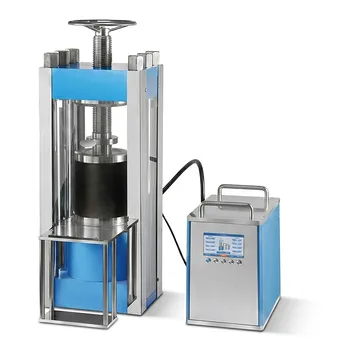
The primary role of a laboratory heated press in preparing brominated plastic thin films is to transform raw polymer powders into continuous, uniform films of precise thickness through the simultaneous application of controlled heat and pressure. This equipment serves as the essential hardware for melting specialized materials, such as brominated polystyrene, into a viscous state that can be molded into specific, non-commercial dimensions required for research and analysis.
The laboratory heated press acts as a bridge between raw chemical components and functional samples by integrating thermal energy with mechanical force. This dual-action process ensures that polymer matrices are consolidated into high-density, defect-free films with the exact structural characteristics needed for specialized testing.
Transforming Powder into Functional Films
The Softening and Melting Process
A heated press provides the precise thermal environment necessary to reach the glass transition or melting temperature of brominated polymer powders. Once the material reaches a softened state, it can flow and spread evenly between the press plates.
This transition from a granular powder to a continuous melt is the first step in creating a homogeneous material structure. Without consistent heat, the resulting film would suffer from uneven density and structural weak points.
Achieving Precise Non-Commercial Thickness
Standard commercial films often lack the specific thickness required for niche laboratory experiments. The heated press allows researchers to produce customized thin films with thicknesses that are not available off-the-shelf.
By adjusting the spacers or the pressure settings, technicians can control the final film gauge with high precision. This is critical for experiments where the path length of light or the mechanical resistance of the film must be strictly defined.
Enhancing Structural Integrity and Performance
Elimination of Voids and Internal Defects
The application of high pressure (often reaching several megapascals) serves to eliminate micro-bubbles and interlaminar gaps. This creates a dense, solid film that is free from internal voids that could interfere with signal transmission or structural strength.
In composite brominated materials, this pressure ensures thorough wetting between the polymer matrix and any reinforcing fillers. This results in superior interface bonding and a consistent microstructure throughout the sample.
Managing Internal Stress through Controlled Cooling
Beyond the heating phase, the press often facilitates a controlled cooling process. Slow, regulated cooling helps to eliminate internal stresses that naturally accumulate as the polymer solidifies.
Effective stress management prevents the film from warping or cracking after it is removed from the press. This results in high-quality specimens that maintain their mechanical flatness and structural integrity over time.
Facilitating Advanced Analytical Research
Preparing Samples for IR Spectroscopy
One of the most common applications for these thin films is transmission IR spectroscopy. For this diagnostic tool to work accurately, the film must have a uniform thickness and high packing density to allow for clear light transmission.
The heated press ensures that the brominated plastic is thin enough for infrared light to pass through while remaining structurally sound. This enables researchers to study the chemical bonding and molecular structure of the material with high precision.
Supporting Mechanical and Packaging Tests
Thin films are also vital for evaluating the tensile strength and crystallinity of new polymer formulations. The press provides a standardized method for sample preparation, ensuring that test results are reproducible across different batches.
In fields like packaging and electronics research, these presses allow for the testing of barrier properties and thermal stability. The ability to create uniform samples is the foundation for any reliable mechanical characterization.
Understanding the Trade-offs
Temperature Sensitivity and Degradation
If the temperature is set too high or the material is held at heat for too long, the brominated polymers may degrade. This can lead to discoloration, the release of corrosive vapors, or a loss of mechanical properties.
Pressure vs. Material Flow
Excessive pressure can force too much material out of the molding area, leading to uneven thickness or "flash" around the edges. Conversely, insufficient pressure will fail to eliminate voids, resulting in a porous and brittle film.
How to Apply This to Your Project
When utilizing a laboratory heated press for film preparation, your specific research goal should dictate your process parameters:
- If your primary focus is optical clarity or IR spectroscopy: Prioritize the elimination of voids by using higher pressure and ensuring the platens are perfectly clean to avoid surface artifacts.
- If your primary focus is mechanical property testing: Focus on the controlled cooling phase to minimize internal stresses that could lead to premature failure during tensile tests.
- If your primary focus is precise thickness control: Use high-precision shims or spacers between the plates to ensure a uniform gap across the entire surface of the film.
The laboratory heated press remains the definitive tool for researchers who require total control over the physical dimensions and internal consistency of specialized plastic films.
Summary Table:
| Process Phase | Key Function | Impact on Research Sample |
|---|---|---|
| Controlled Heating | Melts polymer powders uniformly | Ensures a homogeneous, defect-free material structure. |
| High Pressure | Eliminates micro-bubbles & voids | Enhances structural integrity and increases sample density. |
| Thickness Control | High-precision spacers/shims | Allows for customizable, non-commercial film gauges. |
| Regulated Cooling | Manages internal thermal stress | Prevents warping or cracking for perfectly flat specimens. |
Elevate Your Thin Film Research with KINTEK
Precision is the backbone of reliable material analysis. KINTEK specializes in comprehensive laboratory pressing solutions designed to meet the rigorous demands of material science and battery research. Whether you need to prepare uniform brominated films for IR spectroscopy or high-density samples for mechanical testing, our equipment delivers the control you need.
Our Versatile Range Includes:
- Manual & Automatic Presses: For flexible laboratory workflows.
- Heated & Multifunctional Models: Perfect for complex polymer processing.
- Specialized Systems: Glovebox-compatible models and cold/warm isostatic presses for advanced research.
Don't let sample inconsistencies compromise your data. Contact KINTEK today to discover how our pressing solutions can enhance your lab's efficiency and accuracy!
References
- C. Spindloe, G. Gregori. Target fabrication for the POLAR experiment on the Orion laser facility. DOI: 10.1017/hpl.2015.2
This article is also based on technical information from Kintek Solution Knowledge Base .
Related Products
- Lab Heat Press Special Mold
- Automatic Hydraulic Hot Press with Large Plate and Precision Temperature Control for Advanced Material Sample Preparation and Industrial Research
- Cylindrical Lab Electric Heating Press Mold for Laboratory Use
- 24T 30T 60T Heated Hydraulic Lab Press Machine with Hot Plates for Laboratory
- Automatic Heated Hydraulic Press Machine with Hot Plates for Laboratory
People Also Ask
- How is a laboratory heat press used to evaluate bio-based aliphatic polyesters? Prepare Reliable Samples for Analysis
- How is a laboratory heat press utilized in MEA preparation? Achieve High-Efficiency Iron-Chromium Redox Flow Batteries
- Why is a laboratory heat press necessary for biodegradable films? Unlock Precision Bonding and Barrier Performance
- What is the purpose of incorporating cartridge heaters into a lab press mold for MLCC block compression? Optimize Results
- What is the purpose of using a laboratory heated press for IN 718 green bodies? Enhance 3D Printed Part Density