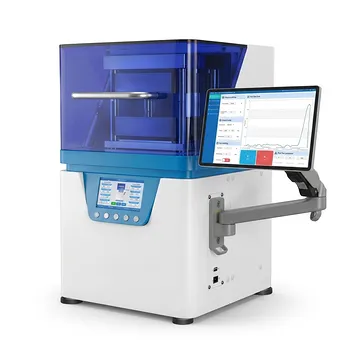
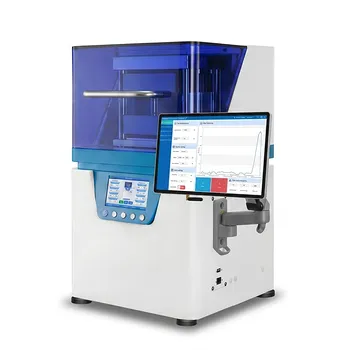
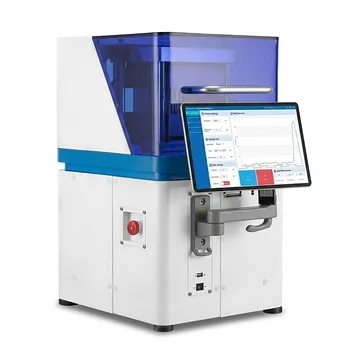
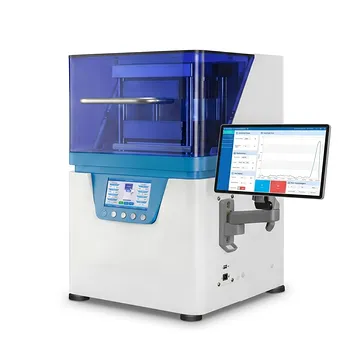
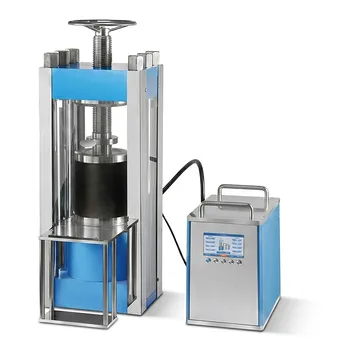
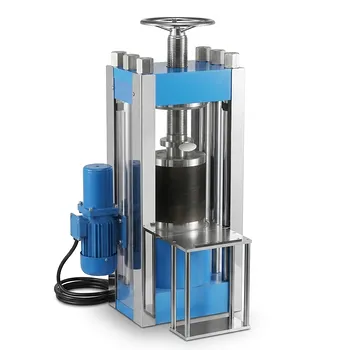
The laboratory heated press is the essential tool for preparing PPC-PCLT copolymer films because it provides the simultaneous thermal and mechanical energy required to transform raw thermoplastic resin into a uniform, high-integrity specimen. By applying precise heat (typically 100 °C) and pressure (around 150 kPa), the press enables the resin to flow and solidify into a film with consistent thickness and density. This controlled environment is critical for eliminating internal stresses, ensuring that subsequent mechanical testing reflects the material's true properties rather than processing artifacts.
Utilizing a laboratory heated press ensures that polymer films are dense, uniform, and free of structural defects. This standardization is vital for accurate physical characterization, as it provides the material with a consistent thermal history and eliminates internal stresses.
Achieving Structural Uniformity and Density
Simultaneous Heat and Pressure Application
A heated press provides the necessary energy to reach the thermoplastic flow state of the PPC-PCLT resin. The simultaneous application of heat and pressure forces the polymer chains to consolidate, eliminating micropores and structural defects that could compromise the film's integrity.
Precision Control of Film Thickness
Maintaining a uniform thickness is paramount for any standardized testing, such as tensile strength or transmission IR spectroscopy. The press ensures that the resin is distributed evenly across the mold, resulting in a flat surface and a specific, repeatable thickness across the entire sample.
Enhancement of Material Consolidation
The pressure applied during the heating phase facilitates the thorough fusion and densification of the polymer matrix. This process is essential for achieving the desired density and crystallinity, which directly influence the copolymer's final mechanical and thermal behavior.
Maximizing Sample Quality for Analytical Testing
Elimination of Internal Stresses
As the primary reference highlights, the controlled slow cooling process following the heat application is critical. By cooling the film under pressure, the press helps dissipate internal stresses that would otherwise cause warping or premature failure during mechanical testing.
Establishing a Consistent Thermal History
Every polymer's properties are influenced by how it was heated and cooled. A laboratory press allows researchers to provide specimens with a standardized thermal history, ensuring that results are comparable across different batches and follow international testing standards.
Improving Interface and Surface Quality
For films used in advanced applications, such as electrolytes, the press improves the compactness and surface wetting. This results in a high-quality specimen suitable for detailed studies of polymer structure and behavior under varying environmental conditions.
Understanding the Trade-offs
Risk of Thermal Degradation
While heat is necessary for resin flow, excessive temperature or prolonged exposure can lead to thermal degradation of the PPC-PCLT chains. It is a delicate balance to ensure the temperature is high enough for flow (100 °C) without triggering polymer breakdown.
The Impact of Cooling Rates
If the cooling rate is too rapid, the material may develop non-uniform crystallinity or trapped "frozen-in" stresses. Conversely, excessively slow cooling can increase processing time and potentially alter the desired morphology of the copolymer.
Pressure Maintenance Challenges
Inconsistent pressure during the cooling phase can lead to thickness variations or surface irregularities. High-performance presses must maintain precise pressure levels (such as 150 kPa) throughout the entire cycle to guarantee the accuracy of physical property testing.
Making the Right Choice for Your Research Goal
To achieve the best results with PPC-PCLT copolymer films, align your pressing parameters with your specific analytical requirements.
- If your primary focus is mechanical property characterization: Prioritize the slow cooling phase to eliminate internal stresses and ensure accurate tensile and impact data.
- If your primary focus is spectroscopic or optical analysis: Focus on the precision of the thickness control to ensure a uniform path length for light or radiation.
- If your primary focus is material density and morphology: Emphasize the simultaneous application of high pressure and heat to ensure total fusion and the elimination of micropores.
By masterfully controlling the interaction between heat, pressure, and time, the laboratory heated press serves as the foundation for reliable and reproducible polymer science.
Summary Table:
| Key Processing Factor | Parameter/Requirement | Benefit for PPC-PCLT Films |
|---|---|---|
| Temperature | Typically 100 °C | Achieves flow state without thermal degradation. |
| Applied Pressure | Around 150 kPa | Eliminates micropores and ensures matrix densification. |
| Cooling Rate | Controlled Slow Cooling | Dissipates internal stresses and prevents warping. |
| Thickness Control | Precision Mold/Platen | Ensures repeatable path length for analytical testing. |
| Structural Integrity | Simultaneous Heat/Pressure | Guarantees high density and consistent crystallinity. |
Elevate Your Polymer Research with KINTEK Precision
Achieving the perfect PPC-PCLT copolymer film requires absolute control over thermal and mechanical variables. KINTEK specializes in comprehensive laboratory pressing solutions designed to meet the rigorous demands of battery research and material science.
Our diverse range includes:
- Manual & Automatic Heated Presses for precise temperature and pressure cycles.
- Multifunctional & Glovebox-Compatible Models for sensitive environments.
- Cold and Warm Isostatic Presses (CIP/WIP) for advanced material consolidation.
Ensure your specimens reflect true material properties, free from processing artifacts. Contact KINTEK today to find the ideal pressing solution for your laboratory’s unique requirements!
References
- Steven Spoljaric, Jukka Seppälä. One-pot, mouldable, thermoplastic resins from poly(propylene carbonate) and poly(caprolactone triol). DOI: 10.1039/c6ra07191k
This article is also based on technical information from Kintek Solution Knowledge Base .
Related Products
- Automatic Large Format Laboratory Heated Hydraulic Press 400x400mm Plate Capacity
- 24T 30T 60T Heated Hydraulic Lab Press Machine with Hot Plates for Laboratory
- Laboratory Split Manual Heated Hydraulic Press Machine with Hot Plates
- Automatic Heated Hydraulic Lab Press 120x120mm Plate Fully Automated Material Research Press
- Heated Hydraulic Press Machine with Heated Plates for Vacuum Box Laboratory Hot Press
People Also Ask
- Why is a laboratory heated hydraulic press required? Ensure Precise Vulcanization for NBR/EPDM Nanocomposites
- What role does a Laboratory Heated Hydraulic Press play in rubber vulcanization? Master Precision Specimen Molding
- How does a laboratory heated hydraulic press improve the performance of dried composite solid-state membranes? Guide
- What role does a laboratory heated hydraulic press play in PLA/MCC molding? Achieve superior composite density.
- Role of Laboratory Heated Hydraulic Presses in Solid Electrolyte Fabrication: Enhance Density & Ionic Conductivity