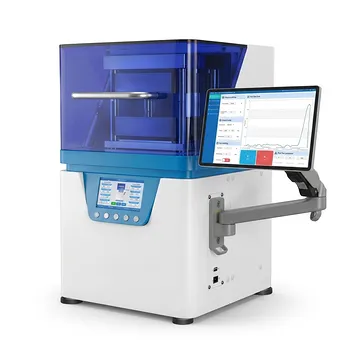
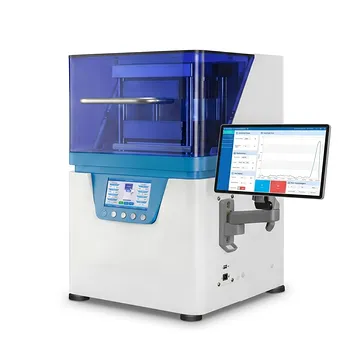
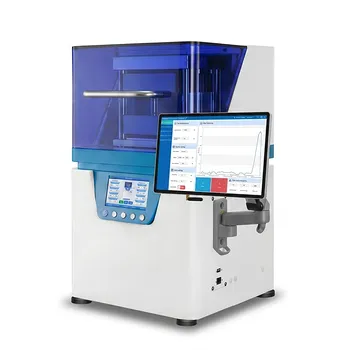
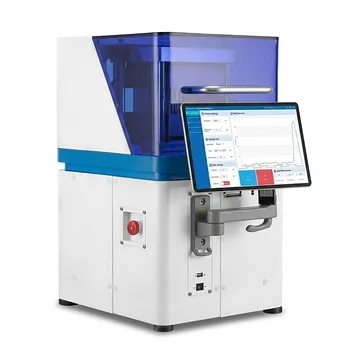
A laboratory hydraulic press is a high-precision instrument that utilizes fluid pressure to generate significant force within a compact footprint. Its fundamental function is to compress materials for specific research outcomes, primarily serving to test material durability, create pellets for spectroscopic analysis, and facilitate advanced pharmaceutical and composite research.
Core Takeaway While often associated with simple crushing, the laboratory hydraulic press is a critical tool for homogenization and characterization. It bridges the gap between raw material and analyzable sample, ensuring that powders are converted into solid forms or that materials are tested under strictly controlled high-pressure conditions.
Sample Preparation for Spectroscopy
Creating Pellets for Analysis
One of the most frequent applications of a lab press is preparing samples for spectroscopy, specifically FTIR (Fourier Transform Infrared) and XRF (X-ray Fluorescence).
The KBr Pellet Method
To analyze powder samples effectively, they must be compressed into thin, flat, and transparent pellets.
The hydraulic press applies uniform force to compact a mixture of the sample and Potassium Bromide (KBr). This ensures the sample is homogenous and allows light or X-rays to pass through for accurate chemical identification.
Material Testing and Characterization
Assessing Strength and Durability
Beyond preparation, the press is used as a testing apparatus to evaluate the inherent properties of a material.
Researchers subject materials to high pressure to measure their breaking points, durability, and resistance to deformation.
Analyzing Stress-Strain Behavior
This application allows scientists to understand how a material reacts under load.
By observing deformation under controlled pressure, researchers can map the stress-strain behavior of metals, ceramics, and polymers, providing critical data for engineering applications.
Advanced Research and Development
Prototyping Microfluidic Devices
The primary reference highlights the use of hydraulic presses in prototyping microfluidic devices.
By using heated platens and precise pressure, researchers can emboss micro-channels into polymers, creating the intricate pathways required for lab-on-a-chip technologies.
Powder Compaction for Composites
In materials science, the press is essential for developing new composite materials.
It compresses loose powders into solid forms, allowing researchers to study density and structural integrity before the material is sintered or processed further.
Pharmaceutical R&D
Pharmaceutical researchers rely on these presses to test formulation stability and tablet formation.
The press simulates industrial manufacturing conditions on a smaller scale, allowing for the validation of drug delivery mechanisms and pill durability.
Understanding the Operational Trade-offs
Precision vs. Force
While industrial presses prioritize raw tonnage, a laboratory press prioritizes control.
However, manual lab presses can introduce human error in pressure application, potentially leading to inconsistent pellet density. For highly sensitive quantitative analysis, an automatic press with programmable pressure cycles is often required to eliminate this variable.
Sample Integrity Risks
Applying too much pressure too quickly can damage the crystalline structure of certain samples.
Users must balance the need for a solid pellet against the risk of altering the chemical or physical properties of the material they intend to measure.
Making the Right Choice for Your Goal
To maximize the utility of a hydraulic press, align the machine's capabilities with your specific research outcomes.
- If your primary focus is Spectroscopy (FTIR/XRF): Prioritize a press with high precision and consistent load maintenance to ensure transparent, homogenous pellets.
- If your primary focus is Material Testing: Ensure the press has a high tonnage capacity and a gauge capable of tracking deformation and stress limits accurately.
- If your primary focus is Microfluidics or Prototyping: Look for a press that supports heated platens to allow for thermal embossing and polymer forming.
Ultimately, the value of a laboratory hydraulic press lies not just in the force it exerts, but in the precision with which it transforms raw materials into measurable scientific data.
Summary Table:
| Application Category | Primary Use Case | Key Benefit |
|---|---|---|
| Spectroscopy | FTIR/XRF Pellet Preparation | Ensures sample homogeneity and transparency for accurate analysis. |
| Material Testing | Strength & Stress-Strain Analysis | Determines breaking points and deformation limits of polymers and metals. |
| Product Development | Microfluidic Prototyping | Enables thermal embossing of intricate channels into polymers. |
| Pharmaceuticals | Tablet Formulation & Stability | Simulates industrial production to validate drug delivery mechanisms. |
| Powder Science | Composite Compaction | Transforms loose powders into solid forms for density study. |
Elevate Your Research Precision with KINTEK
At KINTEK, we understand that scientific breakthroughs depend on the precision of your sample preparation. As specialists in comprehensive laboratory pressing solutions, we offer a versatile range of equipment tailored to your specific research needs, including:
- Manual & Automatic Presses: For consistent, programmable pressure cycles.
- Heated & Multifunctional Models: Perfect for thermal embossing and microfluidic prototyping.
- Advanced Isostatic Presses: Cold and warm models optimized for high-density battery research.
- Glovebox-Compatible Solutions: For sensitive materials requiring controlled environments.
Whether you are refining pharmaceutical formulations or testing material durability, KINTEK provides the reliability your lab demands. Contact our experts today to find the perfect press for your application and see how our technology can streamline your workflow.
Related Products
- Laboratory Hydraulic Press Lab Pellet Press Button Battery Press
- Laboratory Hydraulic Press 2T Lab Pellet Press for KBR FTIR
- Laboratory Hydraulic Press Lab Pellet Press Machine for Glove Box
- 24T 30T 60T Heated Hydraulic Lab Press Machine with Hot Plates for Laboratory
- Automatic Laboratory Hydraulic Press Lab Pellet Press Machine
People Also Ask
- How is a laboratory hydraulic press used for HAP composite gels? Master Mineral Substrate Standardization
- What role does a laboratory hydraulic press play in reaction pellets? Optimizing Lunar Soil and Metal Fuel Density
- What role does a laboratory hydraulic press play in the preparation of piezoelectric ceramic discs for DC-PG? | KINTEK
- What role does a laboratory hydraulic press play in the assembly of all-solid-state battery test cells? Expert Guide
- Why is a laboratory hydraulic press required for PBAT and PLA sample preparation? Achieve Flawless Characterization