
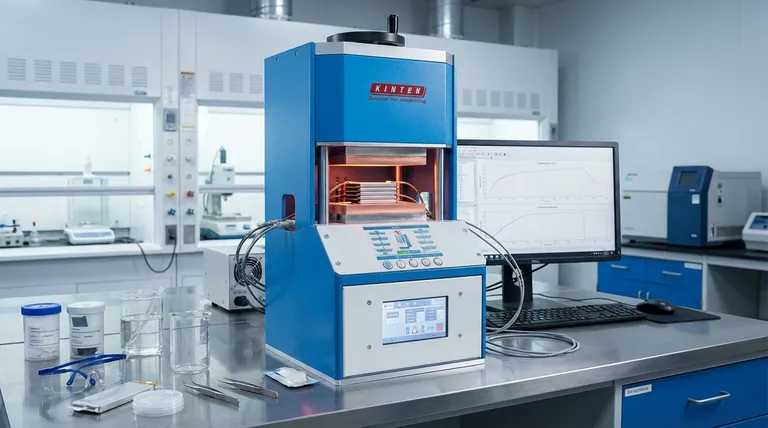
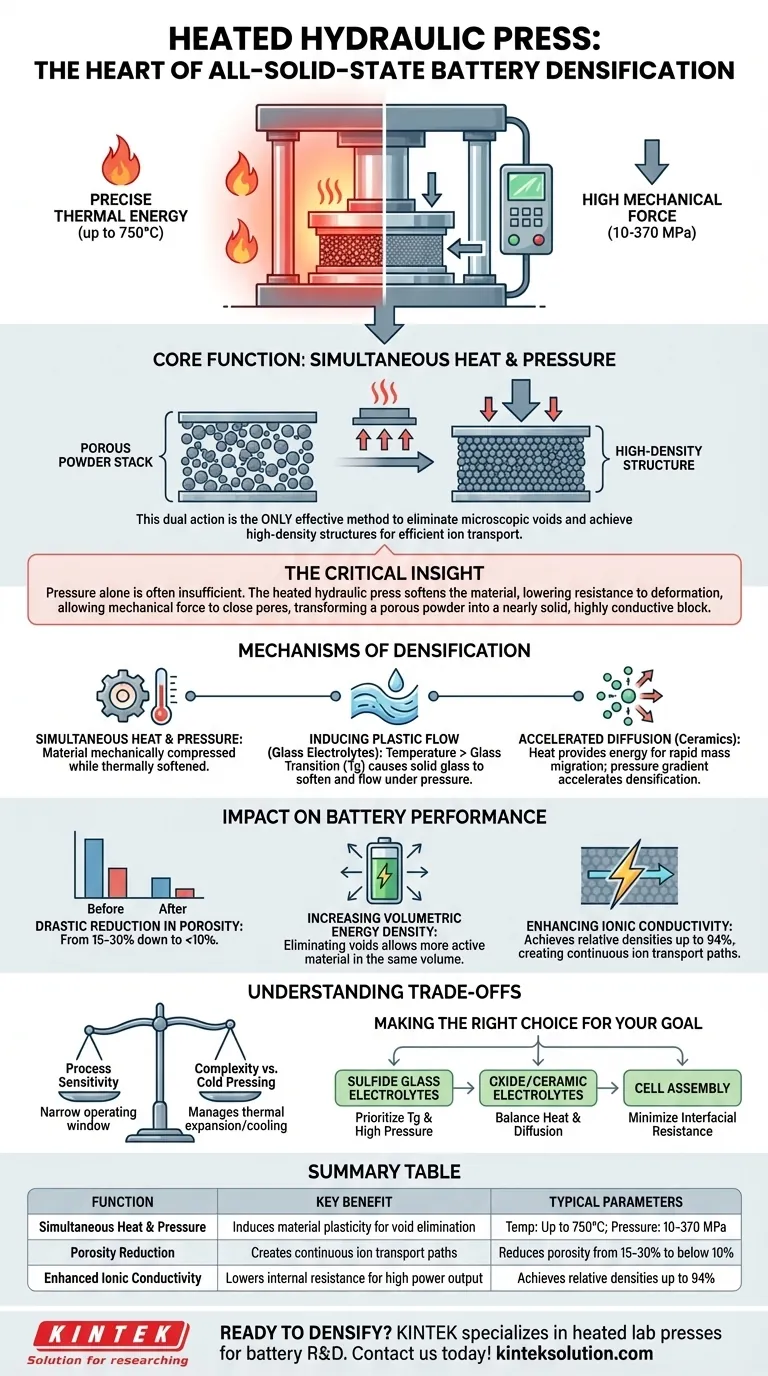
The core function of a heated hydraulic press in this context is the simultaneous application of precise thermal energy and high mechanical force. By integrating heating (e.g., up to 200°C or 750°C) with uniaxial pressure (ranging from 10 MPa to 370 MPa), the equipment forces battery materials into a state of plasticity or accelerated diffusion. This dual action is the only effective method to eliminate microscopic voids and achieve the high-density structure required for efficient ion transport in solid-state batteries.
The Critical Insight Pressure alone is often insufficient to fully densify solid electrolytes. The heated hydraulic press solves this by softening the material—lowering its resistance to deformation—allowing mechanical force to close pores that would otherwise remain open, thereby transforming a porous powder stack into a nearly solid, highly conductive block.
The Mechanisms of Densification
Simultaneous Heat and Pressure
The defining feature of this equipment is its ability to apply force and heat at the exact same moment. This synchronization is critical because the material must be mechanically compressed while it is in a thermally softened state.
Inducing Plastic Flow in Glass Electrolytes
For sulfide glass electrolytes, the press raises the material's temperature above its glass transition temperature ($T_g$). Once this thermal threshold is crossed, the solid glass softens and exhibits fluid-like characteristics.
Particle Rearrangement
While in this softened state, the applied high pressure (e.g., 370 MPa) forces particles to slide past one another and rearrange. This "plastic flow" fills the interstitial voids between particles that cold pressing cannot resolve.
Accelerated Diffusion in Ceramics
In ceramic materials like LSLBO or LLZO, the heat provides the energy for rapid mass migration and diffusion between particles. The pressure gradient accelerates this process, enabling densification at temperatures significantly lower than traditional sintering requires.
Impact on Battery Performance
Drastic Reduction in Porosity
The primary metric of success for a heated hydraulic press is porosity reduction. In sulfide stacks, for example, this process can drive porosity down from 15-30% to below 10%.
Increasing Volumetric Energy Density
By eliminating empty space (air voids), you fit more active material into the same volume. This direct physical compaction significantly boosts the battery's volumetric energy density.
Enhancing Ionic Conductivity
Voids act as insulators that block the path of ions. By achieving relative densities as high as 94%, the press creates a continuous path for ion transport, which is fundamental for low internal resistance and high power output.
Understanding the Trade-offs
Process Sensitivity
Success relies on a narrow operating window. If the temperature is too low, the material remains brittle and will not flow, rendering the pressure ineffective; if too high, you risk material degradation or unwanted side reactions.
Complexity vs. Cold Pressing
Compared to a standard laboratory press used for "green body" formation or cold compaction, a heated system introduces variables regarding thermal expansion and cooling rates. Rapid cooling under pressure must be managed to prevent thermal shock or cracking in the dense ceramic pellet.
Making the Right Choice for Your Goal
To maximize the utility of a heated hydraulic press, align your process parameters with your specific material chemistry:
- If your primary focus is Sulfide Glass Electrolytes: Prioritize reaching the glass transition temperature ($T_g$) to trigger plastic flow, utilizing higher pressures (up to 370 MPa) to maximize void filling.
- If your primary focus is Oxide/Ceramic Electrolytes: Focus on the balance of heat and diffusion, utilizing the press to lower the required sintering temperature (e.g., 750°C) and shorten processing time compared to conventional methods.
- If your primary focus is Cell Assembly: Use the press to minimize interfacial resistance, ensuring intimate physical contact between the anode sheets and the electrolyte separator for stable electrochemical performance.
Mastering the interplay between thermal softening and mechanical compression is the key to unlocking the full potential of all-solid-state battery architectures.
Summary Table:
| Function | Key Benefit | Typical Parameters |
|---|---|---|
| Simultaneous Heat & Pressure | Induces material plasticity for void elimination | Temp: Up to 750°C; Pressure: 10-370 MPa |
| Porosity Reduction | Creates continuous ion transport paths | Reduces porosity from 15-30% to below 10% |
| Enhanced Ionic Conductivity | Lowers internal resistance for high power output | Achieves relative densities up to 94% |
Ready to densify your solid-state battery materials with precision?
KINTEK specializes in laboratory press machines, including automatic lab presses, isostatic presses, and heated lab presses designed for the exacting demands of battery research and development. Our equipment delivers the precise thermal and mechanical control required to achieve the high-density structures essential for superior battery performance.
Contact us today to discuss how our heated hydraulic presses can accelerate your development of all-solid-state batteries.
Visual Guide
Related Products
- Heated Hydraulic Press Machine with Heated Plates for Vacuum Box Laboratory Hot Press
- Automatic High Temperature Heated Hydraulic Press Machine with Heated Plates for Lab
- Heated Hydraulic Press Machine With Heated Plates For Vacuum Box Laboratory Hot Press
- 24T 30T 60T Heated Hydraulic Lab Press Machine with Hot Plates for Laboratory
- Automatic Heated Hydraulic Press Machine with Hot Plates for Laboratory
People Also Ask
- What are the requirements for electrode pressing with high-viscosity ionic liquids like EMIM TFSI? Optimize Performance
- How does a laboratory heated hydraulic press facilitate PBN sample prep for WAXS? Achieve Precise X-Ray Scattering
- What are the industrial applications of heated hydraulic presses? Master Heat & Force for Precision Manufacturing
- Function of a Laboratory Hydraulic Press with Heated Platens in SSE? Enhance Battery Density & Conductivity
- How are heated hydraulic presses utilized in the preparation of thin films? Key Mechanisms and Applications



















