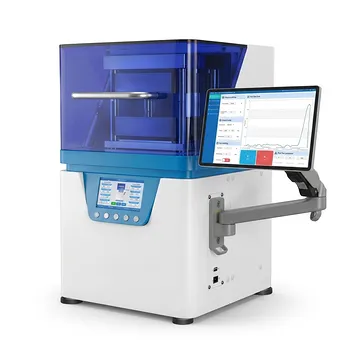
Hydraulic presses in laboratory settings are primarily utilized for sample preparation and material testing. Specifically, they are used to compress powder mixtures into uniform pellets for analytical techniques such as X-ray fluorescence spectroscopy (XRF) and to test the quality, strength, and durability of manufactured products.
Core Takeaway While often associated with heavy industrial force, the laboratory hydraulic press is a tool of precision. Its main role is to transform raw materials into homogenous samples for spectroscopic analysis or to subject materials to controlled pressure for research and quality assurance.
Sample Preparation for Analysis
The most frequent application of hydraulic presses in a lab is preparing samples for spectral analysis.
Creating Pellets for Spectroscopy
Techniques like X-ray fluorescence (XRF) and infrared spectroscopy (FTIR) require samples to be extremely uniform.
Hydraulic presses compress loose powder mixtures into solid, stable pellets.
This process ensures a smooth, homogenous surface, which is critical for accurate data collection and precise chemical measurements.
Thin Film Production
Beyond pellets, presses are used to create thin films of material.
These films allow researchers to investigate optical and physical properties that are not observable in bulk forms.
This is particularly common in polymer testing and pharmaceutical labs where material consistency is paramount.
Material Testing and Research
Beyond preparation, the press itself acts as a testing environment to simulate real-world or extreme conditions.
Quality Control and Durability
Laboratories use these presses to test the quality of manufactured products before they reach the market.
By applying significant force, technicians can evaluate the strength and durability of materials.
This is vital for verifying that a product can withstand the physical stresses it will encounter during its lifecycle.
Investigating High-Pressure Behavior
Research and Development (R&D) teams use hydraulic presses to study how substances behave under extreme pressure.
This offers valuable insights into material deformation, phase changes, and structural integrity.
Such data is essential for "lean manufacturing" and developing new materials for industries ranging from aerospace to rubber molding.
Advantages in the Lab Environment
Compact and Efficient Design
Unlike their massive industrial counterparts used for forging or car crushing, laboratory presses are designed for limited spaces.
They are typically compact and require minimal physical footprint, making them suitable for undergraduate chemistry labs and crowded research facilities.
Consistency and Ease of Use
Modern lab presses, including hydraulic hot press machines, are engineered to deliver consistent pressure.
This consistency removes variability from experiments, ensuring that results are reproducible.
They are generally cost-effective and designed to produce high-quality results with less physical effort from the operator.
Understanding the Limitations and Trade-offs
Throughput vs. Precision
Laboratory presses are optimized for short and limited production runs or individual sample creation.
They are not designed for high-volume mass production.
If your workflow requires processing thousands of units daily, a standard lab press will likely become a bottleneck.
Manual vs. Automated Consistency
Many labs use manual hydraulic pellet presses due to their lower cost.
However, manual operation introduces a human variable.
While they can produce high-quality pellets, achieving absolute consistency across hundreds of samples is more difficult compared to automated or programmable hot presses.
Making the Right Choice for Your Goal
To select the right hydraulic press utility for your laboratory, you must define your primary output.
- If your primary focus is Spectroscopy (XRF/FTIR): Prioritize a press known for creating pellets with perfectly smooth, homogenous surfaces to ensure data accuracy.
- If your primary focus is Materials Research: Look for a press with precise pressure controls and heating capabilities (hot press) to simulate specific environmental conditions.
- If your primary focus is Quality Control: Ensure the press can generate sufficient force to test the breaking points and durability limits of your specific manufacturing materials.
The right hydraulic press transforms raw variability into consistent, measurable scientific data.
Summary Table:
| Application Category | Primary Laboratory Use | Key Benefits |
|---|---|---|
| Spectroscopy | Creating pellets for XRF and FTIR analysis | Ensures uniform, homogenous surfaces for accurate data |
| Material Testing | Evaluating strength, durability, and deformation | Verifies product quality and simulates extreme conditions |
| Thin Film Production | Developing polymer and pharmaceutical films | Enables study of optical and physical material properties |
| R&D Research | Investigating phase changes and high-pressure behavior | Provides insights into structural integrity and lean manufacturing |
Elevate Your Lab’s Precision with KINTEK Pressing Solutions
Maximize your research accuracy with KINTEK’s comprehensive range of laboratory pressing equipment. Whether you are conducting cutting-edge battery research or routine quality control, our solutions are designed to meet the most demanding scientific standards.
Why choose KINTEK?
- Versatile Selection: We offer manual, automatic, heated, and multifunctional models to fit any workflow.
- Specialized Technology: Explore our glovebox-compatible models and cold/warm isostatic presses (CIP/WIP).
- Unmatched Consistency: Achieve reproducible results with precise pressure control for XRF, FTIR, and material stress testing.
Contact KINTEK Today to find the perfect press for your laboratory applications and discover how our expertise can drive your innovation forward.
Related Products
- Laboratory Hydraulic Press Lab Pellet Press Button Battery Press
- Laboratory Hydraulic Press 2T Lab Pellet Press for KBR FTIR
- Laboratory Hydraulic Press Lab Pellet Press Machine for Glove Box
- 24T 30T 60T Heated Hydraulic Lab Press Machine with Hot Plates for Laboratory
- Automatic Laboratory Hydraulic Press Lab Pellet Press Machine
People Also Ask
- How is a laboratory hydraulic press used for HAP composite gels? Master Mineral Substrate Standardization
- What role does a laboratory hydraulic press play in the preparation of piezoelectric ceramic discs for DC-PG? | KINTEK
- What role does a laboratory hydraulic press play in reaction pellets? Optimizing Lunar Soil and Metal Fuel Density
- Why is a laboratory hydraulic press required for PBAT and PLA sample preparation? Achieve Flawless Characterization
- What role does a laboratory hydraulic press play in the assembly of all-solid-state battery test cells? Expert Guide