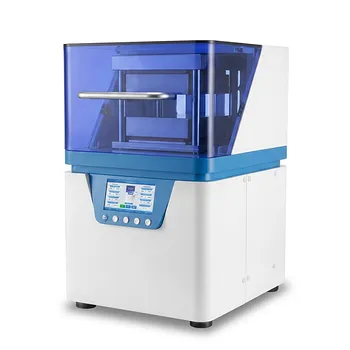
A laboratory heated hydraulic press optimizes composite membranes by using simultaneous thermal and mechanical energy to densify the material structure. It induces plastic deformation in the polymer matrix, allowing it to flow into and fill the interstitial spaces between ceramic particles while eliminating internal micropores. This consolidation results in a membrane with superior density, uniform thickness, and significantly higher ionic conductivity compared to cold-pressed or manual alternatives.
The heated hydraulic press acts as a critical consolidation tool that transforms a porous precursor into a dense, high-performance solid-state electrolyte. By integrating heat with pressure, it maximizes polymer-ceramic contact and minimizes interfacial resistance, which is essential for efficient ion transport in next-generation batteries.
Structural Consolidation and Densification
Plastic Deformation of the Polymer Matrix
The primary function of heat during the pressing process is to soften the polymer matrix, allowing it to undergo plastic deformation. This flow ensures that the polymer effectively "wets" and surrounds ceramic particles, creating a continuous phase.
Without this thermal energy, the polymer remains too rigid to fill the tiny gaps between particles. This results in a brittle, porous structure that lacks the surface flatness required for high-performance electrochemical devices.
Elimination of Internal Micropores
The application of controlled, uniform pressure is essential for removing internal micropores and density gradients. These voids act as barriers to both mechanical strength and ion movement, often serving as failure points under stress.
By eliminating these defects, the press ensures a high relative density. This dense packing is a prerequisite for achieving the structural integrity needed to survive the assembly and cycling of solid-state batteries.
Enhancing Electrochemical Performance
Maximizing Ionic Conductivity
The most significant performance gain is the marked increase in ionic conductivity. When the polymer matrix is thoroughly integrated with lithium salts and ceramic fillers, the pathways for ion transport become more direct and less obstructed.
The heated press ensures that polymer segments and ion sources maintain sufficient contact. This optimization of the internal network allows ions to move efficiently across the membrane, reducing the internal resistance of the final cell.
Reducing Interfacial Impedance
A smooth, uniform membrane surface is critical for reducing interfacial impedance between the electrolyte and the electrodes. The hydraulic press ensures the membrane has a consistent thickness and a flat profile.
This uniformity leads to stable interface contact, preventing "hot spots" where current might concentrate. Stable interfaces are vital for maintaining long-term battery cycle life and preventing rapid capacity fade.
Improving Mechanical Integrity and Safety
Resistance to Lithium Dendrites
In solid-state batteries, a dense and uniform membrane acts as a physical barrier against lithium dendrites. These needle-like structures can grow through porous separators during fast charging, causing internal short circuits.
The thermal-pressing process facilitates the rearrangement of polymer binders and ceramic coatings. This results in a robust film that can effectively resist dendrite penetration, significantly improving the safety profile of the battery.
Prevention of Interlayer Delamination
For hybrid or multi-layer membranes, heat-pressing promotes the formation of strong internal networks, such as hydrogen bond networks between fibers. This thermal consolidation prevents interlayer delamination.
A well-pressed membrane maintains its structural identity even under high-pressure filtration or high-stress mechanical environments. This durability is essential for both industrial manufacturing and specialized research applications.
Understanding the Trade-offs
Thermal Degradation Risks
While heat is necessary for plastic deformation, excessive temperatures can lead to the thermal degradation of the polymer matrix or the lithium salts. If the temperature exceeds the polymer's stability threshold, the membrane may become brittle or lose its electrochemical activity.
Pressure-Induced Short Circuits
Applying excessive pressure can occasionally "crush" certain nanostructured fillers or cause the membrane to become too thin. In extreme cases, this can lead to mechanical failure or facilitate electrical shorts if the ceramic particles are forced into a configuration that bridges the electrodes.
Processing Throughput
The requirement for simultaneous heat and pressure makes this a batch-oriented process. Compared to continuous roll-to-roll processing, laboratory hydraulic pressing is slower, which must be considered when scaling from research to mass production.
How to Apply This to Your Project
Recommendations for Membrane Optimization
To achieve the best results with a laboratory heated hydraulic press, the parameters must be tailored to your specific material composition.
- If your primary focus is Maximizing Ionic Conductivity: Use a temperature slightly above the polymer's glass transition point ($T_g$) to ensure maximum segment mobility and salt integration.
- If your primary focus is Mechanical Durability: Prioritize a slower cooling phase under pressure to allow the polymer to crystallize or stabilize without forming internal stresses.
- If your primary focus is Thin-Film Uniformity: Utilize high-precision spacers or shims within the press plates to ensure an exact, repeatable membrane thickness across the entire surface area.
- If your primary focus is Characterization Accuracy: Ensure the press plates are perfectly clean and parallel to produce standardized specimens for reliable FTIR or XRD analysis.
By precisely controlling the synergy between thermal energy and mechanical force, the heated hydraulic press serves as the definitive tool for engineering high-performance composite solid-state membranes.
Summary Table:
| Key Benefit | Mechanism of Action | Impact on Performance |
|---|---|---|
| High Density | Plastic deformation of polymer | Eliminates micropores and voids |
| Ion Flow | Enhanced polymer-ceramic contact | Maximizes ionic conductivity |
| Interface Quality | Surface leveling and uniformity | Reduces interfacial impedance |
| Cell Safety | Structural consolidation | Prevents lithium dendrite growth |
Advance Your Battery Research with KINTEK
Optimize your solid-state electrolyte development with KINTEK’s comprehensive laboratory pressing solutions. We offer high-precision manual, automatic, heated, and multifunctional presses, as well as cold and warm isostatic models specifically designed for cutting-edge battery research.
Why partner with KINTEK?
- Superior Integration: Achieve the perfect polymer-ceramic contact for maximum ion transport.
- Precision Control: Eliminate internal defects and ensure uniform membrane thickness.
- Proven Safety: Create robust membranes that resist dendrite penetration and delamination.
Take the next step in your battery innovation—contact KINTEK today for a tailored laboratory solution!
References
- Kevin Vattappara, Andriy Kvasha. Ceramic-Rich Composite Separators for High-Voltage Solid-State Batteries. DOI: 10.3390/batteries11020042
This article is also based on technical information from Kintek Solution Knowledge Base .
Related Products
- 24T 30T 60T Heated Hydraulic Lab Press Machine with Hot Plates for Laboratory
- Automatic Large Format Laboratory Heated Hydraulic Press 400x400mm Plate Capacity
- Automatic Heated Hydraulic Lab Press with Programmable Touch Screen Controls and Precision Temperature Regulation
- Automatic Heated Hydraulic Lab Press 120x120mm Plate Fully Automated Material Research Press
- Automatic Heated Hydraulic Press Machine with Hot Plates for Laboratory
People Also Ask
- Function of a Laboratory Hydraulic Press with Heated Platens in SSE? Enhance Battery Density & Conductivity
- Why is a laboratory hydraulic press with heating plates required for PLA/TEC films? Achieve Precise Sample Integrity
- What role does a laboratory heated hydraulic press play in LTCC? Essential for High-Density Ceramic Lamination
- Why reduce load when applying composite strengthening tabs? Protect Specimen Integrity and Data Accuracy
- Why is a laboratory heated hydraulic press required? Ensure Precise Vulcanization for NBR/EPDM Nanocomposites