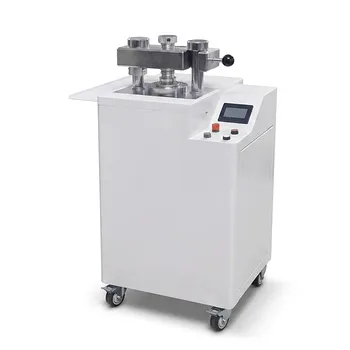
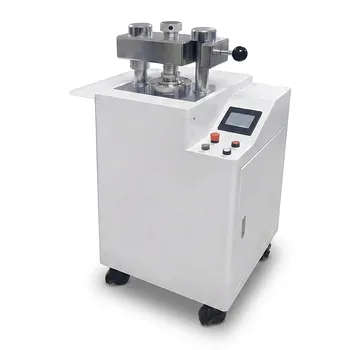
In the cold sintering of Strontium Titanate, an initial pressure of 750 MPa serves as the essential mechanical engine for densification. This high pressure forces powder particles to slide past one another and fill microscopic voids, a process facilitated by a transient solvent. This specific mechanical force is the prerequisite for creating a high-density "green body" capable of reaching final ceramic densities exceeding 96% of their theoretical value.
The 750 MPa pressure level is the primary driving force that replaces high-temperature thermal energy with mechanical energy. It ensures the physical contact and particle rearrangement necessary for the dissolution-reprecipitation process that defines cold sintering.
The Role of Mechanical Pressure in Particle Rearrangement
Overcoming Inter-Particle Friction
In a dry or low-pressure state, Strontium Titanate particles resist movement due to friction and geometric interlocking. The application of 750 MPa provides the necessary shear stress to overcome these resistive forces, allowing particles to move into a more efficient packing arrangement.
Filling Voids and Minimizing Porosity
High-pressure application effectively "squeezes" the powder, forcing smaller particles into the gaps between larger ones. This initial densification reduces the total volume of air pockets, which is critical because any pores remaining at this stage are difficult to remove later in the sintering process.
Creating the Physical Foundation
The laboratory hydraulic press transforms a loose powder into a consolidated green body through this mechanical force. Without the 750 MPa threshold, the physical contact between particles is insufficient to trigger the subsequent chemical stages of sintering.
The Synergy Between Pressure and Transient Solvents
Facilitating Dissolution-Reprecipitation
Cold Sintering Processing (CSP) relies on a moistened environment where a solvent partially dissolves particle surfaces. The 750 MPa pressure enhances this chemical process by ensuring that the liquid film is distributed evenly across all particle boundaries.
Promoting Plastic Flow and Sintering Necks
The combination of pressure and solvent allows for plastic flow and the formation of sintering necks at significantly lower temperatures than traditional methods. This mechanical force acts as a catalyst, enabling the ceramic to achieve high relative density without requiring extreme heat.
Bridging the Temperature Gap
By providing continuous high pressure, the hydraulic press allows densification to occur at or near room temperature. This expands the processing range, making it possible to integrate ceramics with temperature-sensitive materials like polymers.
Understanding the Trade-offs and Challenges
Unidirectional vs. Isostatic Pressure
While a standard hydraulic press typically applies unidirectional pressure, this can sometimes lead to internal stress imbalances or density gradients within the sample. In contrast, isostatic pressing applies uniform pressure from all directions but often operates at lower maximum pressures (e.g., 250 MPa) than the 750 MPa targeted here.
Risk of Mechanical Failure
Applying 750 MPa requires specialized tooling and high-strength dies to prevent equipment failure or sample cracking. If the pressure is released too quickly or applied unevenly, internal micro-cracks can form, potentially compromising the structural integrity of the final ceramic body.
Strategic Implementation for Ceramic Processing
Applying the correct pressure protocol is vital for translating laboratory results into high-quality ceramic components.
- If your primary focus is reaching maximum theoretical density: Ensure the hydraulic press maintains the 750 MPa threshold consistently to facilitate the highest possible level of particle rearrangement.
- If your primary focus is minimizing internal stress gradients: Consider a two-stage approach using a unidirectional press for initial consolidation followed by isostatic pressing to normalize density.
- If your primary focus is processing temperature-sensitive composites: Prioritize the precision of the pressure application to ensure densification occurs successfully at lower thermal levels.
Mastering the use of 750 MPa pressure is the most critical step in unlocking the benefits of cold sintering for high-performance Strontium Titanate ceramics.
Summary Table:
| Factor | Role in Cold Sintering | Impact on Strontium Titanate |
|---|---|---|
| 750 MPa Pressure | Mechanical engine for densification | Achieves >96% theoretical density |
| Friction Reduction | Overcomes inter-particle resistance | Enables efficient particle rearrangement |
| Void Filling | Minimizes porosity in "green body" | Foundation for high-strength ceramics |
| Solvent Synergy | Facilitates dissolution-reprecipitation | Allows sintering at near room temperatures |
Optimize Your Material Research with KINTEK Precision
Achieving the critical 750 MPa threshold for successful cold sintering requires reliable, high-precision equipment. KINTEK specializes in comprehensive laboratory pressing solutions designed to meet the rigorous demands of battery research and advanced ceramics. Our expertise ensures you achieve maximum densification and structural integrity in every sample.
Our specialized product range includes:
- Manual & Automatic Hydraulic Presses for consistent high-pressure application.
- Heated & Multifunctional Models for complex sintering protocols.
- Cold & Warm Isostatic Presses to eliminate internal stress and density gradients.
- Glovebox-Compatible Solutions for oxygen-sensitive materials.
Ready to elevate your lab's performance? Contact KINTEK today to consult with our experts and find the perfect pressing solution for your research goals!
References
- R.C. Boston, Clive A. Randall. Reactive intermediate phase cold sintering in strontium titanate. DOI: 10.1039/c8ra03072c
This article is also based on technical information from Kintek Solution Knowledge Base .
Related Products
- Automatic High Temperature Heated Hydraulic Press Machine with Heated Plates for Lab
- Automatic Hydraulic Hot Press with Large Plate and Precision Temperature Control for Advanced Material Sample Preparation and Industrial Research
- Laboratory Hydraulic Press 2T Lab Pellet Press for KBR FTIR
- Automatic Laboratory Hydraulic Press for XRF and KBR Pellet Pressing
- Automatic Laboratory Hydraulic Press Lab Pellet Press Machine
People Also Ask
- Function of a Laboratory Hydraulic Press with Heated Platens in SSE? Enhance Battery Density & Conductivity
- What are the requirements for electrode pressing with high-viscosity ionic liquids like EMIM TFSI? Optimize Performance
- How does a laboratory heated hydraulic press facilitate PBN sample prep for WAXS? Achieve Precise X-Ray Scattering
- What are the industrial applications of heated hydraulic presses? Master Heat & Force for Precision Manufacturing
- Why is a laboratory hydraulic press with heating plates required for PLA/TEC films? Achieve Precise Sample Integrity