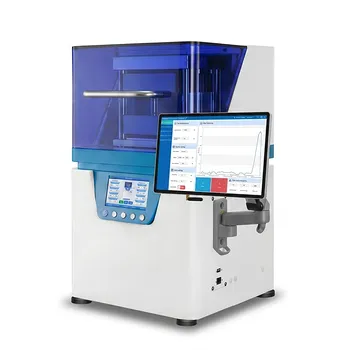
A laboratory hydraulic press and precision metal molds function as the primary consolidation system used to transform loose zirconia powder into a structured, geometric "green body" through uniaxial pressing. By applying controlled axial pressure—typically ranging from 30 MPa to 100 MPa—this system achieves initial particle rearrangement and mechanical interlocking, providing the sample with the necessary dimensions and structural integrity for subsequent processing.
The core function of this setup is to establish a uniform geometric foundation and sufficient "green strength" for the ceramic sample. This preliminary shaping ensures the material can withstand handling and serves as the essential precursor for high-pressure isostatic pressing and final sintering.
Establishing Geometric and Structural Foundations
Uniaxial Compaction and Particle Rearrangement
The hydraulic press applies axial pressure to the zirconia powder contained within the precision metal mold. This force overcomes internal friction, causing the loose particles to rearrange and bond tightly, significantly reducing the volume of the material and increasing its initial packing density.
Definition of Predetermined Geometries
Precision metal molds, often crafted from hardened steel or stainless steel, dictate the final shape of the specimen, such as discs or cylinders. These molds ensure dimensional uniformity across multiple samples, which is a critical requirement for maintaining experimental consistency and accurate data collection in material science.
Development of Green Strength
The compression process creates mechanical interlocking between the zirconia particles, resulting in what is known as a green body. This state provides the material with enough physical strength to be safely handled, removed from the die, and transferred to subsequent equipment without fracturing.
The Role in the Processing Pipeline
Foundation for Isostatic Pressing
In many workflows, uniaxial pressing is only the first stage of densification. The shaped green body acts as a structural substrate that can be vacuum-packaged and subjected to Cold Isostatic Pressing (CIP), where higher, multi-directional pressures are applied to further eliminate internal porosity.
Impact on Final Sintering Outcomes
The initial densification achieved by the hydraulic press directly influences the shrinkage rate and final density of the ceramic after sintering. By reducing internal voids at the start, the press ensures that core indicators such as hardness, compressive strength, and electrochemical performance remain stable and predictable.
Understanding the Trade-offs and Limitations
The Challenge of Density Gradients
While effective for simple shapes, uniaxial pressing often results in internal density gradients due to friction between the powder and the metal mold walls. These variations can lead to uneven shrinkage or warping during the high-temperature sintering phase if the initial pressing is not carefully controlled.
Geometry Constraints
Precision metal molds are generally limited to simple, symmetrical shapes like pellets or rectangular bars. For complex components with intricate internal features, uniaxial pressing serves only as a rough "pre-forming" step, or may be bypassed entirely in favor of more advanced molding techniques.
How to Optimize Your Shaping Process
Recommendations for Success
To achieve the best results with zirconia ceramics, consider the specific goals of your research or production.
- If your primary focus is experimental consistency: Use a high-precision electric hydraulic press to ensure that the exact same pressure (e.g., 30 MPa) is applied to every sample, minimizing human error.
- If your primary focus is maximum final density: Prioritize the initial uniaxial press as a "pre-form" stage, ensuring the green body is robust enough to undergo subsequent Cold Isostatic Pressing (CIP) at much higher pressures.
- If your primary focus is preventing mold wear: Utilize high-quality stainless steel or tungsten carbide molds and ensure the zirconia powder is properly granulated to reduce abrasive friction against the die walls.
The laboratory hydraulic press and its accompanying molds are the critical bridge between raw powder and a functional ceramic component, dictating the structural integrity of the material before it ever enters a furnace.
Summary Table:
| Feature | Core Function | Key Benefit for Zirconia |
|---|---|---|
| Uniaxial Compaction | Axial pressure for particle rearrangement | High initial packing density |
| Precision Molds | Shaping powder into discs or cylinders | Uniform geometry & consistency |
| Mechanical Interlocking | Bonding particles under force | Development of handling "green strength" |
| Structural Substrate | Pre-forming for isostatic pressing (CIP) | Reduced internal porosity & voids |
| Dimensional Control | Managing shrinkage during sintering | Predictable final hardness & density |
Elevate Your Material Research with KINTEK
Precision in the initial shaping phase is critical for high-performance zirconia ceramics. KINTEK specializes in comprehensive laboratory pressing solutions designed to meet the rigorous demands of material science and battery research.
From manual and automatic models to heated, multifunctional, and glovebox-compatible presses, we provide the tools necessary to create perfect green bodies. For those requiring maximum densification, we also offer advanced cold and warm isostatic presses (CIP/WIP) to eliminate internal gradients.
Ready to optimize your ceramic processing pipeline? Contact our experts today to find the ideal pressing solution for your application!
References
- Sa-Hak Kim. A Study on the Colors of Zirconia and Veneering Ceramics. DOI: 10.14347/kadt.2012.34.2.129
This article is also based on technical information from Kintek Solution Knowledge Base .
Related Products
- 24T 30T 60T Heated Hydraulic Lab Press Machine with Hot Plates for Laboratory
- Lab Round Bidirectional Press Mold
- Automatic Heated Hydraulic Press Machine with Heated Plates for Laboratory
- Automatic Heated Hydraulic Lab Press 120x120mm Plate Fully Automated Material Research Press
- Laboratory Hydraulic Press 2T Lab Pellet Press for KBR FTIR
People Also Ask
- Function of a Laboratory Hydraulic Press with Heated Platens in SSE? Enhance Battery Density & Conductivity
- Why is a laboratory hydraulic press with heating plates required for PLA/TEC films? Achieve Precise Sample Integrity
- What role does a laboratory heated hydraulic press play in LTCC? Essential for High-Density Ceramic Lamination
- What is the primary function of a laboratory heated hydraulic press? Mastering Thermoplastic Carbon Fiber Composites
- What is the critical role of a laboratory heated hydraulic press? Mastering PVC Sample Prep for Testing