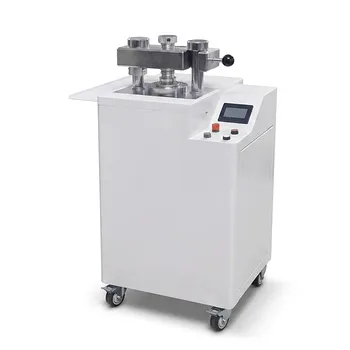
A high-precision laboratory hydraulic press serves as the definitive tool for converting raw rubber compounds into high-performance specimens by simultaneously applying stable pressure and controlled heat. This process ensures the rubber mixture flows completely into mold cavities, expels trapped air, and undergoes a uniform cross-linking reaction (vulcanization). By maintaining precise parameters—such as 10 MPa of pressure and a temperature of 160°C—the press creates finished composites with dense microstructures and exact geometric dimensions.
Core Takeaway: The laboratory hydraulic press is essential for eliminating manufacturing variables, ensuring that the resulting rubber specimens possess the uniform density and molecular integrity required for accurate mechanical and thermal analysis.
Optimizing Material Flow and Structural Density
Achieving Complete Mold Cavity Filling
To create a defect-free part, the rubber compound must reach every corner of the mold. The hydraulic press provides substantial closing pressure, often ranging from 10 MPa to 200 bar, which forces the high-viscosity rubber mixture to flow into intricate geometries. This high-pressure environment is critical for transforming extruded granules or raw sheets into dense, standardized plates.
The Elimination of Internal Air Pores
Internal voids and air bubbles act as failure points that can skew tensile and flexural test results. The simultaneous application of high temperature and pressure drives air out of the mixture during the initial stages of molding. This ensures that the final composite microstructure is solid and homogeneous, which is vital for high-stakes applications like aerospace components or automotive bodies.
Governing the Chemical Kinetics of Vulcanization
Maintaining Precise Thermal Stability
Rubber composites require a specific thermal environment, typically between 160°C and 180°C, to trigger chemical reactions. The laboratory press acts as a constant heat source, providing the thermal energy necessary for chemical vulcanization. Precise temperature control prevents "hot spots" that could cause localized over-curing and material degradation.
Promoting Uniform Molecular Cross-linking
The press facilitates a bidirectional cross-linking reaction, which is the process of "locking" the polymer chains together. In advanced composites, such as those using Liquid Nitrile-Isoprene Rubber (LIR) as a compatibilizer, the press ensures a co-vulcanization effect between different rubber types. This molecular networking significantly enhances the dynamic modulus and overall mechanical strength of the material.
Ensuring Reproducibility in Research and Development
Standardizing Specimens for Mechanical Testing
For R&D professionals, the goal is to produce specimens that accurately reflect the material's properties rather than the molding process's flaws. By accurately controlling the preheating, pressure holding, and cooling phases, the press produces standardized thin sheets (typically 2 mm thick). These sheets provide a reliable baseline for analyzing tensile, flexural, and thermal deformation characteristics.
Eliminating Residual Internal Stresses
Improper cooling or uneven pressure can "trap" stresses within a composite, leading to warping or premature failure. High-precision presses manage the transition from high heat to ambient temperature under pressure, which relaxes the molecular chains and eliminates internal stresses. This is particularly important for multi-layer rubber and fiber fabric composites, such as those used in inflatable rubber dams.
Understanding the Trade-offs and Pitfalls
The Risk of Thermal Gradient Imbalance
While high temperatures are necessary for vulcanization, excessive heat or uneven distribution can lead to thermal degradation of the outer layers before the core is cured. This "over-curing" results in brittle surfaces and weakened mechanical properties. Conversely, insufficient heat leads to "under-curing," where the material remains tacky and lacks the necessary cross-linking density.
Balancing Pressure and Mold Integrity
Applying extreme pressure (up to 150 kN) ensures density but can also lead to "flash"—excess material leaking out of the mold seams. If the pressure is too high, it may damage delicate reinforcement fibers within the composite; if it is too low, the interlayer bonding strength will fail to meet design standards, especially in 10-15mm thick multi-layer structures.
How to Apply This to Your Project
Making the Right Choice for Your Goal
To achieve the best results with a laboratory hydraulic press, you must align your parameters with your specific material objectives:
- If your primary focus is mechanical property testing: Prioritize a press with programmable pressure and cooling phases to eliminate internal stresses and ensure standardized specimen thickness.
- If your primary focus is multi-layer bonding: Ensure the press can maintain high, constant closing pressure (at least 10 MPa) to maximize the interlayer adhesion between rubber and reinforced fiber fabrics.
- If your primary focus is chemical research (vulcanization kinetics): Invest in a press with high-precision digital temperature controllers to maintain a stable thermal environment within ±1°C of your target.
- If your primary focus is industrial prototyping: Use a press that can handle larger mold volumes to simulate the manufacturing conditions of aerospace or automotive components.
By mastering the balance of heat, pressure, and time, you transform a simple rubber mixture into a sophisticated composite capable of withstanding extreme engineering demands.
Summary Table:
| Key Role | Impact on Composites | Critical Parameters |
|---|---|---|
| Mold Filling | Eliminates defects and ensures geometric accuracy | 10 MPa - 200 bar |
| Void Removal | Drives out air pores for a dense, solid microstructure | Simultaneous Heat & Pressure |
| Vulcanization | Facilitates uniform molecular cross-linking and strength | 160°C - 180°C (±1°C) |
| Stress Relief | Prevents warping and improves mechanical stability | Controlled Cooling Phases |
Optimize Your R&D Results with KINTEK Pressing Solutions
Precision in the lab translates to performance in the field. KINTEK provides the high-precision equipment necessary to eliminate manufacturing variables in rubber and battery research. Our expertise ensures your specimens possess the uniform density and molecular integrity required for high-stakes analysis.
Our comprehensive range includes:
- Manual & Automatic Heated Presses: Perfect for precise vulcanization kinetics.
- Multifunctional & Glovebox-Compatible Models: Specialized for sensitive chemical research.
- Cold and Warm Isostatic Presses (CIP/WIP): Widely applied in advanced battery and ceramic research.
Ready to enhance your lab's efficiency and specimen quality?
Contact KINTEK's technical experts today to find the ideal pressing solution for your specific application.
References
- Aline Zanchet, Fabiula Danielli Bastos de Sousa. Elastomeric Composites Containing SBR Industrial Scraps Devulcanized by Microwaves: Raw Material, Not a Trash. DOI: 10.3390/recycling5010003
This article is also based on technical information from Kintek Solution Knowledge Base .
Related Products
- Automatic Hydraulic Hot Press with Large Plate and Precision Temperature Control for Advanced Material Sample Preparation and Industrial Research
- 24T 30T 60T Heated Hydraulic Lab Press Machine with Hot Plates for Laboratory
- Automatic Heated Hydraulic Lab Press with Programmable Touch Screen Controls and Precision Temperature Regulation
- Laboratory Hydraulic Press 2T Lab Pellet Press for KBR FTIR
- Automatic Laboratory Hydraulic Press for XRF and KBR Pellet Pressing
People Also Ask
- What are the specific features and applications of hydraulic hot press machines? Precision Solutions for Modern Labs
- How does an automatic hydraulic press operate? Achieve Precision and Consistency in Lab Pelleting
- What are the advantages and common applications of an automatic hydraulic press? Elevate Your Lab's Precision
- What is the technical significance of setting a precise dwell time? Achieve Peak Material Density and Stability
- When is an automatic hydraulic press more suitable than a manual press? Scale Your Lab with Precision & Speed