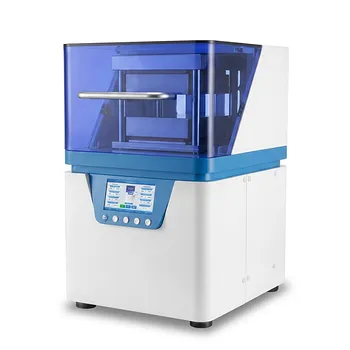
A hydraulic heat press is a versatile machine that merges high-force hydraulic compression with precise thermal energy to bond, shape, or test materials.
By applying heat and pressure simultaneously, this equipment is essential for tasks ranging from laminating industrial composites to preparing sample pellets in scientific laboratories.
The Core Insight A hydraulic heat press is not merely a crushing tool; it is a fusion device. By leveraging Pascal’s principle for force amplification and adding controlled heat, it allows you to manipulate material properties—melting solder, curing resins, or compacting powders—far more effectively than pressure alone.
The Engineering Principles
The Hydraulic Foundation
The mechanism relies on Pascal’s Law, which states that pressure exerted on a confined fluid is transmitted equally in all directions.
The press utilizes a pump to apply a modest force to a small piston. This pressure moves through an oil-filled cylinder to a larger piston (the ram), multiplying the input force significantly to generate immense compressive power.
The Thermal Integration
Unlike a standard shop press, a hydraulic heat press includes heated platens (plates).
These platens allow the operator to raise the temperature of the material while it is under pressure. This combination is critical for processes that require materials to flow, cure, or fuse, such as melting solder or setting thermoplastics.
Primary Applications
Industrial Manufacturing
In manufacturing settings, these presses are the standard for bonding multi-layered components.
They are frequently used for laminating composite materials, where layers must be compressed and heated to cure into a single, strong structure. They also handle reflow soldering, where heat melts solder-coated parts to form robust electrical or mechanical connections.
Laboratory and Research
In scientific environments, precision is more valuable than sheer tonnage.
Researchers use hydraulic heat presses to compress powders into solid pellets for spectral analysis. They are also used for material testing, subjecting new compounds to extreme heat and pressure conditions to evaluate their durability and failure points.
Understanding the Trade-offs
Operational Speed vs. Force
Hydraulic systems are generally slower than mechanical "flywheel" presses.
While they generate smoother and higher controllable force, the cycle time (the time to press and release) is longer. This makes them ideal for precision bonding but potentially less efficient for high-speed, high-volume punch applications.
Maintenance Requirements
The addition of hydraulic fluid introduces maintenance complexity not found in electric or mechanical screw presses.
Operators must monitor for oil leaks, maintain seal integrity, and ensure the hydraulic fluid remains free of contaminants. Furthermore, the heating elements add another layer of potential failure that requires regular calibration to ensure temperature accuracy.
Making the Right Choice for Your Goal
If you are evaluating a hydraulic heat press for your operations, consider your specific end-goal:
- If your primary focus is Material Research: Prioritize a unit with high-precision programmable temperature controls and accurate pressure gauges to ensure repeatability in creating test pellets.
- If your primary focus is Manufacturing Assembly: Look for an automatic press with rapid cycle times and larger platen areas to maximize throughput for laminating or soldering tasks.
The hydraulic heat press is the definitive tool when your project demands the transformative power of heat backed by the unyielding force of hydraulics.
Summary Table:
| Feature | Hydraulic Heat Press Detail |
|---|---|
| Core Principle | Pascal’s Law (Force Amplification) + Thermal Transfer |
| Primary Components | Hydraulic Ram, Pump, and Heated Platens |
| Temperature Role | Facilitates material flow, curing, and fusion (e.g., resins, solder) |
| Pressure Role | High-force compression for bonding or pelletizing powders |
| Key Applications | Composite lamination, reflow soldering, and XRD/XRF pellet prep |
| Maintenance | Requires oil level monitoring, seal checks, and heater calibration |
Elevate Your Laboratory Precision with KINTEK
Are you looking to optimize your material research or manufacturing process? KINTEK specializes in comprehensive laboratory pressing solutions tailored to your specific needs. From manual and automatic models to heated, multifunctional, and glovebox-compatible presses—including cold and warm isostatic systems—we provide the tools essential for advanced battery research and material science.
Our value to you:
- Versatility: Solutions for everything from simple pellet pressing to complex thermal bonding.
- Expertise: High-precision temperature and pressure control for repeatable results.
- Support: Specialized equipment designed for sensitive environments like gloveboxes.
Ready to find the perfect press for your application? Contact our technical experts today and let KINTEK empower your next breakthrough!
Related Products
- Automatic Hydraulic Heat Press Machine with Multi Stage Programmable Control and Integrated Water Cooling Plate Size 180x180mm
- Automatic Hydraulic Hot Press with Large Plate and Precision Temperature Control for Advanced Material Sample Preparation and Industrial Research
- Heated Hydraulic Press Machine with Heated Plates for Vacuum Box Laboratory Hot Press
- Automatic Heated Hydraulic Lab Press with Programmable Touch Screen Controls and Precision Temperature Regulation
- Automatic High Temperature Heated Hydraulic Press Machine with Heated Plates for Lab
People Also Ask
- How does a laboratory hydraulic heat press facilitate the molding of cellulose composite specimens? Precision Molding
- How is a hydraulic heat press used for sample preparation? Achieve Uniform, Void-Free Samples for Lab Analysis
- What is the role of a hydraulic heat press in material testing? Unlock Superior Data for Research & QC
- What are the industrial applications of a hydraulic heat press? Powering Lamination, Bonding, and R&D Efficiency
- What is a hydraulic hot press machine? Master Material Bonding with Precise Thermal Pressure Control