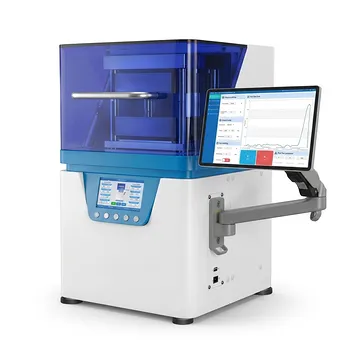
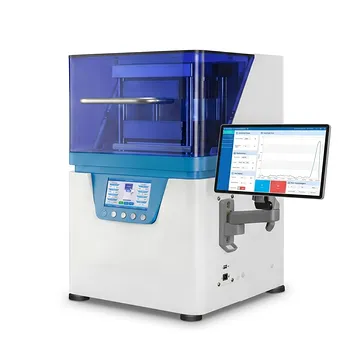
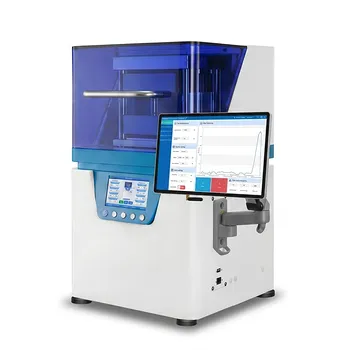
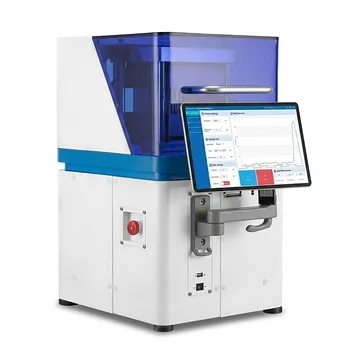
The laboratory hydraulic press serves as the primary instrument for powder consolidation. It transforms loose fly ash ceramic mixtures into solid "green bodies" by applying precise uniaxial pressure within a specialized mold. This process establishes the initial geometry, mechanical integrity, and particle packing required for all subsequent processing and sintering stages.
The laboratory hydraulic press bridges the gap between raw powder and a structured ceramic precursor by physically bonding particles under static pressure. This step is essential for creating a "green body" that possesses enough handling strength and density to undergo further densification.
Consolidating Loose Powder into Structured Solids
Achieving Geometric Definition
The press utilizes a die or mold, such as a circular steel mold, to shape the fly ash powder into a specific form, like an 18 mm disc. By applying uniaxial pressure, the press forces the loose, bulk material to take on the precise dimensions of the internal mold cavity.
Establishing Mechanical Integrity
The mechanical load, which often ranges from a 3-ton load to specific pressures like 20 MPa, causes individual particles to rearrange and bond physically. This creates a green body with sufficient handling strength, allowing researchers to move the sample without it crumbling.
Enhancing Microstructural Uniformity
Particle Rearrangement and Packing
As the press applies vertical force, the powder particles shift to fill the voids between them, achieving an initial close packing. This arrangement is the physical foundation of the ceramic, ensuring that the particles are in direct contact before high-temperature treatment.
Elimination of Trapped Air
One of the most critical roles of the hydraulic press is the preliminary exclusion of air trapped between powder particles. Removing this air during the initial forming stage helps prevent internal voids or micro-cracks that could lead to structural failure during sintering.
Preparing for Advanced Densification
Foundation for Cold Isostatic Pressing (CIP)
In many workflows, the hydraulic press acts as a pre-molding tool that prepares the sample for Cold Isostatic Pressing. It creates a stable structural foundation that can then be subjected to even higher, more uniform pressures to achieve maximum density.
Minimizing Sintering Defects
By ensuring a tight particle arrangement and precise pressure control, the hydraulic press minimizes the risk of internal defects. This laying of a clean foundation is necessary for creating a defect-free, dense ceramic structure during the final high-temperature sintering phase.
Understanding the Trade-offs
Pressure Gradients and Friction
Because a laboratory press applies uniaxial (one-direction) pressure, friction between the powder and the mold walls can cause uneven density. This often results in the center of the green body being denser than the edges, which may lead to slight warping during sintering.
Geometric and Volume Limitations
The use of steel dies limits the green body to relatively simple shapes, such as discs or pellets. Furthermore, if the powder is not mixed with a binder like PVA solution, the green body may remain too fragile for complex handling, regardless of the pressure applied.
Making the Right Choice for Your Goal
How to Apply This to Your Project
- If your primary focus is initial shape formation: Use a specialized steel mold with the hydraulic press to achieve consistent geometric dimensions across multiple samples.
- If your primary focus is maximum density: Use the hydraulic press as a pre-forming step at lower pressures (like 5-20 MPa) before transferring the green body to a Cold Isostatic Press for final compaction.
- If your primary focus is structural integrity: Ensure you include a binder in your powder mix and maintain a specific dwell time under pressure to allow particles to bond fully.
The laboratory hydraulic press is the essential first step in ceramic fabrication, converting raw fly ash into a viable structural precursor through controlled mechanical compaction.
Summary Table:
| Function | Impact on Green Body | Key Parameter |
|---|---|---|
| Powder Consolidation | Transforms loose powder into a solid structure | Pressure (MPa/Tons) |
| Geometric Shaping | Defines precise dimensions (e.g., 18mm discs) | Die/Mold Design |
| Air Elimination | Removes trapped air to prevent sintering cracks | Dwell Time |
| Microstructure Alignment | Ensures uniform particle packing for densification | Uniaxial Loading |
| Isostatic Pre-forming | Prepares stable base for Cold Isostatic Pressing | Initial Density |
Elevate your material science and battery research with KINTEK’s comprehensive laboratory pressing solutions. Whether you need to form fly ash ceramic green bodies or develop advanced energy storage materials, we offer a full range of manual, automatic, heated, multifunctional, and glovebox-compatible models, as well as high-performance cold and warm isostatic presses. Ensure maximum density and structural integrity for your samples today—contact KINTEK now to find your ideal pressing solution!
References
- Nur Azureen Alwi Kutty, Sani Garba. Influence on the Phase Formation and Strength of Porcelain by Partial Substitution of Fly Ash Compositions. DOI: 10.14419/ijet.v7i4.30.22281
This article is also based on technical information from Kintek Solution Knowledge Base .
Related Products
- Laboratory Hydraulic Press Lab Pellet Press Machine for Glove Box
- Laboratory Hydraulic Press 2T Lab Pellet Press for KBR FTIR
- 24T 30T 60T Heated Hydraulic Lab Press Machine with Hot Plates for Laboratory
- Laboratory Hydraulic Press Lab Pellet Press Button Battery Press
- Laboratory Hydraulic Pellet Press for XRF KBR FTIR Lab Press
People Also Ask
- How does a laboratory hydraulic press contribute to the preparation of Li3-3xScxSb samples? Optimize Ionic Conductivity
- What is the function of a laboratory hydraulic press in FT-IR of curcumin-coated MWCNTs? Achieve Optical Clarity.
- Why is a laboratory hydraulic press required for compression molding boron-siloxane? Solve High-Loading Density Challenges
- What role does a laboratory hydraulic press play in reaction pellets? Optimizing Lunar Soil and Metal Fuel Density
- What role does a laboratory hydraulic press play in the preparation of piezoelectric ceramic discs for DC-PG? | KINTEK