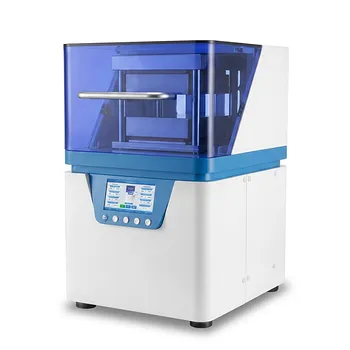
To create a KBr pellet using a hydraulic portable press, you must first prepare a homogenous mixture of your sample and potassium bromide (KBr) powder, load it into a pellet die, and secure the assembly in the press by tightening the top knob. Once secured, manually crank the hydraulic mechanism to apply pressure and maintain this force for several minutes to fuse the powder into a solid disc.
Successful pellet formation relies on the combination of correct sample preparation and sustained hydraulic force. By maintaining pressure on the die for a few minutes, you allow the KBr crystals to fuse cold-flow into a transparent matrix, ready for spectroscopic analysis.
The Step-by-Step Procedure
Preparing the Mixture
Begin by mixing your sample with KBr powder. The ideal ratio is typically 1-2% sample by weight to ensure the final pellet allows light transmission. Thoroughly grind and mix the powders to achieve complete homogeneity.
Loading the Die
Transfer the prepared powder mixture into the pellet die. Ensure the powder is leveled within the die to create a pellet of uniform thickness.
Securing the Assembly
Place the loaded die into the hydraulic portable press. It is critical to secure the pellet die by tightening the top knob effectively. This locks the anvil in place and ensures the hydraulic force is directed entirely into compressing the powder.
Applying Hydraulic Pressure
Actuate the press by cranking the handle to build up pressure. While portable presses vary, a force of approximately 8 tons is generally recommended for standard pellet formation.
The Dwell Time
Once the target pressure is reached, stop cranking but do not release the pressure immediately. You must wait for a couple of minutes. This "dwell time" is essential for the KBr to flow and fuse into a cohesive, transparent solid.
Factors Influencing Pellet Quality
The Role of Vacuum
To achieve a truly transparent pellet, air and moisture must be removed from the powder. If your equipment allows, apply a vacuum of several mm Hg to the die set before and during the pressing stage. This eliminates trapped air that can cause cloudiness or physical instability.
Sample Concentration
Adhering to the 1-2% sample ratio is not just a suggestion; it is an optical necessity. An over-concentrated pellet will result in "bottoming out" the detector, where the pellet is too opaque for the infrared beam to pass through.
Common Pitfalls and Trade-offs
Moisture Absorption
KBr is highly hygroscopic, meaning it absorbs water from the air rapidly. If you skip the vacuum step or work in a humid environment, your pellet may appear cloudy or show significant water bands in your spectrum.
Incomplete Fusion
Rushing the process is a common error. If you release the pressure immediately after cranking without waiting the required couple of minutes, the pellet may crumble or crack upon ejection. The time under pressure is as important as the pressure itself.
Making the Right Choice for Your Goal
When operating a portable press, your procedure should adjust based on the required data quality.
- If your primary focus is quick qualitative identification: Simply mix, load, tighten the knob, crank to pressure, and hold for two minutes; minor cloudiness will likely not affect basic fingerprinting.
- If your primary focus is publication-quality spectra: You must weigh the 1-2% ratio precisely and apply a vacuum to the die set to ensure maximum transparency and minimal water interference.
Systematic preparation and patience during the pressure hold time are the defining factors in producing a clear, usable KBr pellet.
Summary Table:
| Step | Action | Key Requirement |
|---|---|---|
| 1. Mix | Combine Sample + KBr | 1-2% sample concentration by weight |
| 2. Load | Transfer to Pellet Die | Ensure even leveling for uniform thickness |
| 3. Secure | Place in Press | Tighten top knob to lock anvil in place |
| 4. Press | Crank Hydraulic Handle | Apply ~8 tons of force |
| 5. Dwell | Maintain Pressure | Wait 2 minutes for cold-flow fusion |
Elevate Your Spectroscopic Analysis with KINTEK
Precision in sample preparation is the difference between a cloudy disc and a publication-quality spectrum. KINTEK specializes in comprehensive laboratory pressing solutions designed to meet the rigorous demands of battery research and material science.
Whether you need manual, automatic, heated, or multifunctional models, or specialized cold and warm isostatic presses, our equipment ensures consistent pressure and durability. Our glovebox-compatible presses provide the controlled environment necessary to eliminate moisture interference in your KBr pellets.
Ready to optimize your lab’s efficiency? Contact our experts today to find the perfect pressing solution for your research needs.
Related Products
- Automatic Hydraulic Hot Press with Large Plate and Precision Temperature Control for Advanced Material Sample Preparation and Industrial Research
- Automatic Hydraulic Heat Press Machine with Multi Stage Programmable Control and Integrated Water Cooling Plate Size 180x180mm
- Laboratory Hydraulic Press Lab Pellet Press Machine for Glove Box
- Laboratory Hydraulic Press 2T Lab Pellet Press for KBR FTIR
- Laboratory Hydraulic Pellet Press for XRF KBR FTIR Lab Press
People Also Ask
- What are the specific features and applications of hydraulic hot press machines? Precision Solutions for Modern Labs
- How does an automatic hydraulic press operate? Achieve Precision and Consistency in Lab Pelleting
- What are the advantages and common applications of an automatic hydraulic press? Elevate Your Lab's Precision
- What is the technical significance of setting a precise dwell time? Achieve Peak Material Density and Stability
- When is an automatic hydraulic press more suitable than a manual press? Scale Your Lab with Precision & Speed