
Applying high mechanical pressure (such as 300 MPa) is the primary method used to transform loose, resistive sulfide powder into a functional, conductive electrolyte layer. This pressure compacts the material to eliminate microscopic voids, dramatically lowers the resistance at the boundaries between particles, and creates the structural integrity required to support the negative electrode.
Core Insight: In solid-state batteries, there is no liquid to wet the materials and bridge gaps. High pressure acts as the physical binding agent, forcing solid particles into the intimate contact required for ions to "hop" efficiently from one grain to the next.
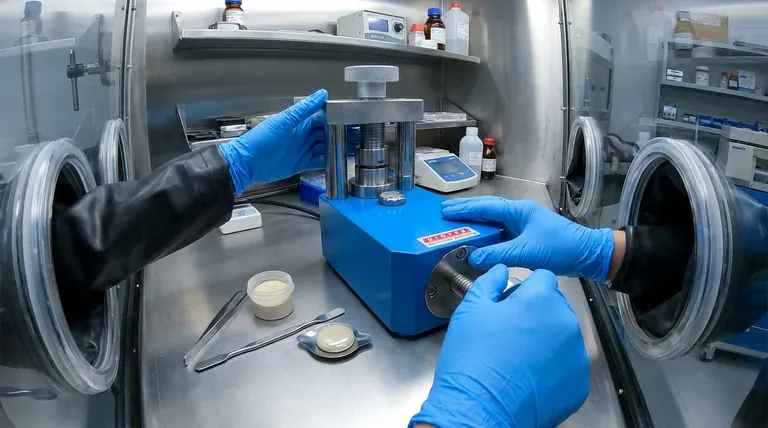
The Physics of Densification
Eliminating Voids
In its raw state, sulfide electrolyte powder is full of empty spaces (voids). These voids act as insulators, blocking the path of lithium ions. Applying 300 MPa of pressure physically crushes the particles together, effectively squeezing out these air pockets to maximize the volume of active material.
Reducing Grain Boundary Resistance
The point where two solid particles meet is known as a grain boundary. If this contact is loose, it creates high electrical resistance, acting as a bottleneck for performance. High-pressure cold pressing tightens these connections, ensuring that grain boundary resistance is minimized for rapid ion transport.
Achieving High Packing Density
Reference materials indicate that utilizing Cold Isostatic Pressing (CIP) leverages Pascal’s principle to apply hydrostatic pressure from all directions. This omnidirectional force results in a uniform internal microstructure and extremely high packing density, which outperforms simple top-down pressing.
Structural Integrity and Interface Formation
Creating a Stable Pellet
Beyond conductivity, the electrolyte must serve as a physical separator. High pressure consolidates the powder into a flat, crack-free pellet. This mechanical stability is vital to prevent short circuits and to handle the stresses of battery assembly.
The Electrode Interface
The quality of the electrolyte surface dictates how well the negative electrode will attach. By forming a dense, smooth pellet, you create an ideal low-impedance interface. This allows the negative electrode to sit flush against the electrolyte, facilitating efficient ion transfer between the anode and the separator.
Understanding the Trade-offs
Mechanical Stress vs. Integrity
While high pressure is essential for conductivity, it must be applied correctly to avoid damaging the material. The goal is to achieve a "solid-solid" interface that mimics the continuity of a single crystal as closely as possible without introducing stress fractures that could propagate during cycling.
Method Selection (Uniaxial vs. Isostatic)
Standard laboratory presses often apply uniaxial pressure (top-down), which can lead to density gradients—harder on top, softer in the middle. Using isostatic pressing (CIP) is often superior because it ensures every part of the pellet experiences the same 300 MPa force, resulting in a homogeneous material that sinters or cycles more reliably.
Making the Right Choice for Your Goal
To maximize the effectiveness of your assembly process, align your pressing strategy with your specific performance targets:
- If your primary focus is Ion Conductivity: Prioritize maximum densification to eliminate voids and reduce grain boundary resistance, ensuring the fastest possible lithium transport.
- If your primary focus is Cycle Life: Focus on the uniformity of the pressure (using CIP) to ensure a crack-free microstructure that can withstand repeated expansion and contraction.
- If your primary focus is Assembly Yield: Ensure the pressure is sufficient to form a mechanically robust, flat pellet that provides a stable substrate for the negative electrode application.
Ultimately, the pressure you apply is not just about compaction; it is about engineering a continuous path for energy to flow through a solid medium.
Summary Table:
| Goal | Recommended Pressing Strategy | Key Benefit |
|---|---|---|
| Maximize Ion Conductivity | High-pressure uniaxial or isostatic pressing | Eliminates voids, minimizes grain boundary resistance for fast ion transport |
| Maximize Cycle Life | Isostatic pressing (CIP) for uniform pressure | Creates a crack-free, homogeneous microstructure for long-term durability |
| Maximize Assembly Yield | Sufficient pressure for mechanical robustness | Forms a flat, stable pellet for reliable electrode integration |
Ready to engineer superior solid-state battery components? KINTEK's precision lab presses, including our automatic and isostatic presses, are engineered to deliver the exact, uniform high pressure (like 300 MPa) required to transform sulfide electrolytes like LGPS into highly conductive, dense layers. Achieve maximum ion conductivity and cycle life for your research and development. Contact our experts today to find the perfect press for your lab's needs!
Visual Guide

Related Products
- XRF KBR Plastic Ring Lab Powder Pellet Pressing Mold for FTIR
- Lab Round Bidirectional Press Mold
- Lab Polygon Press Mold
- Lab XRF Boric Acid Powder Pellet Pressing Mold for Laboratory Use
- Lab Infrared Press Mold for Laboratory Applications
People Also Ask
- What is the purpose of making KBr pellets for FTIR? Achieve Precise Molecular Analysis with Solid Samples
- What factors should be considered when choosing a lab press for XRF pellet preparation? Ensure Accurate and Consistent Results
- Why are pellets used in XRF analysis, and what is their limitation? Boost Accuracy and Speed in Your Lab
- How are pellets prepared for XRF analysis and what is a potential drawback? Master XRF Sample Prep and Accuracy
- What are the different types of XRF pellet preparation methods available? Manual, Hydraulic, and Automated Presses Explained











