
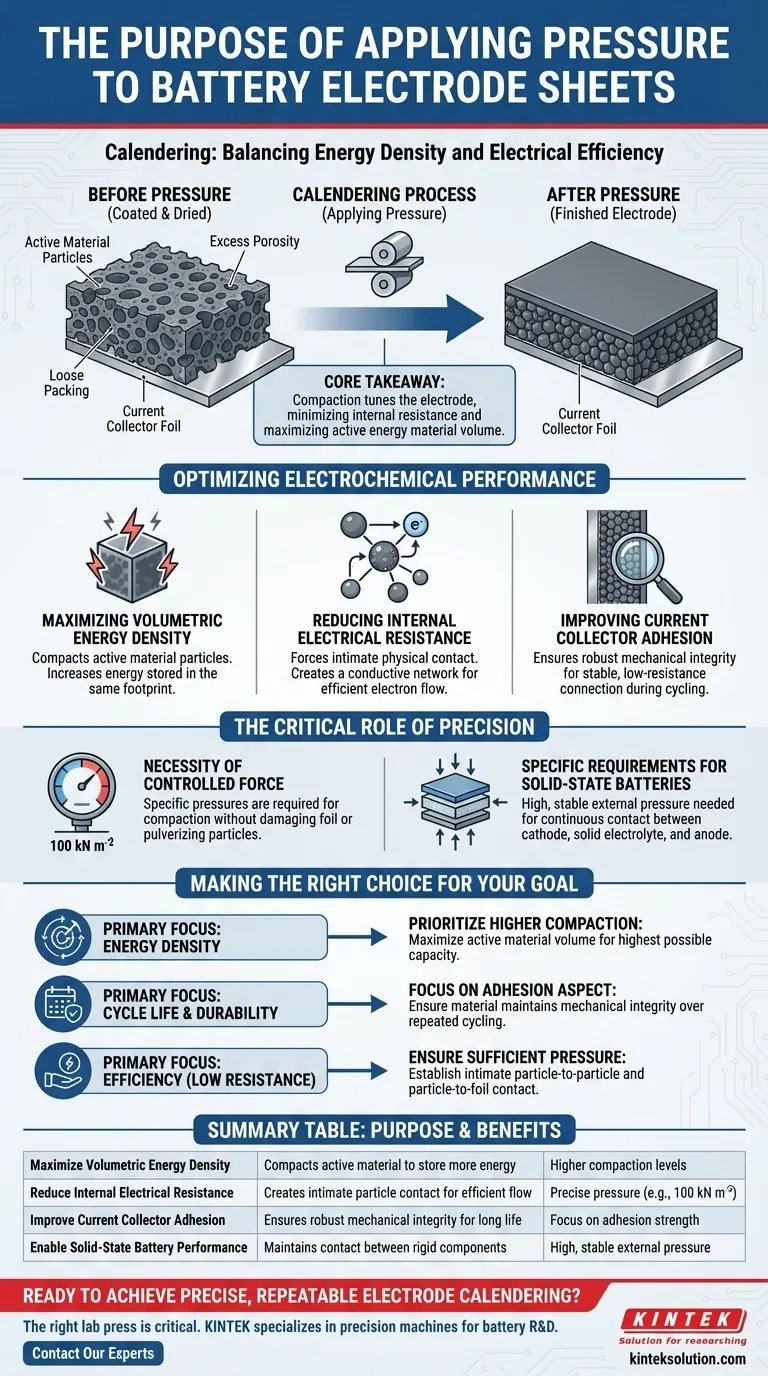
Applying pressure to battery electrode sheets, a process widely known as calendering, is the definitive step for transforming a coated foil into a functional, high-performance electrode. Its primary purpose is to mechanically compact the active material particles, which simultaneously increases the electrode's volumetric energy density and establishes the low-resistance electrical connections necessary for efficient electron transport.
Core Takeaway The application of pressure is not merely about flattening the material; it is a tuning process that balances energy density with electrical efficiency. By compressing the electrode, you minimize internal resistance and maximize the amount of active energy material that fits within a specific volume.
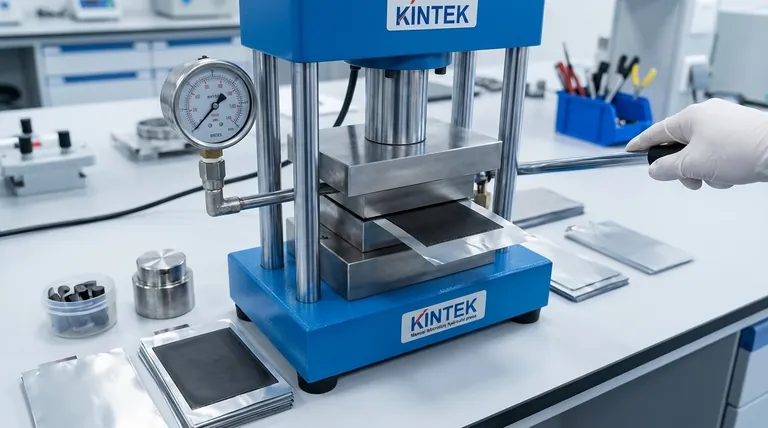
Optimizing Electrochemical Performance
The transition from a dried, coated sheet to a finished electrode requires precise mechanical alteration. The application of pressure serves three distinct engineering goals that directly influence the battery's final specifications.
Maximizing Volumetric Energy Density
The coating and drying stages often leave the electrode layer with excess porosity and loose packing.
Applying pressure compacts the active material particles closer together.
This compaction significantly increases the volumetric energy density, allowing more energy to be stored in the same physical footprint.
Reducing Internal Electrical Resistance
For a battery to operate efficiently, electrons must move freely through the electrode material.
Pressure forces the active particles into intimate physical contact with one another.
This reduces the contact resistance between particles, creating a more conductive network for electron flow.
Improving Current Collector Adhesion
The interface between the active material and the metal foil (current collector) is a common failure point.
Calendering ensures robust adhesion between the material layer and the copper or aluminum foil.
This mechanical integrity is vital for maintaining a stable, low-resistance connection throughout the expansion and contraction cycles of battery usage.
The Critical Role of Precision
While the benefits of pressure are clear, the application must be exact to yield results.
The Necessity of Controlled Force
References indicate that specific pressures, such as 100 kN m⁻², are often targeted to achieve optimal results.
This precision is required to compact graphite or other active materials without damaging the underlying foil or pulverizing the particles.
Specific Requirements for Solid-State Batteries
The rules of pressure become even more stringent when dealing with all-solid-state batteries.
Due to the rigid nature of solid-solid interfaces, stable and high external pressure is required not just during manufacturing, but often during testing.
This pressure ensures continuous contact between the cathode, solid-state electrolyte, and anode, which is critical for minimizing interfacial resistance and facilitating smooth lithium-ion transport.
Making the Right Choice for Your Goal
The amount of pressure applied should be dictated by the specific performance metrics you are trying to prioritize for your cell design.
- If your primary focus is Energy Density: Prioritize higher compaction to maximize the volume of active material, ensuring the highest possible capacity per unit of volume.
- If your primary focus is Cycle Life and Durability: Focus on the adhesion aspect of calendering to ensure the material maintains mechanical integrity with the current collector over repeated cycling.
- If your primary focus is Efficiency (Low Resistance): Ensure sufficient pressure is applied to establish intimate particle-to-particle and particle-to-foil contact, minimizing internal resistance (IR).
Ultimately, the correct application of pressure transforms a raw chemical coating into a highly integrated, electrically efficient component.
Summary Table:
| Purpose of Pressure | Key Benefit | Key Metric/Requirement |
|---|---|---|
| Maximize Volumetric Energy Density | Compacts active material to store more energy in the same volume. | Higher compaction levels. |
| Reduce Internal Electrical Resistance | Creates intimate particle contact for efficient electron flow. | Precise pressure (e.g., 100 kN m⁻²). |
| Improve Current Collector Adhesion | Ensures robust mechanical integrity for long cycle life. | Focus on adhesion strength. |
| Enable Solid-State Battery Performance | Maintains contact between rigid solid components. | High, stable external pressure. |
Ready to achieve precise, repeatable electrode calendering for your battery R&D or production? The right lab press is critical for optimizing energy density, reducing resistance, and ensuring adhesion. KINTEK specializes in lab press machines (including automatic, isostatic, and heated lab presses) designed to meet the exacting demands of battery research and development. Contact us today to discuss how our precision equipment can enhance your electrode manufacturing process and help you build better batteries.
Visual Guide
Related Products
- Automatic Lab Cold Isostatic Pressing CIP Machine
- Automatic High Temperature Heated Hydraulic Press Machine with Heated Plates for Lab
- Electric Lab Cold Isostatic Press CIP Machine
- Electric Split Lab Cold Isostatic Pressing CIP Machine
- Automatic Laboratory Hydraulic Press Lab Pellet Press Machine
People Also Ask
- What are the key features of automated laboratory Cold Isostatic Press (CIP) systems? Achieve Precise, High-Pressure Powder Consolidation
- Why is an Isostatic Press (CIP) Necessary After Uniaxial Pressing? Achieve Transparency in Nd:Y2O3 Ceramics
- What is the primary function of a Cold Isostatic Press (CIP) in NASICON preparation? Achieve 96% Theoretical Density
- How does a Cold Isostatic Press (CIP) facilitate the preparation of CaO-doped silicon carbide (SiC) green bodies?
- How does a Cold Isostatic Press (CIP) increase Bi-2223/Ag current density? Boost Superconductivity with Uniform Pressure















