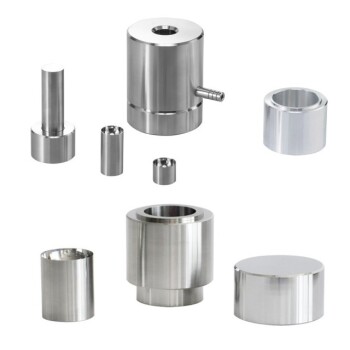
The primary purpose of placing a micro-perforated fine sieve at the bottom of the mold is to maximize ventilation during the oven-drying process. This setup allows moisture to escape efficiently from the base of the cassava particle mass, rather than becoming trapped against a solid surface. By facilitating airflow from beneath, the sieve significantly accelerates the dehydration rate of the material.
By enabling multi-directional evaporation, the sieve ensures the cassava particles dry uniformly. This critical step activates the cassava's natural starches, allowing for strong physical adhesion without the need for external chemical adhesives.
Optimizing the Dehydration Dynamics
Enhancing Moisture Release
In a traditional solid-bottom mold, moisture can only evaporate from the top surface. This often leads to a saturated bottom layer that dries much slower than the rest of the sample.
The micro-perforated sieve eliminates this bottleneck. It provides a continuous escape route for water vapor at the base, ensuring that moisture is removed from the entire mass simultaneously.
Accelerating the Drying Cycle
Speed is often a critical factor in initial molding experiments. By increasing the surface area exposed to heat and airflow, the sieve drastically reduces the time required for the oven-drying phase.
This efficiency prevents the material from "stewing" in its own moisture, which can alter the chemical properties of the cassava.
Achieving Structural Integrity
Leveraging Natural Starch Adhesion
The ultimate goal of these experiments is often to test the material's self-binding capabilities. Cassava possesses high starch content that acts as a natural binder when processed correctly.
Uniform drying is the key to activating this binding mechanism. The sieve ensures that the starch gelatinizes and sets evenly throughout the particle mass, creating a cohesive solid without the addition of synthetic glues.
Eliminating Internal Defects
When moisture is trapped inside a molding mass, it expands as it heats. This internal pressure can create voids, cracks, or warping in the final product.
The sieve mitigates this risk by preventing internal moisture accumulation. The result is a dimensionally stable sample with fewer structural weaknesses.
Understanding the Trade-offs
The Importance of Mesh Size
While the sieve is beneficial, the "micro-perforated" aspect is specific and intentional.
If the mesh is too coarse, fine cassava particles will fall through, compromising the density of the mold. If the mesh is too fine, it may clog with starch paste, effectively sealing the bottom and negating the ventilation benefits.
Handling Considerations
Using a sieve bottom changes the mechanical stability of the mold during transport.
Care must be taken when moving the mold into the oven to avoid shifting the wet particle mass. Additionally, demolding requires a gentle touch to separate the dried base from the fine mesh without tearing the material.
Making the Right Choice for Your Experiment
To get the most out of your cassava molding trials, consider your specific objectives:
- If your primary focus is Material Purity: Rely on the sieve method to achieve binding via natural starches, eliminating variables introduced by chemical adhesives.
- If your primary focus is Structural Homogeneity: Ensure the sieve is completely unblocked before filling to prevent moisture gradients that lead to warping or cracking.
Proper ventilation at the base is the single most effective variable for ensuring a consistent, high-quality natural binder in cassava molding.
Summary Table:
| Feature | Benefit in Cassava Molding |
|---|---|
| Micro-Perforations | Maximizes bottom-up ventilation and moisture escape |
| Enhanced Airflow | Accelerates drying cycle and prevents material "stewing" |
| Starch Activation | Enables uniform starch gelatinization for natural binding |
| Vapor Release | Reduces internal pressure to eliminate voids and cracks |
| Material Purity | Removes the need for external chemical adhesives |
Precision Solutions for Your Molding Research
Achieve superior structural integrity in your material science experiments with KINTEK's specialized equipment. KINTEK specializes in comprehensive laboratory pressing solutions, offering manual, automatic, heated, multifunctional, and glovebox-compatible models, as well as cold and warm isostatic presses widely applied in battery research and advanced material development.
Whether you are refining cassava starch binders or developing the next generation of battery components, our technical experts are ready to help you find the perfect press for your specific research needs. Contact us today to optimize your lab's performance!
References
- Ana Maria Denardi, Anderson Rodrigo Piccini. Literature review and preliminary analysis of cassava by-products potential use in particleboards. DOI: 10.15376/biores.19.1.1652-1665
This article is also based on technical information from Kintek Solution Knowledge Base .
Related Products
- Lab Ring Press Mold for Sample Preparation
- Lab Cylindrical Press Mold with Scale
- Lab Polygon Press Mold
- Lab Round Bidirectional Press Mold
- XRF KBR Plastic Ring Lab Powder Pellet Pressing Mold for FTIR
People Also Ask
- What is the purpose of incorporating cartridge heaters into a lab press mold for MLCC block compression? Optimize Results
- What is the role of a laboratory press in COF electrolyte prep? Achieving High-Performance Pellet Densification
- Why is precise cooling management of the lab press mold necessary? Protect Core Integrity in Thermoforming
- What is the function of a pressing tool in thermoplastic panels? Master Precision Shaping & Fusion Bonding
- What impact does a sample preparation press have on testing results when researching MXene as an electrolyte additive?