
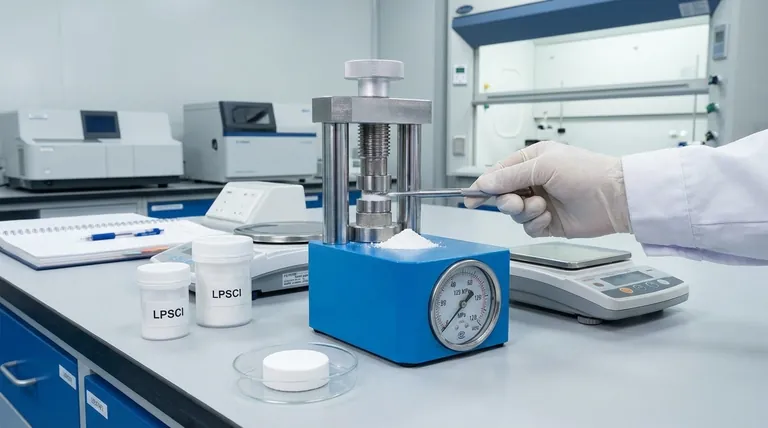
The primary purpose of pre-pressing LPSCl solid electrolyte powder at 125 MPa is to densify the loose powder into a mechanically stable separator layer. This step is essential to eliminate internal voids, which act as insulators, and to establish a continuous ion conduction path.
By applying this precise pressure, you transform the powder into a flat, dense substrate. This pellet provides the necessary structural foundation for coating the subsequent anode layer and ensures the battery has low internal resistance.
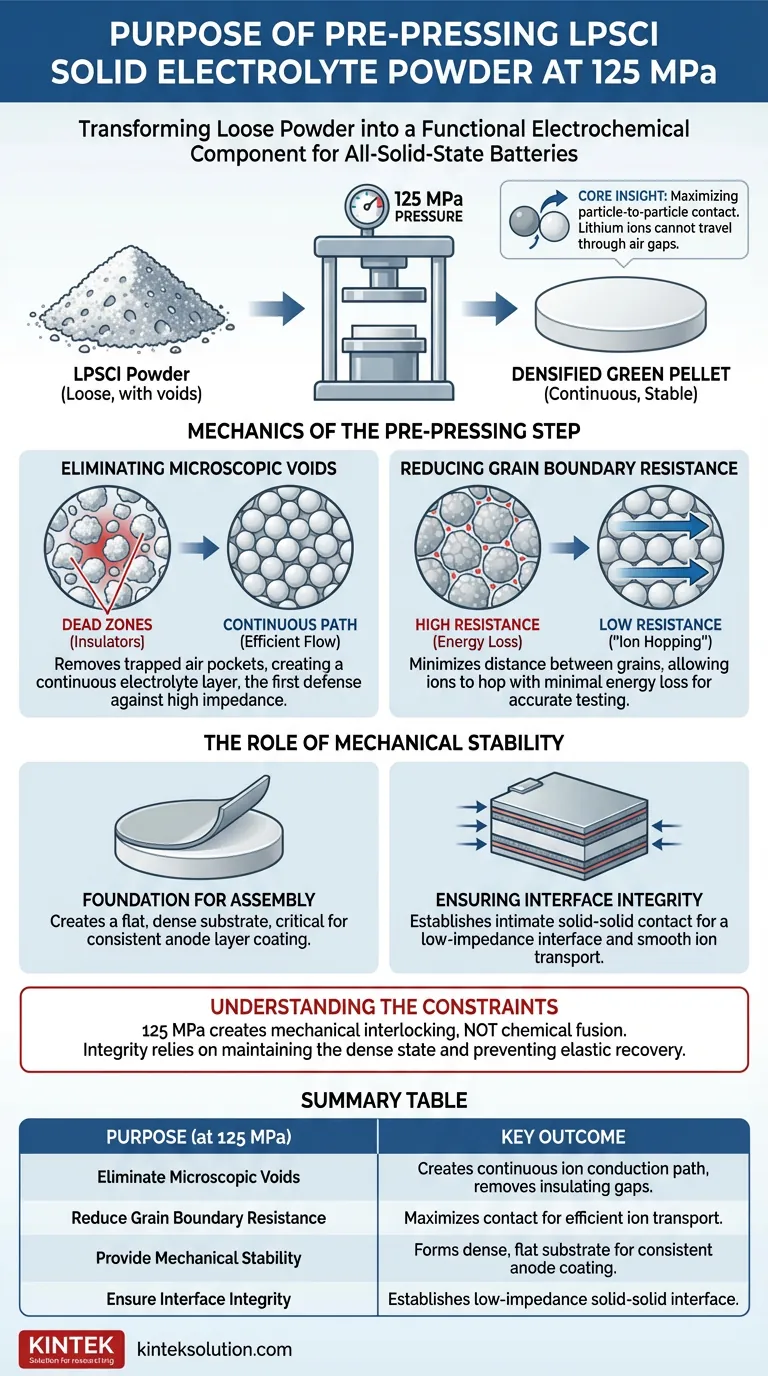
Core Insight: In all-solid-state batteries, lithium ions cannot travel through air gaps. The pre-pressing step is not merely about shaping the material; it is about maximizing particle-to-particle contact to reduce grain boundary resistance and ensure the electrochemical viability of the cell.
Mechanics of the Pre-Pressing Step
Eliminating Microscopic Voids
The most immediate function of applying 125 MPa of pressure is the removal of air pockets trapped between the LPSCl particles.
In a solid-state system, any void represents a "dead zone" where ions cannot flow. By compacting the material, you ensure the electrolyte layer is continuous and uniform. This is the first defense against high impedance in the final cell.
Reducing Grain Boundary Resistance
Beyond simple void removal, high-pressure compaction minimizes the distance between individual electrolyte grains.
References indicate that cold-pressing significantly reduces grain boundary resistance. This tight packing allows ions to "hop" from particle to particle with minimal energy loss. This ensures that subsequent electrochemical tests reflect the material's intrinsic capabilities rather than manufacturing defects.
The Role of Mechanical Stability
Creating a Foundation for Assembly
The electrolyte layer in an all-solid-state battery often acts as the physical substrate for other components.
Pre-pressing creates a "green pellet"—a solid disk that is robust enough to handle the next stage of assembly. Specifically, it provides a flat, dense surface required for the effective coating of the anode layer. Without this stable base, applying electrode materials would be inconsistent and mechanically weak.
Ensuring Interface Integrity
The performance of a solid-state battery is dictated by the quality of its solid-solid interfaces.
Because the internal components are rigid, they do not "wet" surfaces like liquid electrolytes. The pre-pressing step establishes intimate physical contact early in the assembly process. This is a prerequisite for a low-impedance interface, allowing for smooth lithium-ion transport across the separator and into the electrodes.
Understanding the Constraints
While 125 MPa is a specific target for densification, it is vital to understand the limitations of cold pressing.
It creates mechanical interlocking, not fusion. Unlike high-temperature sintering, cold pressing relies on the deformation and packing of particles. While it significantly reduces voids, it does not chemically fuse the particles.
Therefore, the mechanical integrity of the pellet relies entirely on maintaining this dense state. If the pressure during assembly is inconsistent or released prematurely before the cell is constrained, the elastic recovery of the particles could re-introduce voids, negating the benefits of the pre-press.
Optimizing Your Assembly Protocol
To ensure your LPSCl electrolyte functions correctly, align your pressing strategy with your specific experimental goals:
- If your primary focus is minimizing internal resistance: Ensure the pressure is applied uniformly to eliminate all voids, as these are the primary source of grain boundary impedance.
- If your primary focus is fabrication capability: Prioritize the flatness and density of the pellet to serve as a reliable substrate for consistent anode coating.
The pre-pressing step is the defining moment where your raw material becomes a functional electrochemical component.
Summary Table:
| Purpose of Pre-Pressing at 125 MPa | Key Outcome |
|---|---|
| Eliminate Microscopic Voids | Creates a continuous ion conduction path, removing insulating air gaps. |
| Reduce Grain Boundary Resistance | Maximizes particle-to-particle contact for efficient ion transport. |
| Provide Mechanical Stability | Forms a dense, flat substrate for consistent anode layer coating. |
| Ensure Interface Integrity | Establishes intimate contact for a low-impedance solid-solid interface. |
Ready to perfect your solid-state battery assembly?
The precise pre-pressing step is fundamental to your research success. KINTEK specializes in laboratory press machines, including automatic and heated lab presses, designed to deliver the accurate and uniform pressure control required for reproducible battery fabrication.
Let our expertise in lab press technology help you achieve dense, low-resistance electrolyte layers. Contact our team today to discuss how our presses can enhance your protocol and accelerate your development of high-performance all-solid-state batteries.
Visual Guide
References
- Lammi Terefe Kitaba, Bing‐Joe Hwang. Overcoming Chemo-Mechanical Instability at Silicon-Solid Electrolyte Interfaces in Solid-State Batteries. DOI: 10.1021/acsami.5c11621
This article is also based on technical information from Kintek Solution Knowledge Base .
Related Products
- Lab Polygon Press Mold
- Warm Isostatic Press for Solid State Battery Research Warm Isostatic Press
- Lab Round Bidirectional Press Mold
- Cylindrical Lab Electric Heating Press Mold for Laboratory Use
- Assemble Lab Cylindrical Press Mold for Laboratory Use
People Also Ask
- What is the purpose of incorporating cartridge heaters into a lab press mold for MLCC block compression? Optimize Results
- How do the design and geometric precision of pressing molds and mandrels affect the quality of PTFE composite samples?
- What role do precision positioning and pressure molds play in single-lap joints? Ensure 100% Data Integrity
- What are the requirements for pressing molds when using SSCG? Key Materials for Complex Single Crystal Production
- How do industrial-grade pressure molds affect zinc metal pouch cells? Maximize Energy Density & Performance












