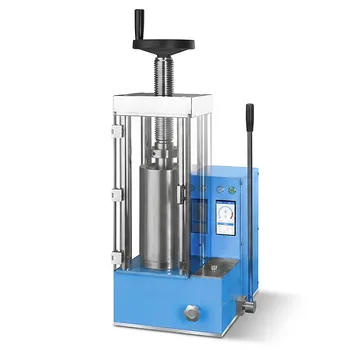
Static pre-pressing via a laboratory press is a critical preparatory step for Magnetic Pulse Compaction (MPC) that transforms loose nanopowder into a semi-solid "green" compact. It functions by applying a controlled static load to compact loose particles to approximately 40% of their theoretical density. This initial densification eliminates large voids and provides the structural stability required for the material to withstand and respond effectively to the subsequent high-speed magnetic pulse.
The laboratory press serves as a foundational tool to establish initial density and geometric integrity. This ensures that the high-energy Magnetic Pulse Compaction process can achieve maximum final density without structural failure, trapped air pockets, or uneven consolidation.
Bridging the Gap Between Loose Powder and Bulk Material
Establishing Initial Green Density
Loose nanopowders naturally contain significant air gaps and minimal particle-to-particle contact. The laboratory press forces these particles together until they reach a threshold—typically 40% of their theoretical density—where the material begins to behave as a single, cohesive entity.
Ensuring Geometric Integrity
MPC involves extreme, high-velocity forces that can easily deform or shatter poorly prepared samples. Pre-pressing creates a stable, fixed shape (the "green body") that prevents the material from shifting or collapsing unevenly when the intense magnetic pulse is applied.
Eliminating Interstitial Voids
By reducing the volume of pores between particles, the static press ensures that the subsequent compaction energy is spent on true densification. Without this step, the energy of the magnetic pulse would be wasted on simply closing large, unnecessary gaps rather than achieving near-theoretical density.
Technical Advantages of the Pre-Pressing Stage
Optimized Energy Propagation
Similar to shock consolidation processes, a denser starting material allows energy waves to propagate more uniformly through the sample. This uniformity is essential for avoiding macro-cracks and ensuring that the final bulk material has consistent properties throughout its volume.
Removal of Entrapped Air
Static pressing slowly squeezes out air trapped between nanoparticles, which is vital for material purity and strength. If air remains during the high-speed MPC process, it can become compressed and pressurized, leading to internal defects or "spring-back" cracks once the pressure is released.
Improved Particle Contact
Increasing the physical contact points between particles during the static phase prepares the material for better bonding. In processes like sintering or electrical compaction, this contact is necessary for thermal or electrical conductivity; in MPC, it ensures the mechanical impact is distributed evenly across the particle interfaces.
Understanding the Trade-offs and Pitfalls
The Risk of Excessive Pre-Pressure
Applying too much pressure during the laboratory press stage can be counterproductive. If the green density is too high (e.g., approaching the limits of the material's plasticity), particles may interlock too rigidly, preventing them from redistributing and densifying further during the magnetic pulse.
Uniformity vs. Peak Density
A common mistake is focusing solely on reaching a specific density number while ignoring distribution. If the laboratory press applies pressure unevenly, the resulting green body will have density gradients that the MPC process may exacerbate, leading to warped or structurally weak final parts.
Tooling and Friction Issues
Nanopowders often exhibit high friction against the walls of the press mold. Without proper lubrication or controlled pressure application, the laboratory press can produce a sample that is dense on the outside but loose in the center, undermining the efficacy of the subsequent magnetic compaction.
How to Apply This to Your Project
Making the Right Choice for Your Goal
To achieve the best results with Magnetic Pulse Compaction, your pre-pressing strategy must be tailored to your specific material requirements:
- If your primary focus is maximizing final density: Use the laboratory press to reach the 40% theoretical density threshold to provide the most efficient starting point for the MPC pulse.
- If your primary focus is preventing macro-cracks: Ensure the pre-pressing stage is slow and steady to allow for the complete escape of entrapped air, which acts as a failure point under high-speed impact.
- If your primary focus is geometric precision: Focus on the precision of the mold within the laboratory press to ensure the green compact perfectly matches the dimensions of the MPC induction coil.
By mastering the static pre-pressing stage, you ensure that the high-speed dynamics of Magnetic Pulse Compaction are used to perfect the material rather than struggle against its initial inconsistencies.
Summary Table:
| Stage Property | Role of Laboratory Press | Impact on MPC Process |
|---|---|---|
| Densification | Reaches ~40% theoretical density | Maximizes final density efficiency |
| Structural Integrity | Forms a stable "green" compact | Prevents deformation under high-speed force |
| Air Management | Squeezes out interstitial air | Eliminates internal defects and cracks |
| Energy Efficiency | Reduces large particle voids | Ensures uniform shockwave propagation |
Elevate Your Material Research with KINTEK Precision
At KINTEK, we understand that a successful Magnetic Pulse Compaction process begins with the perfect pre-press. We specialize in comprehensive laboratory pressing solutions tailored for advanced applications such as battery research and powder metallurgy.
Our extensive range includes:
- Manual & Automatic Models for controlled loading.
- Heated & Multifunctional Presses for specialized material behavior.
- Glovebox-Compatible Systems for air-sensitive samples.
- Cold (CIP) & Warm Isostatic Presses (WIP) for superior density uniformity.
Ready to achieve near-theoretical density and flawless structural integrity? Contact our experts today to find the ideal pressing solution for your lab!
References
- А. В. Первиков, S. Yu. Tarasov. Structural, Mechanical, and Tribological Characterization of Magnetic Pulse Compacted Fe–Cu Bimetallic Particles Produced by Electric Explosion of Dissimilar Metal Wires. DOI: 10.3390/met9121287
This article is also based on technical information from Kintek Solution Knowledge Base .
Related Products
- Electric Isostatic Pressing Machine 40 Tons Automatic Laboratory Powder Compacting Press
- Lab Isostatic Pressing Molds for Isostatic Molding
- Cylindrical Lab Electric Heating Press Mold for Laboratory Use
- Assemble Square Lab Press Mold for Laboratory Use
- Laboratory Hydraulic Pellet Press for XRF KBR FTIR Lab Press
People Also Ask
- What are the key characteristics of the isostatic pressing process? Unlock Uniform Density and Complex Geometries
- Why is vacuum-sealed packaging necessary before isostatic pressing of CuPc thin films? Protect Integrity & Uniformity
- How is pressure applied to the material during isostatic pressing? Master Uniform Density and Complex Geometries
- How does pressure distribute during isostatic pressing of aluminum? Achieve Uniform Density for Your Lab Materials
- What are the applications of isostatic pressing in the automotive industry? Precision Manufacturing for High-Performance Parts