
The application of 380 MPa pressure is a critical densification strategy used to force silicon anode particles and solid electrolytes into an intimate, void-free union. In solid-state battery fabrication, this extreme mechanical force is the primary substitute for the wetting action of liquid electrolytes, ensuring that disparate solid particles fuse into a cohesive, conductive network capable of efficient ion transport.
In the context of all-solid-state batteries, physical contact dictates electrochemical performance. Applying high pressure is not merely a shaping process; it is a fundamental requirement to minimize interfacial impedance and establish the atomic-level connectivity necessary for the battery to function.
Achieving Intimate Solid-Solid Contact
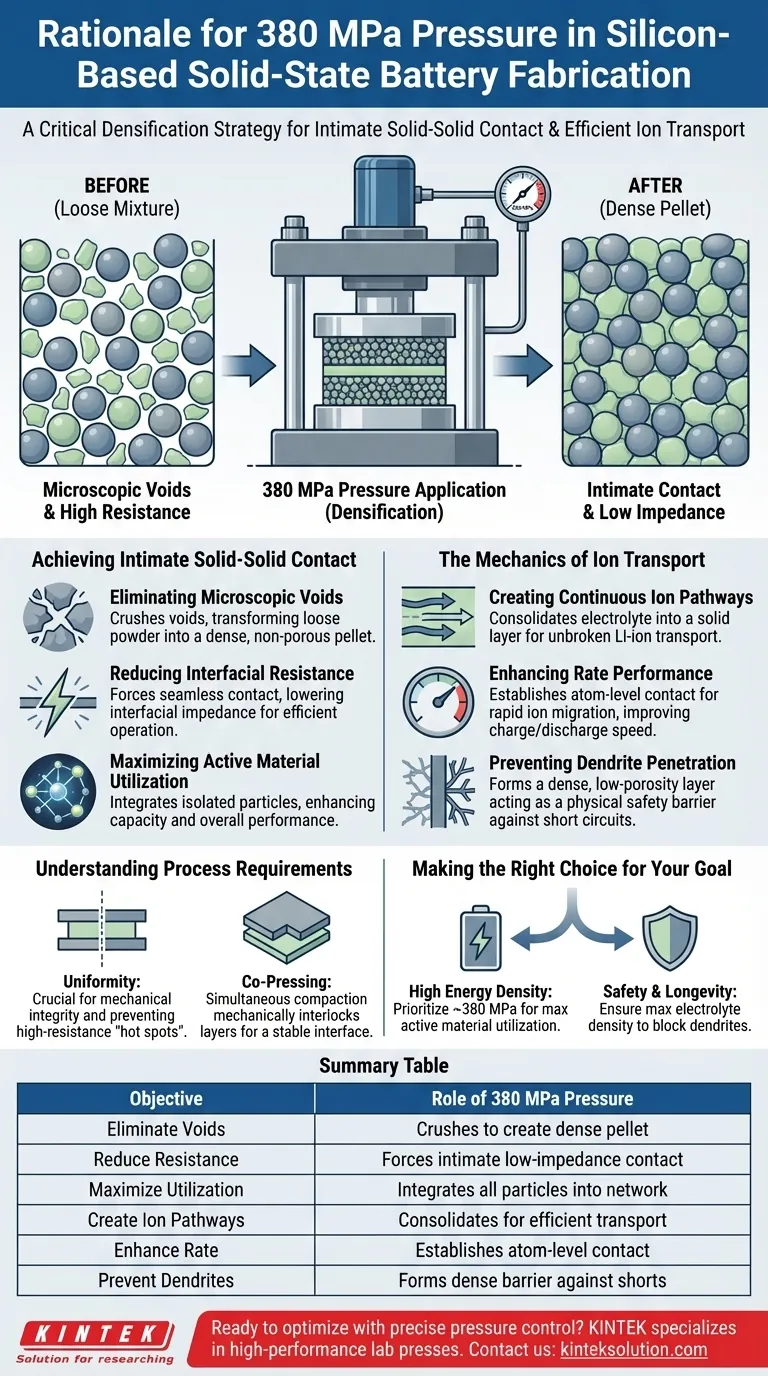
Eliminating Microscopic Voids
Unlike liquid electrolytes that naturally flow into porous structures, solid electrolytes are rigid. Without significant intervention, microscopic voids remain between the electrode and electrolyte layers.
Applying pressures such as 380 MPa (and up to 450 MPa) effectively crushes these voids. This transforms a loose mixture of powders into a dense, non-porous pellet.
Reducing Interfacial Resistance
The presence of gaps or voids acts as an insulator, drastically increasing the internal resistance of the battery.
By compacting the materials at high pressure, you force intimate physical contact between the active material and the electrolyte. This seamless contact is the only way to lower interfacial impedance to a level that allows the battery to operate efficiently.
Maximizing Active Material Utilization
For a silicon-based anode to contribute to capacity, every particle must be electrically and ionically connected to the system.
High-pressure densification ensures that isolated particles are integrated into the network. This maximizes the utilization of the active material, directly enhancing the battery's overall capacity and rate performance.
The Mechanics of Ion Transport
Creating Continuous Ion Pathways
Lithium ions require a continuous material "highway" to move between the anode and cathode.
Pressure application consolidates the electrolyte powder (such as Li7P3S11) into a continuous solid layer. This creates unbroken pathways for lithium-ion transport, which is essential for high ionic conductivity.
Enhancing Rate Performance
The speed at which a battery can charge or discharge is limited by how quickly ions can traverse the interface between materials.
By creating an atom-level contact through high-pressure co-pressing, you establish a low-resistance interface. This allows for rapid ion migration, significantly improving the battery's rate performance.
Preventing Dendrite Penetration
A dense electrolyte layer serves a critical safety function.
Compacting the electrolyte at high pressures (e.g., 360 MPa) minimizes porosity. A highly dense, low-porosity electrolyte layer acts as a physical barrier, effectively preventing the penetration of lithium dendrites that can cause short circuits.
Understanding the Process Requirements
The Necessity of Uniformity
It is not enough to simply apply force; the pressure must be applied uniformly across the entire surface area.
Using a laboratory press to achieve uniform high pressure is vital for maintaining the mechanical integrity of the bilayer or uniform pellet. Uneven pressure can lead to localized voids, creating "hot spots" of high resistance that degrade cycling performance.
The Role of Co-Pressing
The references highlight that high pressure is often applied during "co-pressing" of the electrode and electrolyte layers together.
This simultaneous compaction ensures that the layers do not just sit on top of one another but are mechanically interlocked. This is a prerequisite for achieving a stable solid-solid interface that can withstand the stress of repeated cycling.
Making the Right Choice for Your Goal
To maximize the efficacy of your fabrication process, align your pressure strategy with your specific performance targets:
- If your primary focus is High Energy Density: Prioritize pressures near 380 MPa to maximize active material utilization, ensuring every particle of silicon contributes to capacity.
- If your primary focus is Safety and Longevity: Ensure the electrolyte layer is compacted to maximum density to eliminate porosity and block lithium dendrite propagation.
Ultimately, the success of a solid-state silicon anode relies on treating pressure as a precise manufacturing variable that defines the internal architecture of the cell.
Summary Table:
| Key Objective | Role of 380 MPa Pressure |
|---|---|
| Eliminate Microscopic Voids | Crushes voids to create a dense, non-porous pellet |
| Reduce Interfacial Resistance | Forces intimate solid-solid contact for low impedance |
| Maximize Active Material Utilization | Integrates isolated silicon particles into the conductive network |
| Create Continuous Ion Pathways | Consolidates electrolyte into a solid layer for efficient ion transport |
| Enhance Rate Performance | Establishes atom-level contact for rapid ion migration |
| Prevent Dendrite Penetration | Forms a dense electrolyte barrier to block short circuits |
Ready to optimize your solid-state battery fabrication with precise pressure control? KINTEK specializes in high-performance lab press machines, including automatic and heated lab presses, designed to deliver the uniform high pressure (up to 450 MPa) required for densifying silicon-based anodes and solid electrolytes. Our equipment ensures mechanical integrity, minimizes interfacial resistance, and maximizes ion transport—helping you achieve higher energy density, safety, and longevity in your battery prototypes. Contact us today to discuss how our lab presses can enhance your R&D process!
Visual Guide
References
- Lammi Terefe Kitaba, Bing‐Joe Hwang. Overcoming Chemo-Mechanical Instability at Silicon-Solid Electrolyte Interfaces in Solid-State Batteries. DOI: 10.1021/acsami.5c11621
This article is also based on technical information from Kintek Solution Knowledge Base .
Related Products
- Lab Polygon Press Mold
- Lab Round Bidirectional Press Mold
- Special Shape Lab Press Mold for Laboratory Applications
People Also Ask
- What is the purpose of incorporating cartridge heaters into a lab press mold for MLCC block compression? Optimize Results
- How do the design and geometric precision of pressing molds and mandrels affect the quality of PTFE composite samples?
- What role do precision positioning and pressure molds play in single-lap joints? Ensure 100% Data Integrity
- What are the requirements for pressing molds when using SSCG? Key Materials for Complex Single Crystal Production
- How do industrial-grade pressure molds affect zinc metal pouch cells? Maximize Energy Density & Performance


