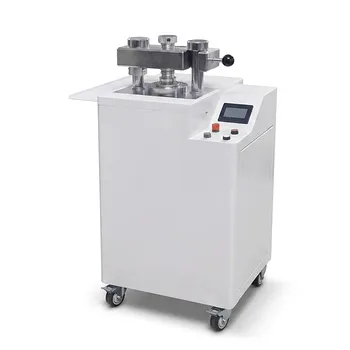
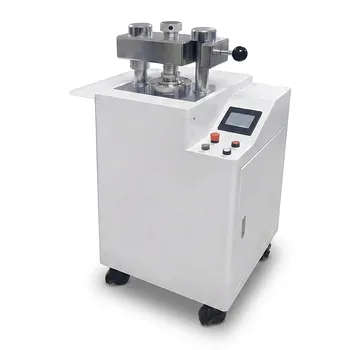
The primary role of a pellet press is to transform loose raw materials into solid, uniform samples with defined geometries. By applying controlled mechanical force, it consolidates powders into dense, stable forms suitable for analytical testing and physical characterization.
A pellet press is essential for converting inconsistent raw powders into high-density, standardized samples. It eliminates internal voids and structural weaknesses to ensure that subsequent experimental data is accurate, reproducible, and comparable.
Mechanisms of Sample Transformation
Densification and Particle Bonding
The fundamental function of the press is densification. It compresses raw materials, forcing particles closer together to increase the overall density and strength of the sample.
According to technical standards, hydraulic presses facilitate the tight rearrangement of powder particles. This pressure induces physical bonding within the mold, creating a cohesive "green body" from loose powder.
Elimination of Internal Defects
A critical aspect of this process is the removal of structural inconsistencies. High-pressure consolidation serves to eliminate internal voids and density gradients that often exist in loose powders.
By removing these defects, the press ensures the material is homogenous. This homogeneity is vital for preventing structural failure during later stages of testing.
Ensuring Data Integrity and Standardization
Precision in Geometry
Analytical techniques often require samples of exact dimensions. A pellet press allows for precise control over the shape and size of the final product.
This geometric precision is not merely aesthetic; it ensures that the path length for spectroscopic analysis or the cross-sectional area for mechanical testing is constant.
Reproducibility for Quality Control
For quality control and comparative studies, consistency is paramount. The press creates standardized samples, reducing variable factors between different test batches.
This standardization ensures that any variance in data is due to material differences, not sample preparation errors. It guarantees the accuracy and reproducibility of experimental data.
Enhancing Material Properties
Improving Mechanical Stability
Pressing significantly improves the material's mechanical and thermal properties. By increasing density, the sample becomes more resistant to physical stress.
Proper molding control prevents common issues such as deformation or cracking during subsequent processing. This stability is required for samples that must withstand heat or force during analysis.
Facilitating Composite Creation
Beyond simple analysis, pellet presses are used to engineer new materials. They allow researchers to create composite materials by compressing mixtures of different powders into a single, unified solid.
Understanding the Trade-offs
The Necessity of Precise Pressure
While pressure is the tool, precision is the requirement. If the pressure applied is not adjustable or precise, you risk introducing density gradients rather than eliminating them.
Risk of "Green Body" Defects
The "green body" (the compacted but un-sintered sample) relies entirely on the quality of the pressing. Inadequate pressure or poor mold control can lead to invisible internal micro-cracks.
These defects may not be immediately visible but will cause the sample to fail catastrophically during testing, rendering the gathered data useless.
Making the Right Choice for Your Goal
To maximize the utility of a pellet press, align its function with your specific objective:
- If your primary focus is Analytical Chemistry (e.g., XRF/FTIR): Prioritize the standardization capability of the press to ensure identical sample thickness and density for reproducible spectral data.
- If your primary focus is Materials Engineering: Focus on the densification and composite capabilities to test the mechanical limits and thermal properties of new formulations.
Success in sample preparation depends on treating the pellet press not just as a compactor, but as a precision instrument for data assurance.
Summary Table:
| Feature | Role in Sample Preparation | Benefit to Research |
|---|---|---|
| Densification | Compresses loose powder into solid forms | Eliminates voids and ensures homogeneity |
| Geometric Precision | Standardizes sample shape and dimensions | Ensures constant path lengths for analysis |
| Particle Bonding | Creates a cohesive "green body" | Increases mechanical stability and durability |
| Reproducibility | Maintains consistent pressure across batches | Guarantees accurate and comparable data |
| Composite Creation | Unifies mixtures of different powders | Enables the engineering of new formulations |
Elevate Your Material Analysis with KINTEK
Precision in sample preparation is the foundation of reliable data. KINTEK specializes in comprehensive laboratory pressing solutions designed for researchers who demand excellence. Whether you are conducting battery research or material characterization, our range of manual, automatic, heated, and multifunctional models—including specialized glovebox-compatible and isostatic presses (CIP/WIP)—ensures your samples meet the highest standards of density and uniformity.
Ready to eliminate structural defects and enhance your lab's efficiency? Contact KINTEK today to find the perfect pressing solution for your application.
Related Products
- Automatic XRF Pellet Press for Laboratory Spectrometry Sample Preparation
- Laboratory Hydraulic Split Electric Lab Pellet Press
- Laboratory Hydraulic Pellet Press for XRF KBR FTIR Lab Press
- Manual Laboratory Hydraulic Pellet Press Lab Hydraulic Press
- Automatic Fluorescence Sample Preparation Press 40 Ton Lab Pellet Press for XRF Analysis
People Also Ask
- How can contamination occur during the preparation of pressed pellets for XRF analysis? Expert Prevention Guide
- How does the sample material influence the required pressing load for making an XRF pellet? Find the Optimal Pressure
- What are the different methods for preparing a sample pellet for XRF analysis? Expert Guide to Superior XRF Results
- What are the advantages of preparing a sample as a dense pellet for XRF? Unlock High-Precision Trace Element Analysis
- What is the primary purpose of using an automatic pellet press? Achieve Precise Geopolymer Analysis Results