
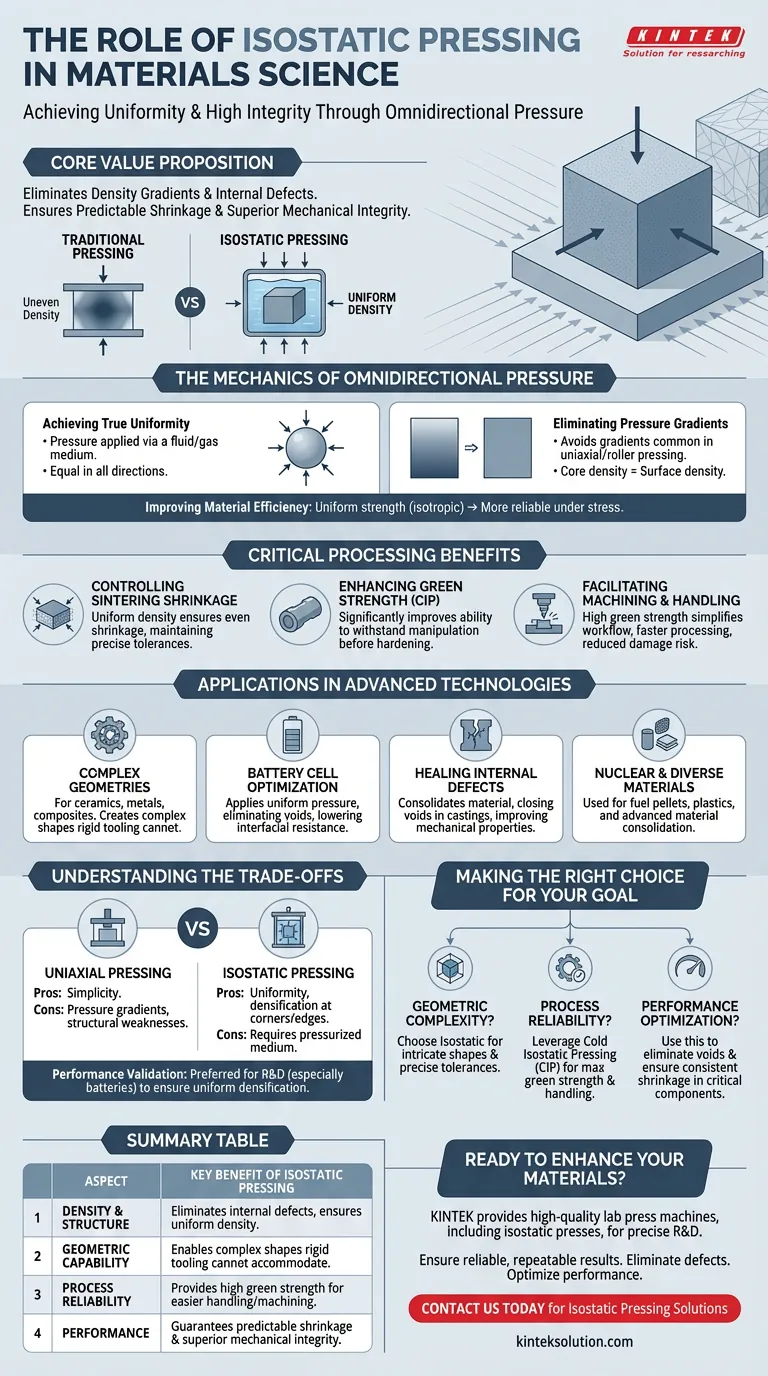
Isostatic pressing is a critical consolidation technique used in materials science to apply equal pressure to a material from every direction simultaneously. Unlike traditional methods that compress from a single axis, this process utilizes a fluid or gas medium to shape and densify powders or castings, ensuring uniform material properties and the ability to form complex geometries with high precision.
The Core Value Proposition The primary role of isostatic pressing is to eliminate the density gradients and internal defects common in other molding techniques. By ensuring uniform density, it guarantees predictable shrinkage during sintering and superior mechanical integrity for high-performance applications.
The Mechanics of Omnidirectional Pressure
Achieving True Uniformity
The defining characteristic of isostatic pressing is the application of pressure via a surrounding medium, such as liquid or gas. Because the pressure is equal in all directions, it reaches every part of the material with the same magnitude.
Eliminating Pressure Gradients
Traditional techniques, such as uniaxial or roller pressing, often create pressure gradients across a part. Isostatic pressing avoids this, ensuring that the density at the core of the material is identical to the density at the surface.
Improving Material Efficiency
Materials consolidated this way possess uniform strength throughout. In engineering contexts, materials with isotropic (uniform) strength are generally considered more efficient and reliable under stress.
Critical Benefits in Processing
Controlling Shrinkage During Sintering
Uniform density in the "green" (unsintered) state is a prerequisite for dimensional accuracy. Because the density is consistent, the material shrinks evenly during subsequent sintering processes, maintaining precise tolerances.
Enhancing Green Strength
Cold Isostatic Pressing (CIP) significantly improves the "green strength" of a molded part. This is the material's ability to withstand manipulation before it is fully hardened.
Facilitating Machining and Handling
High green strength simplifies the manufacturing workflow. It allows for faster processing and easier machining of the part before the final sintering step, reducing the risk of damage during handling.
Applications in Advanced Technologies
Complex Geometries and Diverse Materials
Since the 1950s, this technology has been used to consolidate ceramics, metals, composites, plastics, and nuclear materials like fuel pellets. It is uniquely capable of producing parts with complex shapes that rigid tooling cannot accommodate.
Optimization of Battery Cells
In energy storage research, isostatic pressing plays a unique role in fabricating battery cells. It applies uniform pressure to sealed cells, eliminating interfacial voids and significantly lowering interfacial resistance.
Healing Internal Defects
Beyond shaping new parts, the process is used to heal defects in existing castings. The high, uniform pressure consolidates the material, closing internal voids and improving the mechanical properties of the final component.
Understanding the Trade-offs
Isostatic vs. Uniaxial Pressing
The choice often comes down to the need for uniformity versus simplicity. Uniaxial pressing creates pressure gradients which can lead to structural weaknesses. Isostatic pressing requires a pressurized medium (liquid or gas) to solve this, ensuring densification even at corners and edges.
Performance Validation
In research and development, particularly for batteries, isostatic pressing is preferred over roller pressing. It ensures optimal performance validation by guaranteeing that densification is uniform throughout the entire cell structure.
Making the Right Choice for Your Goal
Isostatic pressing is not just a molding method; it is a quality assurance step for high-integrity materials.
- If your primary focus is Geometric Complexity: Choose this method to produce intricate shapes with precise tolerances that traditional unidirectional pressing cannot achieve.
- If your primary focus is Process Reliability: Leverage Cold Isostatic Pressing to maximize green strength, ensuring your parts survive handling and machining prior to sintering.
- If your primary focus is Performance Optimization: Use this technique to eliminate internal voids and pressure gradients, ensuring uniform density and consistent shrinkage in critical components.
By applying force from all sides, isostatic pressing transforms raw powders and castings into materials of uniform strength and unwavering reliability.
Summary Table:
| Aspect | Key Benefit of Isostatic Pressing |
|---|---|
| Density & Structure | Eliminates internal defects and ensures uniform density throughout the material. |
| Geometric Capability | Enables the production of complex shapes that rigid tooling cannot accommodate. |
| Process Reliability | Provides high green strength for easier handling and machining before sintering. |
| Performance | Guarantees predictable shrinkage and superior mechanical integrity for critical applications. |
Ready to enhance your material properties with uniform pressure?
For laboratories and researchers developing advanced ceramics, metals, composites, or battery materials, achieving uniform density and complex geometries is paramount. KINTEK specializes in providing high-quality lab press machines, including isostatic presses, designed to meet the precise demands of materials science R&D.
Our equipment ensures reliable, repeatable results, helping you eliminate defects and optimize your materials' performance. Contact us today using the form below to discuss how our isostatic pressing solutions can benefit your specific application.
Visual Guide
Related Products
- Warm Isostatic Press for Solid State Battery Research Warm Isostatic Press
- Automatic Lab Cold Isostatic Pressing CIP Machine
- Lab Isostatic Pressing Molds for Isostatic Molding
- Electric Lab Cold Isostatic Press CIP Machine
- Electric Split Lab Cold Isostatic Pressing CIP Machine
People Also Ask
- Why must composite cathodes be sealed in vacuum lamination bags for WIP? Ensure Battery Stability and Density
- What is the function of elastic molds in warm isostatic pressing? Achieve Uniform Density in Composite Particles
- How do sacrificial volume materials (SVM) maintain microchannels in isostatic pressing? Ensure Structural Integrity
- What is the mechanism of a Warm Isostatic Press (WIP) on cheese? Master Cold Pasteurization for Superior Safety
- How does Warm Isostatic Pressing differ from traditional pressing methods? Unlock Uniform Density for Complex Parts



















