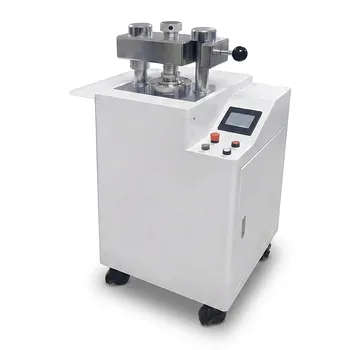
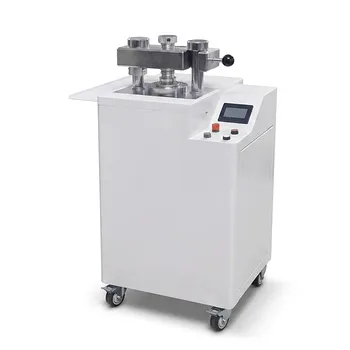
High-precision laboratory pellet presses serve as the critical bridge between theoretical materials science and physical reality. By transforming synthesized powders into standardized, high-density "green bodies," these machines provide the uniform physical medium required to empirically test predictions of lattice parameters and mechanical hardness. This process ensures that measurements—such as Vickers hardness or bulk modulus—are reflective of the material's intrinsic properties rather than inconsistencies in the sample preparation itself.
Core Takeaway: Laboratory pellet presses eliminate experimental noise by creating specimens with controlled density and internal uniformity, allowing researchers to directly compare physical measurements against idealized mathematical simulations and first-principles calculations.
From Powder to Standardized Physical Models
The Creation of High-Density Green Bodies
Materials predicted by computational models often exist initially as synthesized powders that cannot be directly tested for mechanical properties. The laboratory press consolidates these powders into "green bodies," which are high-density bulk specimens prepared for subsequent sintering and analysis.
Standardizing the Experimental Baseline
To validate a simulation, the physical sample must match the theoretical model's assumptions as closely as possible. Precision presses ensure that every pellet is uniform in size and density, providing a consistent baseline for testing properties like the hardness of CrSi2 or the stability of MAX phases.
Facilitating Advanced Characterization
Once pressed into a dense pellet, the material can undergo Vickers hardness testing or ultrasonic velocity measurements. Without this standardized form, researchers could not accurately measure the actual compressive strength or elastic limits of materials like Al3NiP4 ceramic.
Precision Control as a Validation Requirement
Eliminating Internal Gradients
High-precision presses use threaded rods and nuts for rapid, precise platen adjustment to ensure a perfectly level compression. This level of mechanical control prevents density gradients within the pellet, which would otherwise skew results during X-ray diffraction or indentation tests.
Managing Environmental Variables
Advanced presses often integrate heated platens with digital temperature control. By stabilizing temperature during the pressing cycle, these machines prevent thermal variations from compromising the pellet’s structural integrity or altering its phase stability.
Simulating Stress States
Beyond simple compaction, these presses can simulate specific uniaxial or hydrostatic pressure states. This allows scientists to measure how a material’s lattice parameters respond to stress, directly validating theoretical bulk modulus values derived from first-principles calculations.
Enhancing Material Interface and Performance
Optimizing Electrochemical Contact
In solid-state battery research, the press is used to minimize interfacial impedance between electrolytes and electrodes. By accurately controlling holding time and pressure, the press improves ion transport efficiency, providing data to validate electrochemical performance models.
Replicating Geologic and Structural Features
For synthetic rock and geopolymer research, presses utilize layered technology to create artificial fractures or specific pore structures. This enables the validation of AI prediction models regarding how alkali concentrations or curing environments affect long-term compressive strength.
Understanding the Trade-offs and Limitations
The Risk of Pressure-Induced Defects
Applying excessive pressure too quickly can lead to "capping" or internal laminations, where the pellet splits into layers. While high density is required for validation, exceeding a material's natural limit during the pressing phase can create artificial flaws that do not exist in the theoretical model.
Sample Size and Edge Effects
Small-scale laboratory pellets may exhibit "edge effects" where the friction between the powder and the die wall creates non-uniform density. Researchers must balance the need for high-precision data with the physical reality that a small pellet may not perfectly represent a truly "infinite" bulk crystal lattice.
Material Memory and Elastic Recovery
All materials experience some level of elastic recovery once pressure is released. If this is not accounted for, the final density of the physical sample may differ from the simulation’s target density, potentially leading to discrepancies in lattice constant measurements.
Applying Precision Pressing to Your Research Goals
To ensure your experimental results effectively validate your simulated predictions, choose a pressing strategy that aligns with your specific material objectives.
- If your primary focus is validating mechanical hardness: Utilize a high-precision automatic press to ensure maximum packing density and internal uniformity for Vickers indentation.
- If your primary focus is measuring lattice parameters: Focus on precise pressure control and holding times to achieve the ideal packing density required for accurate diffraction analysis.
- If your primary focus is electrochemical performance: Prioritize a press with heated platens and fine-tuned pressure control to optimize the contact interfaces between solid-state components.
By mastering the transition from powder to pellet, researchers transform abstract mathematical predictions into measurable, physical evidence.
Summary Table:
| Research Application | Role of the Pellet Press | Key Validation Metric |
|---|---|---|
| Mechanical Testing | Creates uniform, high-density green bodies | Vickers Hardness / Bulk Modulus |
| Structural Analysis | Eliminates internal gradients and porosity | Lattice Parameters (XRD) |
| Battery Research | Optimizes interfacial contact between layers | Interfacial Impedance |
| Environmental Studies | Simulates specific stress and thermal states | Phase Stability / Stress Response |
Elevate Your Material Validation with KINTEK Precision
Don't let inconsistent sample preparation compromise your computational models. KINTEK specializes in comprehensive laboratory pressing solutions designed to turn theoretical predictions into verifiable data. Whether you are conducting cutting-edge battery research or analyzing advanced ceramics, our equipment ensures the internal uniformity and density your research demands.
Our versatile range includes:
- Manual & Automatic Presses for routine or high-throughput prep.
- Heated & Multifunctional Models for controlled environmental testing.
- Glovebox-Compatible & Isostatic Presses (Cold/Warm) for specialized material handling.
Ready to achieve superior sample consistency? Contact us today to find the perfect pressing solution for your laboratory.
References
- Grzegorz Matyszczak, Krzysztof Krawczyk. Mathematical Modeling of Properties and Structures of Crystals: From Quantum Approach to Machine Learning. DOI: 10.3390/cryst15010061
This article is also based on technical information from Kintek Solution Knowledge Base .
Related Products
- Automatic Fluorescence Sample Preparation Press 40 Ton Lab Pellet Press for XRF Analysis
- Automatic XRF Pellet Press for Laboratory Spectrometry Sample Preparation
- Lab XRF Boric Acid Powder Pellet Pressing Mold for Laboratory Use
- Manual Laboratory Hydraulic Pellet Press Lab Hydraulic Press
- Laboratory Hydraulic Pellet Press for XRF KBR FTIR Lab Press
People Also Ask
- What is the general process for preparing a sample pellet for XRF? Master Consistency for Accurate Analysis
- What are the advantages of preparing a sample as a dense pellet for XRF? Unlock High-Precision Trace Element Analysis
- What are the common operational types of lab pellet presses? Choosing the Right Manual, Automatic, or Hydraulic System
- What are the emerging trends in the design and materials of lab pellet presses? Modernize Your Lab Efficiency
- What are common lab pellet press issues? Expert Troubleshooting Guide for Reliable Material Research