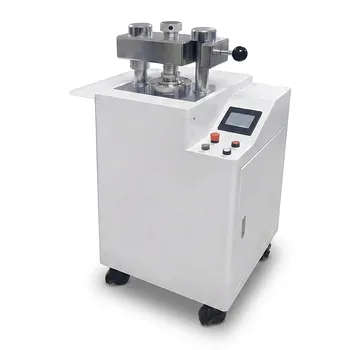
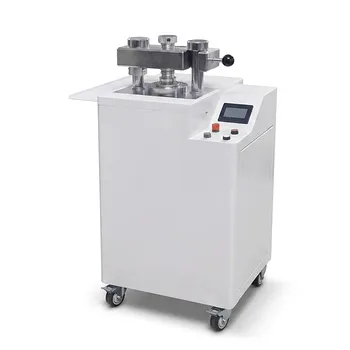
To ensure consistent sample quality and operator safety, the most critical feature to prioritize in a lab pellet press is a precise force gauge. Beyond simple pressure application, you should look for units offering heated platens (ranging from 600°F to 1200°F) for thermal processing and extensive customization options, such as interchangeable dies, to adapt to varying sample requirements.
Effective sample preparation is not merely about applying weight; it is about controlled repeatability. A press equipped with accurate monitoring tools and modular components transforms raw mechanical force into scientifically valid, consistent data.
Precision and Control Capabilities
The Force Gauge
This is the single most important feature for reproducible results. A precise force gauge allows you to monitor the exact load applied to your sample, preventing over-pressing or under-pressing.
Accurate measurement is also a critical safety feature. It prevents the operator from exceeding the rated capacity of the die set, which could lead to catastrophic failure.
Be aware of the distinction between pressure and force. If a press only displays hydraulic pressure (psi/bar), you must convert this to force (tons/kN) based on the ram's surface area to ensure you are within safe operating limits.
Integrated Heated Platens
For applications involving polymers, ceramics, or other materials requiring thermal manipulation, heated platens are essential.
Look for a press capable of reaching temperatures between 600°F and 1200°F. This capability allows for the molding and lamination of samples directly within the press, expanding the utility of the equipment beyond simple compaction.
Adaptability and Customization
Interchangeable Dies and Plungers
A versatile lab press should not be limited to a single sample geometry.
Prioritize models that support interchangeable dies and plungers. This allows you to quickly switch between different pellet diameters and shapes without investing in a completely new machine for every new experiment.
Tonnage Capacity Range
Presses typically range from 15 tons to over 100 tons.
You must select a capacity that matches your material's hardness and surface area. While a 15-ton press suits most standard FTIR or XRF pelletizing, harder materials or larger surface areas will require significantly higher tonnage to achieve particle cohesion.
Operational and Safety Factors
Safety Guards and Construction
Never compromise on operator safety. Look for presses equipped with integrated safety guards or shields.
Ensure the press features flat, stable pressing surfaces to prevent lateral movement of the die stack. High-quality construction ensures durability and minimizes the risk of mechanical failure under high loads.
Maintenance Accessibility
Equipment downtime delays research. Select a press designed for easy upkeep, featuring accessible components for cleaning and hydraulic fluid replacement.
Understanding the Trade-offs
Manual vs. Automated Systems
Manual presses are cost-effective and compact, making them ideal for low-volume labs. However, they introduce operator variability and physical strain.
Electric or pneumatic systems offer superior consistency and speed for batch production but require significantly more laboratory space and a higher capital investment.
Space Constraints vs. Power
There is often a direct correlation between the physical footprint of the unit and its maximum force.
Benchtop models save space but typically cap out at lower tonnage limits. Floor-standing models provide the high force required for industrial materials but demand dedicated floor space and potentially specialized power requirements.
Making the Right Choice for Your Goal
- If your primary focus is precise analytical results (e.g., XRF/FTIR): Prioritize a press with a high-precision force gauge and a stable, manual hydraulic system to ensure exact repeatability between samples.
- If your primary focus is material synthesis or molding: Select a unit with heated platens capable of reaching 1200°F and a high tonnage capacity to handle complex thermal processing.
- If your primary focus is high-throughput production: Invest in an automated, electric press with safety guards to maximize speed and minimize operator fatigue.
The right lab press balances the raw force required for your toughest material with the precision controls needed for your most delicate analysis.
Summary Table:
| Feature | Importance | Target Application |
|---|---|---|
| Precise Force Gauge | Essential for repeatability & safety | Analytical results (XRF/FTIR) |
| Heated Platens | Enables thermal manipulation (up to 1200°F) | Polymers & material synthesis |
| Interchangeable Dies | Offers versatility in sample geometry | General laboratory research |
| High Tonnage (15-100T) | Overcomes material hardness/surface area | Industrial ceramics & metallurgy |
| Automation System | Reduces variability & operator fatigue | High-throughput batch production |
Elevate Your Research with KINTEK Laboratory Press Solutions
Precision sample preparation is the foundation of reliable data. KINTEK specializes in comprehensive laboratory pressing solutions designed for the most demanding research environments. Whether you are conducting advanced battery research or routine analytical testing, our diverse range of equipment offers the control and durability you need.
Our Value to You:
- Comprehensive Range: From compact manual benchtop models to high-capacity automatic and isostatic presses.
- Thermal Control: Advanced heated and multifunctional models for complex material synthesis.
- Specialized Environments: Glovebox-compatible designs for sensitive battery and chemical research.
- Precision & Safety: Integrated force monitoring and safety guarding on all professional-grade units.
Ready to find the perfect press for your lab? Contact our technical experts today to discuss your specific tonnage and temperature requirements.
Related Products
- Automatic Fluorescence Sample Preparation Press 40 Ton Lab Pellet Press for XRF Analysis
- Automatic Laboratory Hydraulic Press Lab Pellet Press Machine
- Laboratory Hydraulic Press 2T Lab Pellet Press for KBR FTIR
- Laboratory Hydraulic Pellet Press for XRF KBR FTIR Lab Press
- Laboratory Hydraulic Press Lab Pellet Press Machine for Glove Box
People Also Ask
- What is the general process for preparing a sample pellet for XRF? Master Consistency for Accurate Analysis
- What are the advantages of preparing a sample as a dense pellet for XRF? Unlock High-Precision Trace Element Analysis
- What are the common operational types of lab pellet presses? Choosing the Right Manual, Automatic, or Hydraulic System
- What are the emerging trends in the design and materials of lab pellet presses? Modernize Your Lab Efficiency
- What are common lab pellet press issues? Expert Troubleshooting Guide for Reliable Material Research