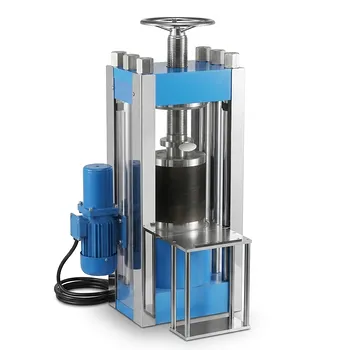
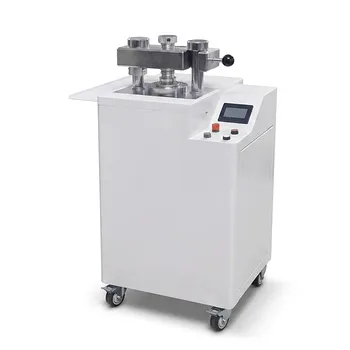
Proper maintenance of a KBr press requires a disciplined regimen of cleaning, lubrication, and environmental control. You must regularly clean the die set and plungers to eliminate contamination risks and maintain the optical quality of your pellets. Furthermore, the hydraulic components require appropriate lubrication for smooth operation, while the entire assembly must be stored in a dry environment to prevent corrosion.
Consistent maintenance is not just about protecting the machinery; it is essential for analytical accuracy. A neglected press leads to contaminated samples and corroded dies, directly compromising the transparency required for infrared spectroscopy.
Preserving Component Integrity
Cleaning the Die Set and Plungers
The most critical maintenance task is the regular cleaning of the die set and plungers. Any residual powder left on these surfaces can lead to cross-contamination between samples.
Failure to clean these components properly will degrade the quality of future pellets. A dirty die results in pellets that produce unclear or inaccurate spectral data.
Preventing Corrosion
When the equipment is not in active use, storage conditions are paramount. You must store the KBr press and its die set in a dry, clean environment.
Moisture is the primary enemy of KBr press components. Exposure to humidity can lead to rapid corrosion of the metal surfaces, rendering the precision die set unusable.
Ensuring Mechanical Reliability
Lubricating Moving Parts
To ensure the hydraulic press applies the necessary 8 to 10 tons of pressure smoothly, proper lubrication is non-negotiable. This applies to both the hydraulic press mechanism and the moving components of the die set.
Lubrication prevents friction-related wear and ensures the plungers move freely within the die. Without it, the mechanism may seize or apply pressure unevenly.
Inspecting the Base Plate
While often overlooked, the base plate provides the stable surface necessary for even pressure distribution. Ensure this component remains clean and free of debris to maintain mechanical stability during the pressing process.
Common Pitfalls to Avoid
Ignoring Safety Guidelines
Maintenance and operation involve high-pressure mechanics and chemical handling. Always adhere to the manufacturer’s safety instructions, as the press operates under significant force.
Additionally, always wear appropriate Personal Protective Equipment (PPE), such as gloves and safety glasses, when handling KBr powder or servicing the unit.
Inconsistent Maintenance Schedules
Waiting until the press shows signs of failure is a costly mistake. Maintenance should be proactive, not reactive, to avoid permanent damage to the die surfaces.
Optimizing Your Maintenance Strategy
To get the most out of your equipment, align your care routine with your specific operational priorities:
- If your primary focus is Data Accuracy: Prioritize rigorous cleaning of the die set and plungers after every single use to prevent spectral interference.
- If your primary focus is Equipment Longevity: Focus on consistent lubrication and dry storage to prevent mechanical seizing and rust.
By treating the KBr press as a precision instrument rather than a simple tool, you ensure years of reliable service and high-quality spectroscopic results.
Summary Table:
| Maintenance Task | Frequency | Key Benefit |
|---|---|---|
| Die Set Cleaning | After Every Use | Prevents cross-contamination and ensures pellet transparency |
| Lubrication | Monthly / Per Use | Ensures smooth hydraulic operation and prevents mechanical seizing |
| Dry Storage | When Not In Use | Protects precision components from humidity and corrosion |
| Base Plate Check | Before Every Use | Maintains stability and ensures even pressure distribution |
| Safety Inspection | Regularly | Ensures operator safety and verifies mechanical integrity |
Maximize Your Lab's Precision with KINTEK
Don't let poor maintenance compromise your spectroscopic results. KINTEK specializes in comprehensive laboratory pressing solutions, offering a diverse range of manual, automatic, heated, multifunctional, and glovebox-compatible models, as well as specialized cold and warm isostatic presses for advanced battery research.
Whether you need help maintaining your current setup or are looking to upgrade to a more durable system, our experts are here to support your research goals.
Contact us today to find your perfect laboratory press solution
Related Products
- Laboratory Hydraulic Press 2T Lab Pellet Press for KBR FTIR
- Laboratory Hydraulic Pellet Press for XRF KBR FTIR Lab Press
- Automatic Laboratory Hydraulic Press for XRF and KBR Pellet Pressing
- Lab Infrared Press Mold for No Demolding
- Button Battery Sealing Press Machine for Lab
People Also Ask
- What is the role of a laboratory pressure machine and KBr in FTIR? Master Sample Preparation for Flame Retardants
- What is the role of a laboratory hydraulic press in high-loading NCM811 cathode prep for solid-state batteries?
- Why is a laboratory hydraulic press necessary for sample preparation? Precise Pelleting for Spiro Heterocyclic Analysis
- What role does a laboratory hydraulic press play in reaction pellets? Optimizing Lunar Soil and Metal Fuel Density
- Why is a laboratory hydraulic press necessary for the assembly of trilayer bipolar stacking pouch cells?