
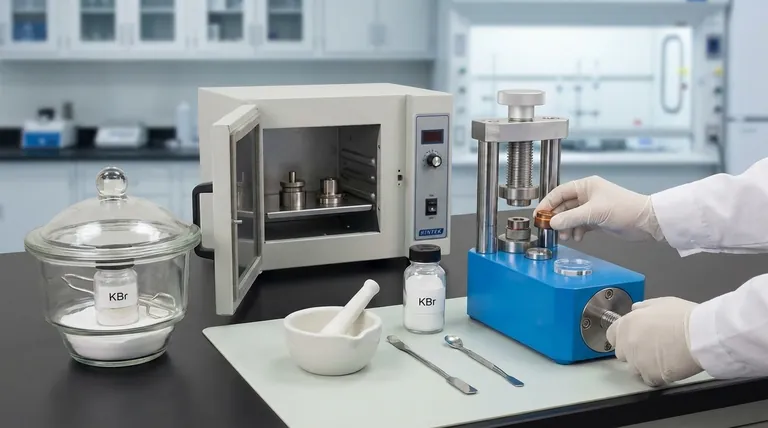
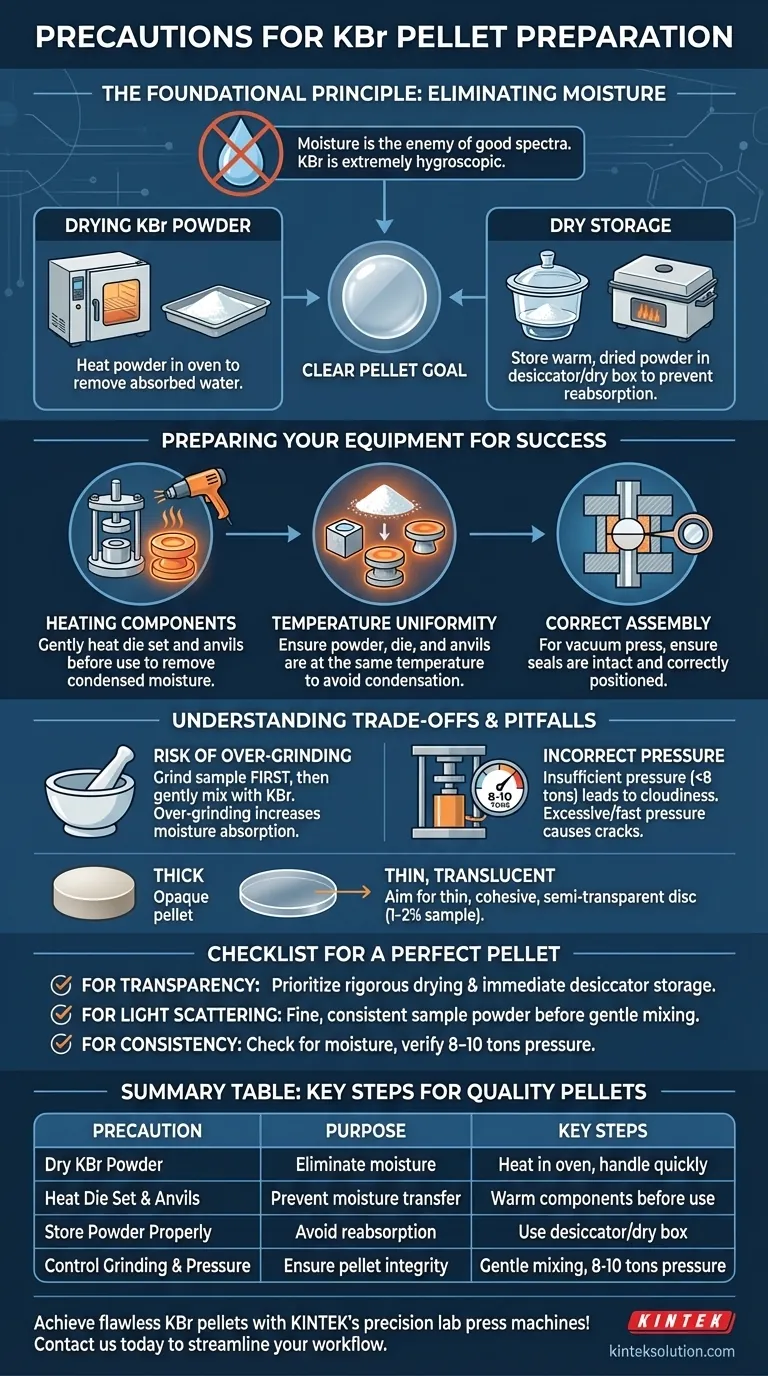
The key to creating a high-quality KBr pellet lies in a systematic approach to moisture elimination. The most critical precautions are to ensure the potassium bromide (KBr) powder is scrupulously dry and to heat the die set and anvils before use. Storing the dried powder in a desiccator or heated case is essential to prevent it from reabsorbing atmospheric moisture.
The quality of your infrared spectrum is decided before you even press the pellet. Because KBr is extremely hygroscopic (it readily absorbs water), your primary goal is to control moisture at every step of the process. A dry powder, a dry die, and proper handling are the non-negotiable foundations for a clear, transparent pellet.
The Foundational Principle: Eliminating Moisture
Nearly every common problem with KBr pellets—from cloudiness to large, obscuring peaks in your spectrum—can be traced back to unwanted moisture. Understanding how to combat it is the single most important skill.
Why Moisture is the Enemy of Good Spectra
KBr's hygroscopic nature is the central challenge. When water is present, it causes two major problems.
First, water has very strong, broad absorption bands in the infrared spectrum, which can easily overwhelm or obscure the peaks from your actual sample. Second, absorbed moisture prevents the KBr from forming a clear, glassy matrix under pressure, resulting in an opaque or cloudy pellet that scatters the IR beam and significantly weakens your signal.
How to Properly Dry KBr Powder
Spectroscopy-grade KBr is sold as a dry powder, but it will absorb atmospheric moisture as soon as the container is opened.
Before use, you should dry the powder by heating it in an oven. This removes any absorbed water. After drying, the powder must be handled quickly or moved immediately to a controlled environment.
The Importance of Dry Storage
Once dried, the KBr powder must be stored in a desiccator or a temperature-controlled dry box.
This step is not optional. Exposing the warm, dry powder to ambient air for even a few minutes can be enough to compromise its quality, as it will immediately begin absorbing moisture again.
Preparing Your Equipment for Success
A dry powder is only half the battle. Your pellet press and die set can also introduce moisture into the system if not prepared correctly.
Heating the Die Set and Anvils
The metal surfaces of your die set and anvils hold a thin, invisible layer of condensed moisture from the air. This moisture will transfer directly to your KBr powder during pressing.
To prevent this, gently heat the die components before use. A lab oven or a heat gun works well for this purpose. The parts should be warm to the touch, but not excessively hot.
Ensuring Temperature Uniformity
For best results, the KBr powder, die set, and anvils should all be at the same temperature.
If cold powder is loaded into a warm die, condensation can form. This principle of thermal equilibrium ensures that no new moisture is introduced at the moment of loading and pressing.
Correct Die Assembly for Vacuum Use
If your press uses a vacuum to help remove air during compression, ensure the die set is correctly assembled with seals in good condition.
Faulty or improperly positioned seals will allow moist ambient air to be pulled into the die chamber, completely negating all your careful drying preparations.
Understanding the Trade-offs and Common Pitfalls
Beyond moisture control, procedural nuances can make the difference between a perfect pellet and a failed attempt.
The Risk of Over-Grinding
The goal is to create a homogenous mixture. You must grind your sample into a fine powder before adding it to the KBr.
Once combined, the sample and KBr should be gently mixed, not aggressively ground together. Over-grinding the mixture increases the total surface area, which accelerates moisture absorption and can degrade the pellet quality.
Using the Right Amount of Material
The reference to using "minimal powder" is about creating a thin, translucent disc. A pellet that is too thick will be opaque and block too much of the IR beam.
However, a pellet that is too thin will be fragile and difficult to handle. The goal is to use just enough of the KBr/sample mixture (typically 1-2% sample by weight) to form a solid, cohesive, and semi-transparent disc after pressing.
Incorrect Pressure Application
Pressure is what turns the powder into a glassy solid. Insufficient pressure (less than 8 tons) will result in a cloudy, weak pellet that scatters light.
Conversely, excessive pressure or applying it too quickly can cause the pellet to crack or become opaque. Following the recommended pressure for your specific die set (often 8-10 tons for a 13 mm die) is critical.
A Checklist for a Perfect Pellet
Use these guidelines to diagnose issues and refine your technique based on your specific goals.
- If your primary focus is maximum transparency: Prioritize rigorous drying of the KBr and die set, and store the powder in a desiccator right up until the moment of use.
- If you are struggling with light scattering: Ensure your sample is ground to a fine, consistent powder before gently mixing it with the KBr, avoiding aggressive grinding of the mixture itself.
- If your pellets are consistently cloudy: Double-check for moisture in your powder or die, and verify you are applying sufficient pressure (typically 8-10 tons) for an adequate duration.
A systematic and dry preparation process is the most reliable path to obtaining clear, publication-quality spectra.
Summary Table:
| Precaution | Purpose | Key Steps |
|---|---|---|
| Dry KBr Powder | Eliminate moisture for clear pellets | Heat in oven, handle quickly |
| Heat Die Set and Anvils | Prevent moisture transfer | Warm components before use |
| Store Powder Properly | Avoid reabsorption of moisture | Use desiccator or dry box |
| Control Grinding and Pressure | Ensure pellet integrity | Gentle mixing, apply 8-10 tons pressure |
Achieve flawless KBr pellets for your laboratory with KINTEK's precision lab press machines! Our automatic lab presses, isostatic presses, and heated lab presses are designed to deliver consistent pressure and temperature control, minimizing moisture issues and enhancing your IR spectroscopy results. Don't let pellet preparation hold back your research—contact us today to discover how our equipment can streamline your workflow and improve data accuracy!
Visual Guide
Related Products
- Laboratory Hydraulic Press 2T Lab Pellet Press for KBR FTIR
- XRF KBR Plastic Ring Lab Powder Pellet Pressing Mold for FTIR
- XRF KBR Steel Ring Lab Powder Pellet Pressing Mold for FTIR
- Laboratory Hydraulic Pellet Press for XRF KBR FTIR Lab Press
- Automatic Laboratory Hydraulic Press for XRF and KBR Pellet Pressing
People Also Ask
- What is the role of a laboratory pressure machine and KBr in FTIR? Master Sample Preparation for Flame Retardants
- What is the role of a laboratory hydraulic press in high-loading NCM811 cathode prep for solid-state batteries?
- What role does a laboratory hydraulic press play in reaction pellets? Optimizing Lunar Soil and Metal Fuel Density
- Why is a laboratory hydraulic press necessary for sample preparation? Precise Pelleting for Spiro Heterocyclic Analysis
- What is the function of a laboratory hydraulic press in powder compaction? Enhance Composite Material Density



















