
In essence, control valves are the command and control system of a hydraulic press. They precisely regulate the hydraulic fluid's flow, pressure, and direction, which in turn gives the operator exact control over the press ram's speed, the force it exerts, and its position. This transforms the raw power of the hydraulic system into an accurate and repeatable industrial tool.
While Pascal's Principle explains how a hydraulic press generates immense force, it is the control valves that harness and direct that force. Without them, a press is merely a powerful but uncontrollable device; with them, it becomes a precision instrument.
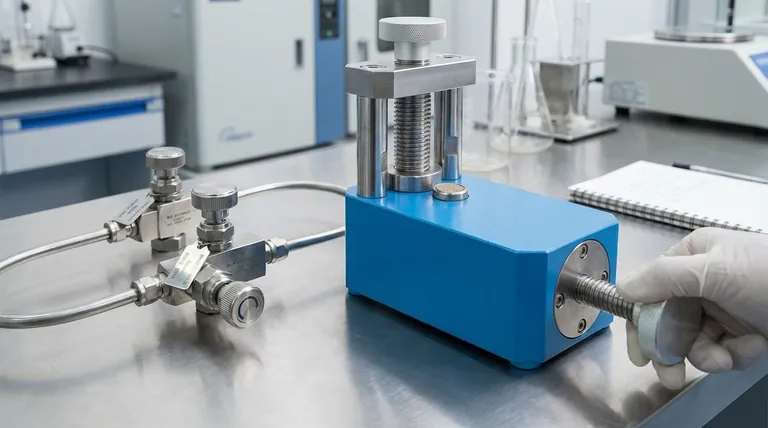
The Foundation: How a Hydraulic Press Generates Force
To understand the role of valves, we must first understand the principle they are designed to manage. A hydraulic press operates on a fundamental law of physics.
The Power of Pascal's Principle
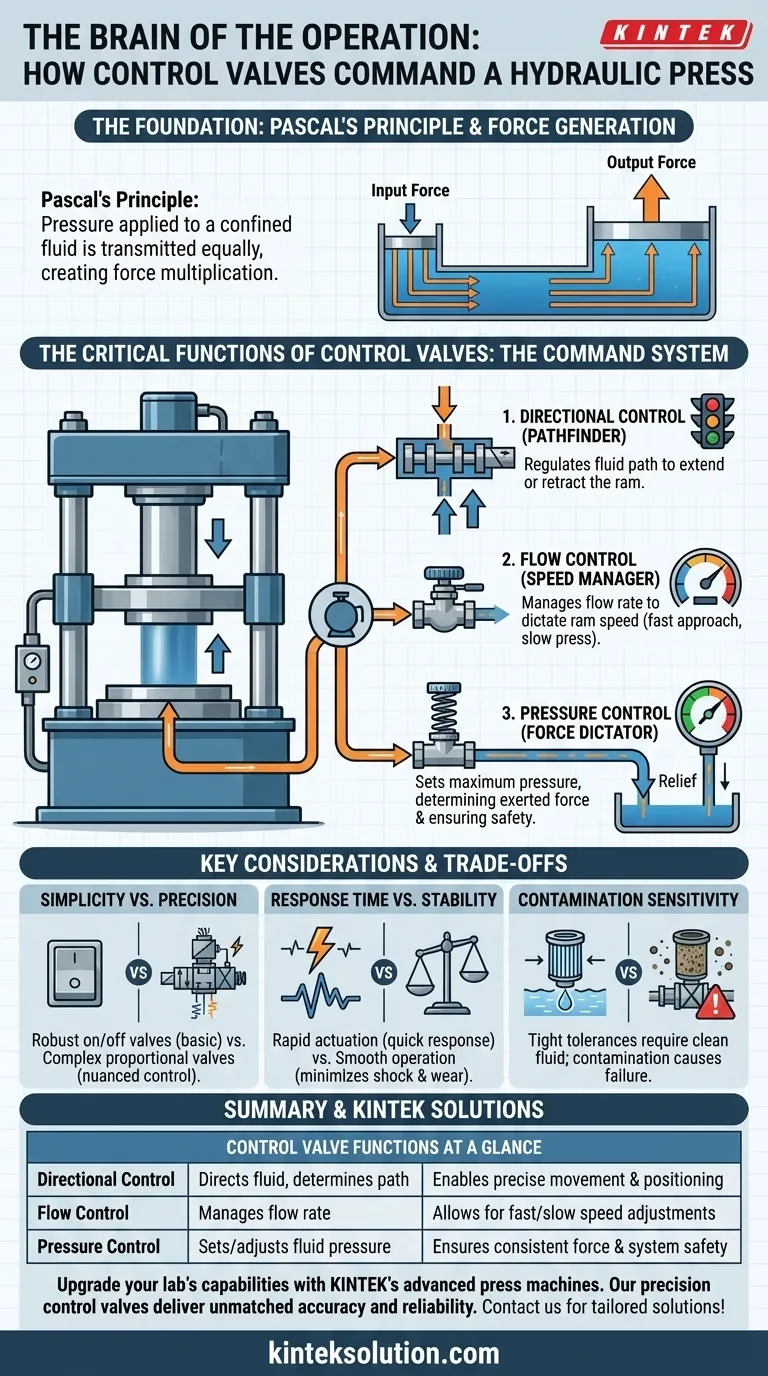
A hydraulic system is a closed system filled with an incompressible fluid, typically oil. Pascal's Principle states that when pressure is applied to this confined fluid, that pressure is transmitted equally and undiminished to all points throughout the fluid.
This principle allows for force multiplication. A small force applied to a small piston creates pressure in the fluid, and that same pressure acting on a much larger piston generates a proportionally larger output force.
The Critical Functions of Control Valves
If the hydraulic pump is the heart of the system, the control valves are its brain and nervous system. They interpret commands and manipulate the fluid to execute a specific task. They perform three primary functions.
Directional Control: Extending and Retracting the Ram
Directional control valves act like a traffic controller for the hydraulic fluid. They determine the path the fluid takes from the pump.
By shifting the valve's position, an operator can direct fluid to the top of the main cylinder to extend the press ram (the downstroke) or direct it to the bottom of the cylinder to retract the ram (the upstroke).
Flow Control: Managing the Ram's Speed
The speed at which the press ram moves is directly proportional to the flow rate of the hydraulic fluid entering the cylinder.
Flow control valves function like a faucet. By opening or closing the valve, an operator can precisely increase or decrease the volume of fluid moving through the system per unit of time, thus controlling the ram's velocity for both fast approaches and slow, delicate pressing operations.
Pressure Control: Dictating the Exerted Force
The force exerted by the press ram is a product of the fluid pressure and the piston's surface area (Force = Pressure x Area). Pressure control valves are used to manage this critical variable.
These valves can set a maximum system pressure, acting as a safety device (a relief valve) to prevent overload. More advanced pressure control valves can dynamically adjust the pressure during the work cycle, ensuring the exact force required for a task like molding or forging is applied consistently.
Understanding the Trade-offs and Key Considerations
Choosing and implementing control valves is not without its challenges. Understanding these trade-offs is key to a well-designed and reliable system.
Simplicity vs. Precision
Simple on/off directional valves are robust and cost-effective for basic up/down operations. However, for applications requiring fine control over speed and force, more complex and expensive proportional valves are necessary. These valves can adjust their opening in response to a variable electrical signal, allowing for nuanced, real-time adjustments.
Response Time vs. System Stability
Valves that actuate very quickly can provide a rapid response, but they can also introduce hydraulic shock into the system. This abrupt starting and stopping of fluid flow can cause pressure spikes, noise, and component wear. System design must balance the need for speed with the need for smooth, stable operation.
Contamination Sensitivity
Control valves are precision-engineered components with very tight internal tolerances. They are highly sensitive to contamination in the hydraulic fluid. Dirt, metal particles, or degraded oil can cause a valve to stick, leak, or fail entirely, leading to unpredictable press behavior and costly downtime. Proper filtration is not optional; it is essential.
Making the Right Choice for Your Goal
The right control valve strategy depends entirely on the press's intended application.
- If your primary focus is high-speed stamping or punching: Prioritize durable, fast-acting directional and flow control valves that can withstand millions of cycles.
- If your primary focus is precision molding or forging: Invest in proportional or servo valves that offer finite control over pressure and flow profiles throughout the work cycle.
- If your primary focus is safety and system longevity: Ensure your system is equipped with properly-set pressure relief valves and a rigorous fluid filtration and maintenance program.
By understanding how these valves function and interact, you can ensure your hydraulic press operates not just with power, but with precision and reliability.
Summary Table:
| Function | Description | Key Benefit |
|---|---|---|
| Directional Control | Directs hydraulic fluid to extend or retract the press ram | Enables precise movement and positioning |
| Flow Control | Manages fluid flow rate to control ram speed | Allows for fast approaches and slow, delicate operations |
| Pressure Control | Sets and adjusts fluid pressure to dictate force exerted | Ensures consistent force application and system safety |
Upgrade your laboratory's capabilities with KINTEK's precision lab press machines! Whether you need an automatic lab press, isostatic press, or heated lab press, our advanced control valves deliver unmatched accuracy, repeatability, and reliability for your pressing tasks. Contact us today to discuss how we can tailor a solution to meet your specific needs and boost your efficiency!
Visual Guide
Related Products
- Automatic High Temperature Heated Hydraulic Press Machine with Heated Plates for Lab
- Manual Heated Hydraulic Lab Press with Integrated Hot Plates Hydraulic Press Machine
- Heated Hydraulic Press Machine with Heated Plates for Vacuum Box Laboratory Hot Press
- Laboratory Hydraulic Press 2T Lab Pellet Press for KBR FTIR
- Laboratory Hydraulic Press Lab Pellet Press Machine for Glove Box
People Also Ask
- Function of a Laboratory Hydraulic Press with Heated Platens in SSE? Enhance Battery Density & Conductivity
- What are the requirements for electrode pressing with high-viscosity ionic liquids like EMIM TFSI? Optimize Performance
- How does a laboratory heated hydraulic press facilitate PBN sample prep for WAXS? Achieve Precise X-Ray Scattering
- What are the industrial applications of heated hydraulic presses? Master Heat & Force for Precision Manufacturing
- Why is a laboratory hydraulic press with heating plates required for PLA/TEC films? Achieve Precise Sample Integrity



















