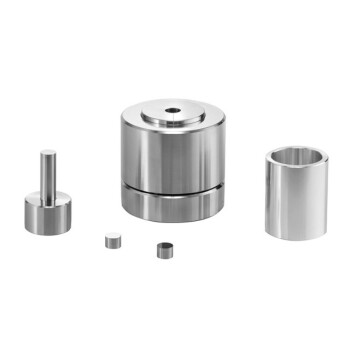
High-purity graphite molds act as the critical interface between the heavy machinery of a hot press and the delicate chemistry of LLZO powder. They serve a dual function as both the precise containment vessel for the sample and the direct medium for transmitting mechanical pressure, enabling the material to withstand sintering temperatures around 1100°C without losing structural integrity.
Core Takeaway High-purity graphite is chosen specifically for its ability to maintain mechanical strength and chemical inertness under extreme conditions. It allows for the uniform application of pressure required to achieve >98% density in LLZO electrolytes while minimizing the interface reactions that would otherwise degrade the ceramic's ionic conductivity.
Mechanical and Structural Roles
Precise Containment
The most fundamental role of the graphite mold is to define the geometry of the final ceramic component. Because graphite is easily machined, it allows researchers and engineers to create precise mold cavities that dictate the final dimensions of the LLZO discs.
Pressure Transmission
During hot pressing, the mold is not passive; it acts as an active transmission component. The graphite punches within the mold assembly transmit mechanical force (often around 50 MPa) from the press directly to the LLZO powder. This pressure is essential for particle rearrangement and diffusion bonding.
High-Temperature Structural Stability
Standard metal molds would soften or deform at the sintering temperatures required for LLZO (approx. 1100°C). High-purity graphite retains excellent mechanical strength at these temperatures, ensuring that the pressure is applied uniformly without the mold collapsing or warping.
Thermal and Chemical Management
The Heat Conduction Bridge
Graphite possesses high thermal conductivity, acting as a bridge to transfer heat from the furnace elements to the ceramic powder. This property ensures the LLZO is heated uniformly from all sides. Uniform heating is critical to prevent internal stresses, which leads to cracks in large ceramic components.
Chemical Stability and Purity
At 1100°C, many mold materials would react chemically with oxide ceramics, contaminating the sample. High-purity graphite is chemically stable, which significantly minimizes interface reactions between the mold walls and the LLZO. This preservation of purity is vital for ensuring the final electrolyte meets the stringent requirements for ionic conductivity in solid-state batteries.
Understanding the Trade-offs
The Risk of Interface Reactions
While graphite is chemically stable, it is not completely immune to interaction under all conditions. At extreme pressures and temperatures, there is still a risk of the ceramic powder sticking to the mold or reacting slightly.
The Role of Graphite Foil
To mitigate sticking and further protect the mold, graphite foil is often employed as a lining between the powder and the mold walls. This foil acts as a release agent and a sacrificial protective layer, extending the life of the rigid mold and ensuring the dense ceramic sample can be removed smoothly after sintering.
Making the Right Choice for Your Goal
When selecting mold configurations for LLZO sintering, consider the following specific objectives:
- If your primary focus is densification: Prioritize the mechanical strength of the graphite grade to ensure it can withstand the maximum pressure (50+ MPa) needed to eliminate pores and achieve >98% relative density.
- If your primary focus is chemical purity: Use the highest purity graphite available and utilize graphite foil liners to create a physical barrier against carbon diffusion or reduction reactions at the surface.
High-purity graphite molds are not just containers; they are active thermal and mechanical tools that directly dictate the density and performance of the final solid-state electrolyte.
Summary Table:
| Role Category | Specific Function | Impact on LLZO Quality |
|---|---|---|
| Mechanical | Pressure Transmission (50 MPa+) | Facilitates particle rearrangement for >98% density |
| Structural | Geometry Definition | Ensures precise dimensions and prevents mold deformation |
| Thermal | Heat Conduction Bridge | Provides uniform heating to prevent internal cracking |
| Chemical | High-Purity Inertness | Minimizes interface reactions to preserve ionic conductivity |
Maximize Your LLZO Research Precision with KINTEK
High-performance solid-state batteries require uncompromising materials. KINTEK specializes in comprehensive laboratory pressing solutions, providing the high-purity graphite molds and advanced pressing equipment necessary for achieving superior LLZO densification.
Whether you need manual, automatic, heated, or glovebox-compatible models—or specialized cold and warm isostatic presses—our technology ensures uniform pressure and thermal stability for your most demanding battery research.
Ready to elevate your lab's capabilities? Contact KINTEK today to find your custom pressing solution!
References
- Sewon Kim, Kisuk Kang. High-energy and durable lithium metal batteries using garnet-type solid electrolytes with tailored lithium-metal compatibility. DOI: 10.1038/s41467-022-29531-x
This article is also based on technical information from Kintek Solution Knowledge Base .
Related Products
- Lab Heat Press Special Mold
- Special Shape Lab Press Mold for Laboratory Applications
- Lab Round Bidirectional Press Mold
- Lab Anti-Cracking Press Mold
- Lab Polygon Press Mold
People Also Ask
- How is a laboratory heat press used to evaluate bio-based aliphatic polyesters? Prepare Reliable Samples for Analysis
- How is a laboratory heat press utilized in MEA preparation? Achieve High-Efficiency Iron-Chromium Redox Flow Batteries
- Why is a laboratory heat press necessary for biodegradable films? Unlock Precision Bonding and Barrier Performance
- What is the purpose of incorporating cartridge heaters into a lab press mold for MLCC block compression? Optimize Results
- How does the Born stability criterion inform LLZO heated press processes? Mastering Cubic Phase Ceramic Stability