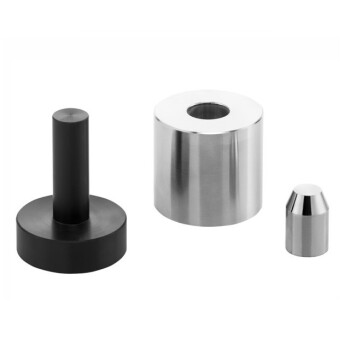
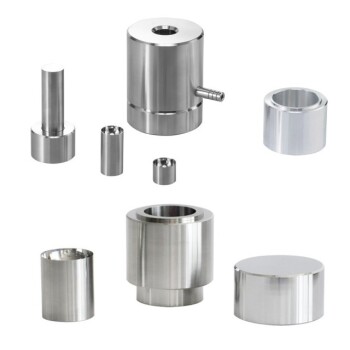
Precision molds serve as the definitive physical constraints that dictate the final geometric accuracy of phase change material (PCM) composites. When used with a laboratory hydraulic press, these molds transform the raw expanded graphite matrix into specific, consistent shapes—such as rectangular structures for battery packs or cylindrical forms for mechanical testing—ensuring the material is compacted to exact dimensions.
By enforcing strict dimensional consistency under high pressure, precision molds ensure the composite fits tightly against heat sources like battery cells. This tight interface minimizes contact thermal resistance, which is the critical factor in maximizing the heat dissipation efficiency of the final application.
Defining Geometry and Density
Achieving Geometric Fidelity
The primary function of the mold is to define the final shape of the expanded graphite matrix. Whether the application requires rectangular blocks for battery modules or cylinders for standardized testing, the mold forces the material to conform to these exact boundaries.
Ensuring Uniform Compaction
Inside the mold, the hydraulic press applies uniaxial pressure to the composite material. The mold’s rigidity ensures that this pressure is transmitted effectively, compacting the loose powder or matrix into a dense, solid structure.
Controlling Material Thickness
Precision dies allow researchers to produce samples with specific, repeatable thicknesses. This standardization is vital for accurately evaluating how different densities affect the material's thermal and mechanical performance.
The Critical Link to Thermal Performance
Minimizing Contact Resistance
The most significant impact of a precision mold is its ability to create a product that fits perfectly against its intended target, such as a battery cell. A precise fit reduces microscopic air gaps at the interface.
Maximizing Heat Dissipation
By eliminating gaps, the mold ensures low contact thermal resistance. This allows heat to transfer efficiently from the source into the PCM composite, optimizing the system's overall cooling capability.
Eliminating Internal Defects
The high-pressure environment created within the mold helps eliminate internal air bubbles and voids. This results in a continuous structure where thermal conductive fillers are better aligned, further enhancing energy exchange efficiency.
Mold Integrity and Sample Quality
Withstanding High Tonnage
Molds must be constructed from high-strength steel or carbide to withstand pressures often ranging from 300 to 500 MPa. This material strength prevents the mold itself from deforming, which would otherwise compromise the geometric accuracy of the sample.
Preserving Surface Quality
High-quality molds feature superior surface finishes that reduce friction. This is essential during the demolding process, preventing the PCM composite from chipping, cracking, or delaminating when ejected.
Preventing Uneven Force Distribution
A precision mold ensures that the force from the press is applied uniformly across the powder body. This prevents density gradients that could lead to weak spots or inconsistent thermal properties within a single sample.
Understanding the Trade-offs
Material Hardness vs. Brittleness
While molds must be extremely hard to resist deformation, this rigidity can make them brittle. If the press applies force too abruptly or if the alignment is off, the mold itself can fracture.
Complexity of Demolding
As the precision of the mold increases, the tolerance between the plunger and the die wall decreases. While this improves sample density, it can make the ejection process more difficult, requiring careful control to avoid damaging the sample or the tool.
Making the Right Choice for Your Goal
To select the right molding strategy for your PCM composites, consider your ultimate objective:
- If your primary focus is Thermal Management (e.g., Battery Cooling): Prioritize molds that produce strict geometric tolerances to ensure a zero-gap fit with the heat source, minimizing thermal resistance.
- If your primary focus is Material Characterization: Select molds with high surface finishes and uniform pressure distribution to create defect-free cylinders that yield consistent mechanical and thermal test data.
The effectiveness of a PCM composite is determined not just by its chemistry, but by how accurately it is shaped; a precision mold is the tool that bridges the gap between raw material potential and actual thermal performance.
Summary Table:
| Role of Precision Molds | Key Function & Benefit |
|---|---|
| Geometric Fidelity | Defines exact shapes (blocks/cylinders) for battery packs and mechanical testing. |
| Density Control | Ensures uniform compaction and eliminates internal voids for better heat flow. |
| Thermal Interface | Minimizes air gaps and contact thermal resistance for maximum dissipation. |
| Material Integrity | High-strength steel construction prevents deformation under 300-500 MPa pressure. |
| Surface Quality | Superior finishes prevent sample cracking and delamination during demolding. |
Maximize Your Thermal Research with KINTEK Precision Solutions
Precision in molding is the difference between a failing heat sink and a high-performance battery cooling system. KINTEK specializes in comprehensive laboratory pressing solutions, offering a versatile range of manual, automatic, heated, multifunctional, and glovebox-compatible models, as well as cold and warm isostatic presses widely applied in battery research.
Our high-strength precision molds and hydraulic presses are engineered to help you achieve zero-gap fits and superior material density. Contact us today to find the perfect pressing solution for your lab!
References
- Onur Güler, Mustafa Yusuf Yazıcı. Electrolytic Ni-P and Ni-P-Cu Coatings on PCM-Loaded Expanded Graphite for Enhanced Battery Thermal Management with Mechanical Properties. DOI: 10.3390/ma18010213
This article is also based on technical information from Kintek Solution Knowledge Base .
Related Products
- Lab Polygon Press Mold
- Infrared Heating Quantitative Flat Plate Mold for Precise Temperature Control
- Lab Round Bidirectional Press Mold
- Lab Cylindrical Press Mold with Scale
- Lab Button Battery Tablet Press Sealing Mold
People Also Ask
- What is the purpose of incorporating cartridge heaters into a lab press mold for MLCC block compression? Optimize Results
- How do the design and geometric precision of pressing molds and mandrels affect the quality of PTFE composite samples?
- What role do precision positioning and pressure molds play in single-lap joints? Ensure 100% Data Integrity
- What are the requirements for pressing molds when using SSCG? Key Materials for Complex Single Crystal Production
- How do industrial-grade pressure molds affect zinc metal pouch cells? Maximize Energy Density & Performance