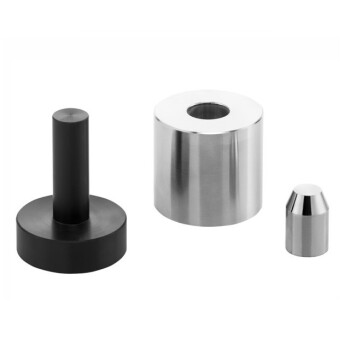
A lab press machine serves as a critical integration tool in the fabrication of Sodium Metal Batteries (SMBs), primarily used to minimize physical gaps between cell components. Its main function is to apply highly uniform, precise pressure to bond the Na3V2(PO4)3 (NVP) active material to the current collector and to force intimate contact between the quasi-solid-state electrolyte (PVEC-QSPE) and the sodium metal anode.
Core Takeaway The fundamental purpose of the lab press in SMB assembly is the minimization of interfacial contact resistance. By eliminating microscopic voids and ensuring atomic-level tightness between the electrodes and the electrolyte, the press directly enables superior rate performance and long-term cycling stability.
The Mechanics of Interface Optimization
Bonding the Cathode Active Material
In SMBs, the cathode often utilizes Na3V2(PO4)3 (NVP) as the active material. A lab press is required to exert precise pressure on this material to secure a tight bond with the current collector.
Without this mechanical compaction, the active material would lack sufficient electrical continuity with the collector. This ensures that the electron pathway is robust, which is a prerequisite for the battery to function efficiently.
Securing the Electrolyte-Anode Interface
The interface between the sodium metal anode and the electrolyte—specifically quasi-solid-state electrolytes like PVEC-QSPE—is a notorious bottleneck for performance.
The lab press plays a decisive role here by forcing these two distinct materials into intimate contact. This physical closeness is necessary to facilitate the efficient transfer of sodium ions across the boundary layers.
Utilizing Thermal Plasticity
In advanced setups involving ceramic electrolytes (such as Na5SmSi4O12), a heated laboratory press is often employed.
By applying pressure at elevated temperatures (approx. 97°C, near sodium's melting point), the machine leverages the plastic flow characteristics of sodium. This allows the metal to flow into and fill microscopic surface depressions on the ceramic, creating a gap-free, molecular-level connection.
Why Pressure Uniformity Matters
Reducing Contact Resistance
The primary adversary in battery assembly is interfacial contact resistance.
If the pressure applied during assembly is uneven or insufficient, gaps remain between layers. These gaps act as barriers to ion flow, increasing impedance. The lab press standardizes this process, ensuring that the resistance is minimized uniformly across the entire cell area.
Enhancing Rate Performance and Stability
The direct outcome of tight, uniform bonding is improved rate performance.
When resistance is low, the battery can charge and discharge at higher currents without significant voltage drops. Furthermore, the structural integrity provided by this compression contributes to improved cycling stability, allowing the battery to maintain its capacity over many charge-discharge cycles.
Densification of Conductive Networks
Beyond simple adhesion, the press compacts the material particles.
This effectively eliminates internal voids within the electrode structure. By densifying the material, the press establishes a comprehensive network for both ion and electron conduction, which is fundamental to achieving high capacity.
Understanding the Trade-offs
The Balance of Pressure
While pressure is vital, precision is paramount.
Applying too much pressure can lead to the mechanical failure of ultra-thin electrolyte layers or excessive deformation of the metal anode. The goal is to achieve atomic-level contact without crushing the delicate internal structures of the cell.
Thermal Considerations
When using a heated press, temperature control must be exact.
The synergy of heat and pressure is powerful, but it relies on specific material properties (like the melting point of sodium). Deviating from the optimal temperature range can result in poor adhesion or damage to the active materials.
Making the Right Choice for Your Goal
To maximize the effectiveness of your SMB assembly process, consider your specific performance targets:
- If your primary focus is High Rate Performance: Prioritize a press with high-precision pressure control to ensure maximum void elimination and the lowest possible impedance.
- If your primary focus is Solid-State Integration: Utilize a heated laboratory press to exploit the plastic flow of sodium for seamless contact with ceramic electrolytes.
- If your primary focus is Cycle Life: Focus on pressure uniformity to prevent uneven current distribution, which helps inhibit dendrite growth and extends battery longevity.
Precise application of pressure is not merely a manufacturing step; it is a critical parameter that defines the electrochemical potential of the final cell.
Summary Table:
| Process Component | Role of Lab Press | Key Benefit |
|---|---|---|
| NVP Cathode | Compaction & bonding to current collector | Robust electron pathway & electrical continuity |
| PVEC-QSPE Electrolyte | Forcing intimate contact with Sodium anode | Efficient sodium ion transfer across boundaries |
| Ceramic Electrolytes | Heated pressing (utilizing plastic flow) | Molecular-level, gap-free connections |
| Internal Structure | Densification of conductive networks | Eliminated voids & enhanced rate performance |
Maximize Your Battery Research with KINTEK Precision
At KINTEK, we specialize in comprehensive laboratory pressing solutions designed for the rigorous demands of battery research. Whether you are optimizing Sodium Metal Batteries (SMBs) or exploring solid-state architectures, our range of manual, automatic, heated, and glovebox-compatible presses ensures the pressure uniformity and thermal control essential for minimizing interfacial resistance.
From cold to warm isostatic presses, we provide the tools needed to achieve atomic-level contact and long-term cycling stability. Contact us today to find the perfect pressing solution for your lab!
References
- Ziyong Li, Min Zhu. In Situ Polymerization Enhances Anion Solvation Structure for Stable High‐Temperature Cycling in Quasi‐Solid‐State Sodium Metal Batteries. DOI: 10.1002/sus2.70015
This article is also based on technical information from Kintek Solution Knowledge Base .
Related Products
- Button Battery Sealing Press Machine for Lab
- Laboratory Hydraulic Press Lab Pellet Press Button Battery Press
- Lab Infrared Press Mold for Laboratory Applications
- Warm Isostatic Press for Solid State Battery Research Warm Isostatic Press
- Automatic High Temperature Heated Hydraulic Press Machine with Heated Plates for Lab
People Also Ask
- Why use standardized CR2032 components & high-precision presses? Ensure reliability in lithium metal battery research.
- Why is a laboratory battery sealing press essential for desolvation energy testing? Ensure Reliable Kinetic Data
- Why is a laboratory hydraulic press or battery sealing machine essential? Ensure Coin Cell Data Integrity
- How do laboratory battery sealing machines ensure performance consistency? Master Your Lithium and LFP Battery Assembly
- What role does a laboratory sealing press play in thermal analysis of solid dispersion films? Ensure Data Integrity