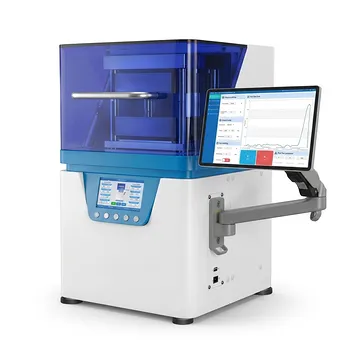
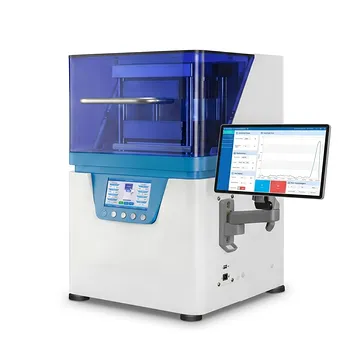
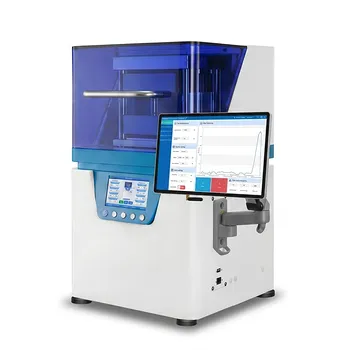
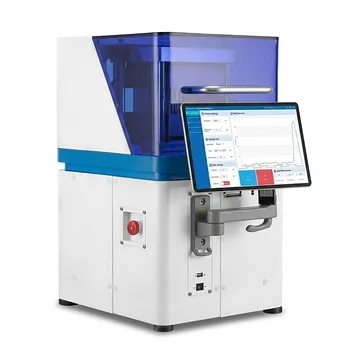
A laboratory hydraulic press is the definitive tool for converting loose powder reagents into dense, uniform, and cohesive solid pellets or disks. This equipment applies high-intensity, controlled pressure to powder materials within a specialized mold, inducing particle rearrangement and plastic deformation. The resulting samples possess the specific geometric shapes and mechanical strength necessary for precise analytical testing.
The laboratory hydraulic press serves as a critical bridge between raw chemical synthesis and accurate data acquisition. By eliminating internal air pockets and ensuring a uniform density distribution, it standardizes the physical form of the sample to remove variables that would otherwise compromise spectroscopic and electrochemical measurements.
Transforming Powder into Precision Samples
Particle Rearrangement and Plastic Deformation
At the heart of the process is the application of force to overcome the friction between individual grains. As pressure increases, particles shift to fill voids and eventually undergo plastic deformation, locking together to form a solid "green body." This transition is essential for creating a sample that can be handled and analyzed without crumbling.
Eliminating Internal Porosity
Loose powders contain significant air gaps which can scatter light or block electrical pathways. The hydraulic press effectively eliminates internal pores, creating a homogeneous medium. This high-density consolidation ensures that the physical characteristics of the sample are consistent throughout the entire volume.
Achieving Geometric and Surface Consistency
Analytical instruments require samples with a specific thickness and a smooth, flat surface. The use of polished dies within the press allows researchers to produce pellets with repeatable dimensions. This repeatability is the foundation of scientific reproducibility, ensuring that results are due to the material's properties rather than its shape.
Crucial Applications in Chemical Analysis
Enhancing Spectroscopic Accuracy
In X-ray Fluorescence (XRF) and Fourier-Transform Infrared (FT-IR) spectroscopy, sample form is everything. For FT-IR, the press creates thin, translucent KBr pellets that allow for uniform light transmission. For XRF, the hydraulic press produces a flat, dense surface that minimizes X-ray scattering and provides a reliable signal for elemental analysis.
Optimizing Electrochemical and Solid-State Testing
For researchers working on batteries or fuel cells, a hydraulic press is used to optimize electrical contact between particles. By compressing electrode materials into dense disks, the press ensures that electrons can flow efficiently during testing. This is also a vital pre-treatment step for solid-state reactions, where intimate contact between different powdered precursors is required for the reaction to occur.
Standardizing X-Ray Diffraction (XRD)
While XRD can be performed on loose powders, pressing them into a flat disk can sometimes help in achieving a consistent surface height. This alignment is critical for maintaining the correct Bragg angle during the scan. However, care must be taken to avoid induced orientation of the crystals, which can occur under extreme pressure.
Understanding the Trade-offs and Limitations
The Risk of Over-Pressing
Applying excessive force can lead to pressure-induced phase transitions or the unwanted orientation of crystals. In some materials, too much pressure can shatter the grains rather than deforming them, leading to a loss of the sample's original crystalline structure. Finding the "sweet spot" of pressure is essential for maintaining chemical integrity.
Contamination and Die Wear
The high-strength steel or tungsten carbide dies used in the press are subject to wear over time. If not properly cleaned or if the material is highly abrasive, cross-contamination between samples can occur. Furthermore, some chemical reagents may react with the metal of the die under high pressure, potentially altering the sample's purity.
Material Elastic Recovery
Not all powders stay compressed; some materials exhibit elastic recovery or "spring-back" once the pressure is released. This can cause the pellet to crack or delaminate shortly after being removed from the mold. In these cases, binders or specific dwell times (holding the pressure) are required to ensure the sample remains stable.
How to Apply This to Your Laboratory Workflow
Effective sample preparation requires matching the pressing parameters to your specific analytical goals.
- If your primary focus is Infrared Spectroscopy (FT-IR): Prioritize the use of vacuum-capable dies to remove all air, ensuring maximum transparency and preventing moisture interference.
- If your primary focus is X-ray Fluorescence (XRF): Focus on achieving a perfectly flat, mirror-like surface finish on the pellet to ensure accurate elemental detection.
- If your primary focus is Solid-State Synthesis: Use consistent, high pressure to maximize the contact area between different powder grains to facilitate efficient chemical reactions.
By mastering the precise control of a hydraulic press, you ensure that your analytical data reflects the true nature of your chemical materials rather than the inconsistencies of their preparation.
Summary Table:
| Application | Role of Hydraulic Press | Key Outcome |
|---|---|---|
| FT-IR Spectroscopy | Creates thin KBr pellets | Maximum light transmission and clarity |
| XRF Analysis | Produces flat, dense surfaces | Minimal X-ray scattering and accurate signals |
| Battery Research | Optimizes particle electrical contact | Efficient electron flow for electrochemical tests |
| Solid-State Synthesis | Maximizes grain-to-grain contact | Facilitates efficient chemical reactions |
| General Analysis | Eliminates internal porosity | Standardized density and geometric consistency |
Elevate Your Material Research with KINTEK’s Precision Pressing Solutions
Accuracy in chemical analysis begins with flawless sample preparation. KINTEK specializes in comprehensive laboratory pressing solutions designed to meet the rigorous demands of modern research. Whether you need manual, automatic, heated, multifunctional, or glovebox-compatible models, or advanced cold and warm isostatic presses for specialized battery research, our equipment delivers the uniform density and structural integrity your samples require.
Don't let preparation variables compromise your data. Partner with KINTEK to achieve superior reproducibility and precision in every pellet.
Contact our experts today to find the ideal press for your lab!
References
- Abdullah Alotaibi, Katabathini Narasimharao. Iron Phosphate Nanomaterials for Photocatalytic Degradation of Tetracycline Hydrochloride. DOI: 10.1002/slct.202501231
This article is also based on technical information from Kintek Solution Knowledge Base .
Related Products
- Laboratory Hydraulic Press Lab Pellet Press Machine for Glove Box
- Laboratory Hydraulic Press 2T Lab Pellet Press for KBR FTIR
- 24T 30T 60T Heated Hydraulic Lab Press Machine with Hot Plates for Laboratory
- Laboratory Hydraulic Press Lab Pellet Press Button Battery Press
- Laboratory Hydraulic Pellet Press for XRF KBR FTIR Lab Press
People Also Ask
- How does a laboratory hydraulic press contribute to the preparation of Li3-3xScxSb samples? Optimize Ionic Conductivity
- What is the function of a laboratory hydraulic press in FT-IR of curcumin-coated MWCNTs? Achieve Optical Clarity.
- Why is a laboratory hydraulic press required for compression molding boron-siloxane? Solve High-Loading Density Challenges
- What role does a laboratory hydraulic press play in the preparation of piezoelectric ceramic discs for DC-PG? | KINTEK
- What role does a laboratory hydraulic press play in reaction pellets? Optimizing Lunar Soil and Metal Fuel Density