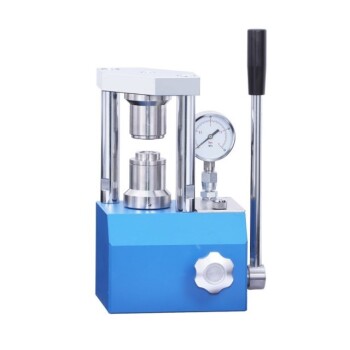
A manual or automatic laboratory press serves as the foundational tool for establishing electrochemical stability in zinc-ion batteries. Its specific role is to apply a constant sealing pressure, typically around 10 kPa, to unify the battery's internal components during the assembly process.
By ensuring intimate physical contact between the cathode, gel electrolyte, and zinc anode, the press minimizes interface impedance and guarantees a hermetic seal that prevents the evaporation of vital electrolyte moisture.
The Critical Functions of Applied Pressure
The laboratory press is not merely a closing device; it is an active component in defining the battery's internal architecture. It accomplishes this through two primary mechanisms.
Optimizing the Electrochemical Interface
For a zinc-ion battery to function effectively, ions must move freely between layers. The press applies approximately 10 kPa of pressure to force the cathode, gel electrolyte, and zinc anode into optimal physical contact.
This compression eliminates microscopic gaps between these layers. By maximizing the contact area, the press significantly reduces the interface impedance (resistance), facilitating efficient ion transport.
Ensuring Hermetic Integrity
Zinc-ion batteries often utilize gel electrolytes containing moisture that is critical for operation. The press guarantees the seal of the battery system is tight and uniform.
A proper seal prevents the evaporation of electrolyte moisture. Retaining this moisture is essential for maintaining the battery's conductivity and preventing the system from drying out during operation.
Why Precision Control Matters
Using a dedicated laboratory press allows for consistency that manual assembly cannot match. This precision directly impacts the reliability of the data collected from the battery.
Reducing Ohmic Internal Resistance
Inconsistent pressure leads to variable internal resistance (ohmic resistance). If the layers are loosely connected, resistance spikes, leading to poor performance data that reflects assembly errors rather than the battery's true chemistry.
The press ensures the contact is "tight" and uniform across the entire surface area. This standardization ensures that test results accurately reflect the intrinsic performance of the materials being tested.
Preventing Environmental Contamination
Beyond keeping moisture in, the press ensures external contaminants stay out. A rigorous seal prevents external air or moisture from entering the cell, which could trigger unwanted side reactions or corrosion of the zinc anode.
Understanding the Trade-offs
While pressure is necessary, the amount and consistency of that pressure are the variables that determine success or failure.
The Risk of Under-Compression
If the pressure falls significantly below the optimal 10 kPa threshold, the physical contact between the gel electrolyte and electrodes will be insufficient. This results in high interfacial impedance, leading to poor voltage performance and unreliable cycling data.
The Risk of Over-Compression
Excessive force can physically damage the delicate gel electrolyte structure or puncture the separator. This can lead to internal short circuits or the squeezing out of the liquid component of the electrolyte, effectively ruining the cell before testing begins.
Making the Right Choice for Your Goal
When utilizing a laboratory press for zinc-ion battery assembly, your approach should be dictated by your specific testing objectives.
- If your primary focus is lowering internal resistance: Ensure your press is calibrated to deliver uniform, flat pressure to maximize surface contact between the gel electrolyte and electrodes.
- If your primary focus is long-term cycle life: Prioritize the sealing capability of the press to ensure the encapsulation is perfectly airtight, preventing electrolyte evaporation over hundreds of hours.
The laboratory press bridges the gap between raw materials and a functional device, transforming separate layers into a cohesive, testable energy storage system.
Summary Table:
| Feature | Role in Zinc-Ion Battery Assembly | Impact on Performance |
|---|---|---|
| Interface Optimization | Eliminates microscopic gaps between cathode, electrolyte, and anode | Minimizes impedance and facilitates ion transport |
| Pressure Control | Applies consistent ~10 kPa pressure | Reduces ohmic resistance and ensures data reliability |
| Hermetic Sealing | Creates an airtight seal for the battery system | Prevents electrolyte evaporation and contamination |
| Consistency | Standardizes assembly across multiple test cells | Ensures repeatable and accurate experimental results |
Elevate Your Battery Research with KINTEK Precision
Consistency is the backbone of reliable battery data. KINTEK specializes in comprehensive laboratory pressing solutions designed to meet the rigorous demands of energy storage research. Whether you need the portability of a manual press, the precision of an automatic system, or specialized glovebox-compatible and isostatic models, we provide the tools necessary to minimize interface impedance and guarantee hermetic integrity.
Ready to optimize your zinc-ion battery assembly? Contact KINTEK today to discover how our high-performance presses can enhance your laboratory's efficiency and experimental accuracy.
References
- Juan Liu, Feng Zhou. Stabilization of V4+ in VOPO4 via Organophosphonate-Modified Electrolyte for High-Capacity Zinc-Ion Batteries. DOI: 10.21203/rs.3.rs-7359678/v1
This article is also based on technical information from Kintek Solution Knowledge Base .
Related Products
- Lab Button Battery Tablet Press Sealing Mold
- Button Battery Sealing Press Machine for Lab
- Laboratory Hydraulic Press Lab Pellet Press Button Battery Press
- Lab Infrared Press Mold for Laboratory Applications
- Lab Button Battery Disassembly and Sealing Mold
People Also Ask
- How does a sealed battery mold facilitate the assembly and testing of asymmetric supercapacitors using VO2?
- Why use standardized CR2032 components & high-precision presses? Ensure reliability in lithium metal battery research.
- Why is a laboratory battery sealing press essential for desolvation energy testing? Ensure Reliable Kinetic Data
- What is the function of specialized battery molds and sealing consumables? Optimize Your In-situ XRD Testing Today
- What role does a laboratory sealing press play in thermal analysis of solid dispersion films? Ensure Data Integrity