
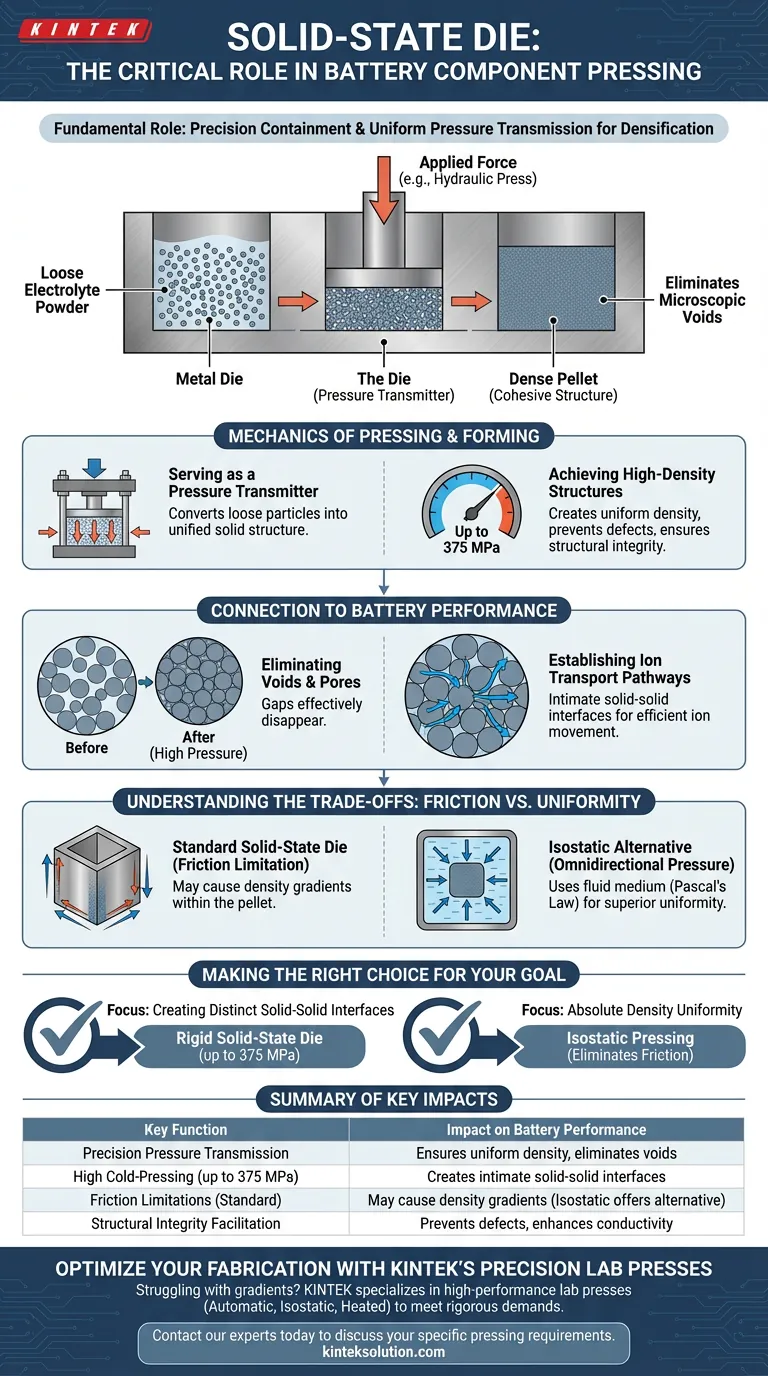
The fundamental role of a solid-state die is to act as both a precision containment vessel and a mechanism for uniform pressure transmission during battery fabrication. It is the critical tool used to transform loose electrolyte powder into a cohesive, dense pellet with the structural integrity required for operation.
The die is not merely a mold; it is the facilitator of the extreme densification required for solid-state batteries. Its primary function is to translate applied force into the elimination of microscopic voids, creating the intimate solid-solid interfaces necessary for efficient ion transport.
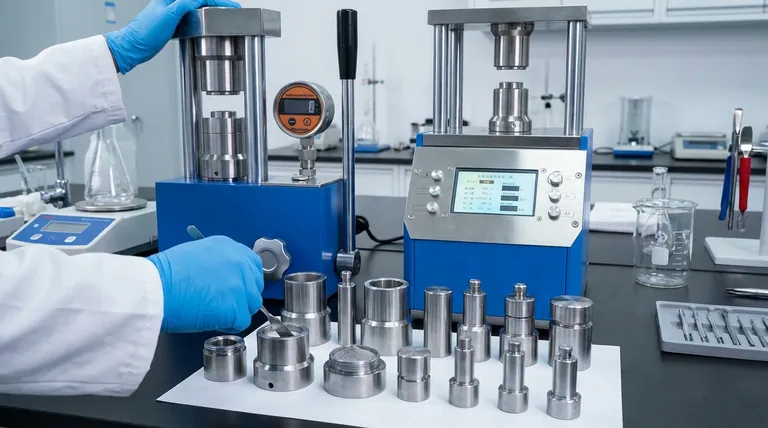
The Mechanics of Pressing and Forming
Serving as a Pressure Transmitter
While a die functions as a container for battery components, its active role is in the transmission of force.
When used with a hydraulic press, the die ensures that the applied load is distributed across the electrolyte powder. This distribution is essential for converting loose particles into a unified solid structure.
Achieving High-Density Structures
To create a functional solid-state battery, the die must facilitate the application of high cold-pressing pressures, often reaching up to 375 MPa.
This immense pressure creates a pellet with uniform density. It prevents the formation of macroscopic defects that would otherwise compromise the structural integrity of the cell.
The Connection to Battery Performance
Eliminating Voids and Pores
The performance of a solid-state battery is directly linked to the density achieved within the die.
High pressure eliminates the air voids and pores that naturally exist between the solid electrolyte and active material particles. A solid-state die allows you to compress these materials until those gaps effectively disappear.
Establishing Ion Transport Pathways
The removal of voids creates intimate and extensive solid-solid contact interfaces.
These tight interfaces are a prerequisite for battery function. Without the pressure facilitated by the die, ions cannot move efficiently between particles, resulting in poor conductivity and low performance.
Understanding the Trade-offs: Friction and Uniformity
The Friction Limitation
While standard solid-state dies are essential, they are subject to physical limitations.
Traditional die pressing can suffer from frictional forces between the powder and the die walls. This friction can lead to non-uniform pressure distribution, resulting in density gradients within the pellet.
The Isostatic Alternative
To overcome the friction inherent in rigid dies, isostatic pressing offers a different approach.
By using a fluid (liquid or gas) as the medium according to Pascal’s law, isostatic pressing applies omnidirectional pressure. This eliminates friction-induced defects, offering superior density uniformity for applications where standard die pressing yields inconsistent results.
Making the Right Choice for Your Goal
Whether you use a standard solid-state die or an isostatic method depends on your specific requirements for density and uniformity.
- If your primary focus is creating distinct solid-solid interfaces: Utilize a rigid solid-state die capable of withstanding pressures up to 375 MPa to mechanically crush voids between particles.
- If your primary focus is absolute density uniformity: Consider isostatic pressing to eliminate wall friction and ensure even pressure distribution across the entire sample volume.
The quality of your die and the pressure it facilitates are the deciding factors in establishing the conductive pathways that power your solid-state battery.
Summary Table:
| Key Function | Impact on Battery Performance |
|---|---|
| Precision Pressure Transmission | Ensures uniform density and eliminates voids |
| High Cold-Pressing (up to 375 MPa) | Creates intimate solid-solid interfaces for ion transport |
| Friction Limitations (Standard Dies) | May cause density gradients; isostatic pressing offers an alternative |
| Structural Integrity Facilitation | Prevents defects and enhances battery conductivity |
Optimize Your Solid-State Battery Fabrication with KINTEK's Precision Lab Presses
Struggling with density gradients or inconsistent pellet formation? KINTEK specializes in high-performance lab press machines—including automatic lab presses, isostatic presses, and heated lab presses—designed to meet the rigorous demands of solid-state battery research and production. Our equipment ensures uniform pressure distribution, eliminates voids, and establishes the critical ion transport pathways your batteries need for peak performance.
Let us help you achieve superior results. Contact our experts today to discuss your specific pressing requirements and discover the right solution for your laboratory.
Visual Guide
Related Products
- Warm Isostatic Press for Solid State Battery Research Warm Isostatic Press
- Lab XRF Boric Acid Powder Pellet Pressing Mold for Laboratory Use
- Lab Cylindrical Press Mold with Scale
- XRF KBR Plastic Ring Lab Powder Pellet Pressing Mold for FTIR
- Lab Infrared Press Mold for No Demolding
People Also Ask
- Why must composite cathodes be sealed in vacuum lamination bags for WIP? Ensure Battery Stability and Density
- How do sacrificial volume materials (SVM) maintain microchannels in isostatic pressing? Ensure Structural Integrity
- What is the function of elastic molds in warm isostatic pressing? Achieve Uniform Density in Composite Particles
- What is the role of the flexible material in warm isostatic pressing? Key to Uniform Density & Precision
- How does Warm Isostatic Pressing differ from traditional pressing methods? Unlock Uniform Density for Complex Parts






