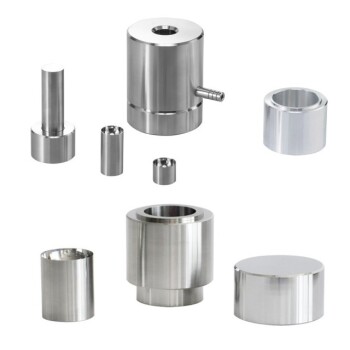
In shock consolidation experiments, the steel sleeve functions as far more than a simple storage vessel; it is an active mechanical component in the physics of the process. Its dual purpose is to act as a pressure transmitter for the explosive shock wave and as a structural constraint that prevents the sample from disintegrating after compression.
The steel sleeve serves as the critical interface that converts external explosive energy into the internal pressure needed for bonding, while simultaneously providing the lateral support required to survive the volatile unloading phase.
The Mechanics of Pressure Transmission
Acting as a Shock Wave Conduit
The steel sleeve is positioned between the external explosives and the AlCoCrFeNi powder. Its first role is to effectively transmit the energy generated by the detonation.
This creates an environment of extremely high instantaneous pressure, typically exceeding 1 GPa.
Driving Deformation and Heating
The transmitted pressure is what forces the internal powder particles together. This immense force causes severe plastic deformation within the alloy powder.
Simultaneously, the rapid compression generates adiabatic compression heating. This combination of heat and deformation is the fundamental mechanism that consolidates the loose powder into a solid high-entropy alloy.
Structural Integrity and Constraint
Managing the Unloading Phase
The experiment does not end with the explosion; the subsequent "unloading phase" is equally critical. This is when the pressure releases and shock waves can reflect through the material.
Preventing Sample Failure
When shock waves hit a boundary, they often reflect as tensile stress (pulling forces). Without support, this would rip the newly formed alloy apart.
The strength of the steel tube provides lateral constraint during this phase. It physically holds the sample together, counteracting the reflective tensile stress and preventing the material from shattering.
Understanding the Trade-offs
The Dependency on Sleeve Strength
The success of the consolidation is entirely dependent on the material properties of the sleeve itself. The sleeve must be strong enough to withstand the initial blast without failing.
The Risk of Insufficient Constraint
If the steel tube lacks the necessary strength to provide adequate lateral constraint, the physics of the unloading phase will dominate.
Specifically, the reflective tensile stresses will exceed the strength of the bonds between the powder particles, leading to immediate fracture or total disintegration of the sample.
Making the Right Choice for Your Experiment
To ensure the successful formation of AlCoCrFeNi alloys, you must view the steel sleeve as an integral part of the pressure system.
- If your primary focus is densification: Ensure the sleeve geometry and material are capable of transmitting pressures exceeding 1 GPa without dissipating energy.
- If your primary focus is sample integrity: Prioritize a sleeve with high yield strength to provide maximum lateral constraint against reflective tensile forces during unloading.
The steel sleeve is the guardian of the sample, bridging the gap between destructive explosive force and constructive alloy formation.
Summary Table:
| Function | Mechanism | Impact on AlCoCrFeNi Alloy |
|---|---|---|
| Pressure Transmission | Acts as a conduit for shock waves (>1 GPa) | Drives severe plastic deformation and adiabatic heating for bonding. |
| Structural Constraint | Provides lateral support during the unloading phase | Prevents sample disintegration by counteracting reflective tensile stresses. |
| Mechanical Interface | Converts explosive energy into internal pressure | Facilitates the transition from loose powder to a consolidated solid. |
| Yield Strength Role | Resists initial blast and subsequent stress | Ensures the sample remains intact without fracturing during pressure release. |
Elevate Your Materials Research with KINTEK Precision
Successful shock consolidation and material forming require more than just force; they require the right equipment and expertise. KINTEK specializes in comprehensive laboratory pressing solutions tailored for cutting-edge applications like high-entropy alloy development and battery research.
Whether you need manual, automatic, heated, or multifunctional models—including glovebox-compatible designs and advanced isostatic presses (CIP/WIP)—our tools provide the stability and precision your experiments demand. Don't let insufficient constraints compromise your results.
Ready to optimize your consolidation process? Contact KINTEK today to find the perfect pressing solution for your lab!
References
- Ali Arab, Pengwan Chen. Fabrication of Nanocrystalline AlCoCrFeNi High Entropy Alloy through Shock Consolidation and Mechanical Alloying. DOI: 10.3390/e21090880
This article is also based on technical information from Kintek Solution Knowledge Base .
Related Products
- Lab Button Battery Disassembly and Sealing Mold
- Lab Cylindrical Press Mold for Laboratory Use
- XRF KBR Steel Ring Lab Powder Pellet Pressing Mold for FTIR
- Square Lab Press Mold for Laboratory Use
- Lab Button Battery Tablet Press Sealing Mold
People Also Ask
- How does a sealed battery mold facilitate the assembly and testing of asymmetric supercapacitors using VO2?
- What is the function of specialized battery molds and sealing consumables? Optimize Your In-situ XRD Testing Today
- How does the geometry of laboratory molds influence mycelium-based composites? Optimize Density and Strength
- Why are specialized battery test molds used? Ensure Peak Performance for All-Solid-State Sodium Batteries (ASSIBs)
- What role do battery testing molds play in electrolyte performance? Exploring Pressure vs. Viscoelasticity