
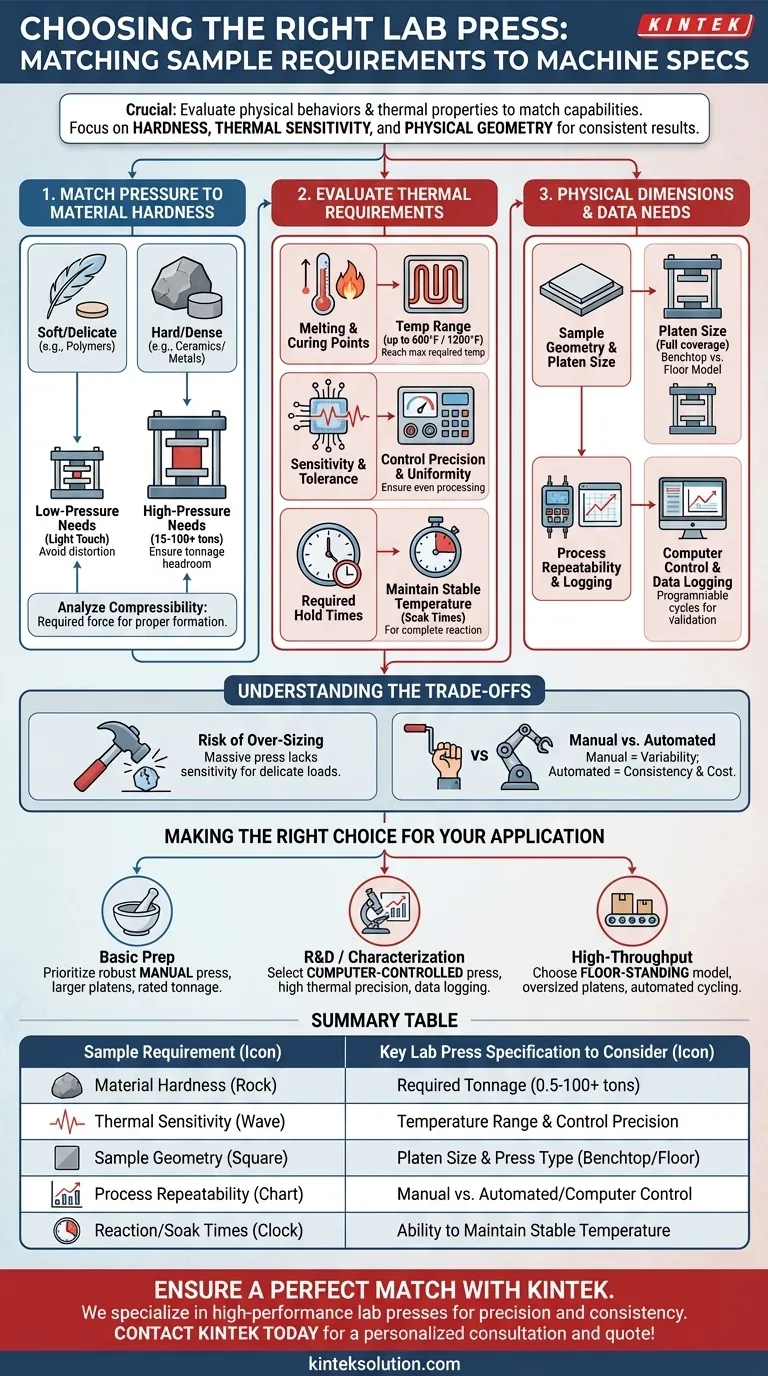
To select the correct lab press, you must rigorously evaluate the physical behaviors and thermal properties of the specific materials you intend to process. The decision relies primarily on matching the machine's capabilities to your sample's hardness, thermal sensitivity, and physical geometry.
The ideal lab press is not defined merely by its maximum specifications, but by how precisely it accommodates the material science of your sample. Focusing on the interplay between required force, temperature stability, and sample dimensions ensures consistent results without over-investing in unnecessary capacity.

Matching Pressure to Material Hardness
Analyzing Sample Compressibility
The most critical sample characteristic is hardness. Soft materials require significantly less force to form a proper pellet or film than hard, dense materials.
You must assess whether your sample requires a "light touch" or extreme force to bind.
Low-Pressure vs. High-Pressure Needs
For soft samples, a press designed for lower pressures is essential to avoid crushing or distorting the matrix.
Conversely, hard samples often require presses capable of delivering 15 to over 100 tons of force. Ensuring the press has the tonnage headroom to handle your hardest sample is vital for equipment longevity.
Evaluating Thermal Requirements
Melting and Curing Points
Your sample's thermal properties dictate the required temperature range. Standard applications may require heating up to 600°F, while specialized high-temperature materials may need capabilities up to 1200°F.
Verify that the press can reach the maximum temperature required to fully melt, sinter, or cure your material.
Temperature Sensitivity and Tolerance
Some samples degrade or cross-link prematurely if the temperature fluctuates. If your material has a narrow thermal window, you require a press with high temperature control precision.
You must also consider the need for uniform temperature distribution across the platens to ensure the entire sample is processed evenly.
Required Hold Times
Certain materials, particularly thermosetting plastics or ceramics, require specific "soak" times at a set temperature to react properly.
Ensure the press is capable of maintaining a stable temperature for the full duration of your longest process cycle.
Physical Dimensions and Data Needs
Sample Geometry and Platen Size
The physical footprint of your sample determines the minimum necessary platen size. The platens must fully cover the mold or sample to ensure even pressure application.
If you are working with large composite sheets or multiple molds, a compact benchtop model may be insufficient, necessitating a larger floor model.
Process Repeatability and Logging
If your sample is part of a research study or quality control process requiring strict validation, the sample "needs" data logging.
In these cases, computer control options become a requirement. Programmable cycles ensure that complex pressure and temperature ramps are applied identically to every sample, eliminating operator error.
Understanding the Trade-offs
The Risk of Over-Sizing
A common mistake is assuming a higher tonnage press is always better. A massive 100-ton press may lack the sensitivity to apply a precise, low-force load (e.g., 0.5 tons) required for a delicate sample.
Manual vs. Automated Operation
Manual presses are cost-effective for simple, occasional runs. However, for samples that require complex heating and cooling ramps, manual operation introduces variability.
Automated presses solve this but come at a higher cost and complexity. You must balance your budget against the sample's need for strict process control.
Making the Right Choice for Your Application
To finalize your decision, categorize your primary objective:
- If your primary focus is basic sample preparation: Prioritize a robust manual press with platens slightly larger than your largest sample and tonnage rated for your hardest material.
- If your primary focus is R&D or precise characterization: Select a computer-controlled press with high thermal precision and data logging to ensure every variable is tracked.
- If your primary focus is high-throughput or large parts: Choose a floor-standing model with oversized platens and automated cycling to maximize consistency and volume.
Aligning the machine specs with the material reality of your sample is the only way to guarantee a reliable laboratory workflow.
Summary Table:
| Sample Requirement | Key Lab Press Specification to Consider |
|---|---|
| Material Hardness | Required Tonnage (e.g., 0.5 to 100+ tons) |
| Thermal Sensitivity | Temperature Range & Control Precision |
| Sample Geometry | Platen Size & Press Type (Benchtop/Floor) |
| Process Repeatability | Manual vs. Automated/Computer Control |
| Reaction/Soak Times | Ability to Maintain Stable Temperature |
Ensure your lab press perfectly matches your sample's needs. KINTEK specializes in high-performance lab press machines, including automatic lab presses, isostatic presses, and heated lab presses. Our experts will help you select the ideal equipment for your specific material hardness, thermal requirements, and sample dimensions, guaranteeing precision, efficiency, and consistent results in your laboratory workflow.
Contact KINTEK today for a personalized consultation and quote!
Visual Guide
Related Products
- 24T 30T 60T Heated Hydraulic Lab Press Machine with Hot Plates for Laboratory
- Manual Heated Hydraulic Lab Press with Integrated Hot Plates Hydraulic Press Machine
- Laboratory Hydraulic Pellet Press for XRF KBR FTIR Lab Press
- Lab Infrared Press Mold for Laboratory Applications
- Laboratory Hydraulic Press Lab Pellet Press Machine for Glove Box
People Also Ask
- Function of a Laboratory Hydraulic Press with Heated Platens in SSE? Enhance Battery Density & Conductivity
- Why is a laboratory hydraulic press with heating plates required for PLA/TEC films? Achieve Precise Sample Integrity
- What role does a laboratory heated hydraulic press play in LTCC? Essential for High-Density Ceramic Lamination
- Why reduce load when applying composite strengthening tabs? Protect Specimen Integrity and Data Accuracy
- Why is a laboratory heated hydraulic press utilized during the lamination stage of NASICON green tapes?



















