
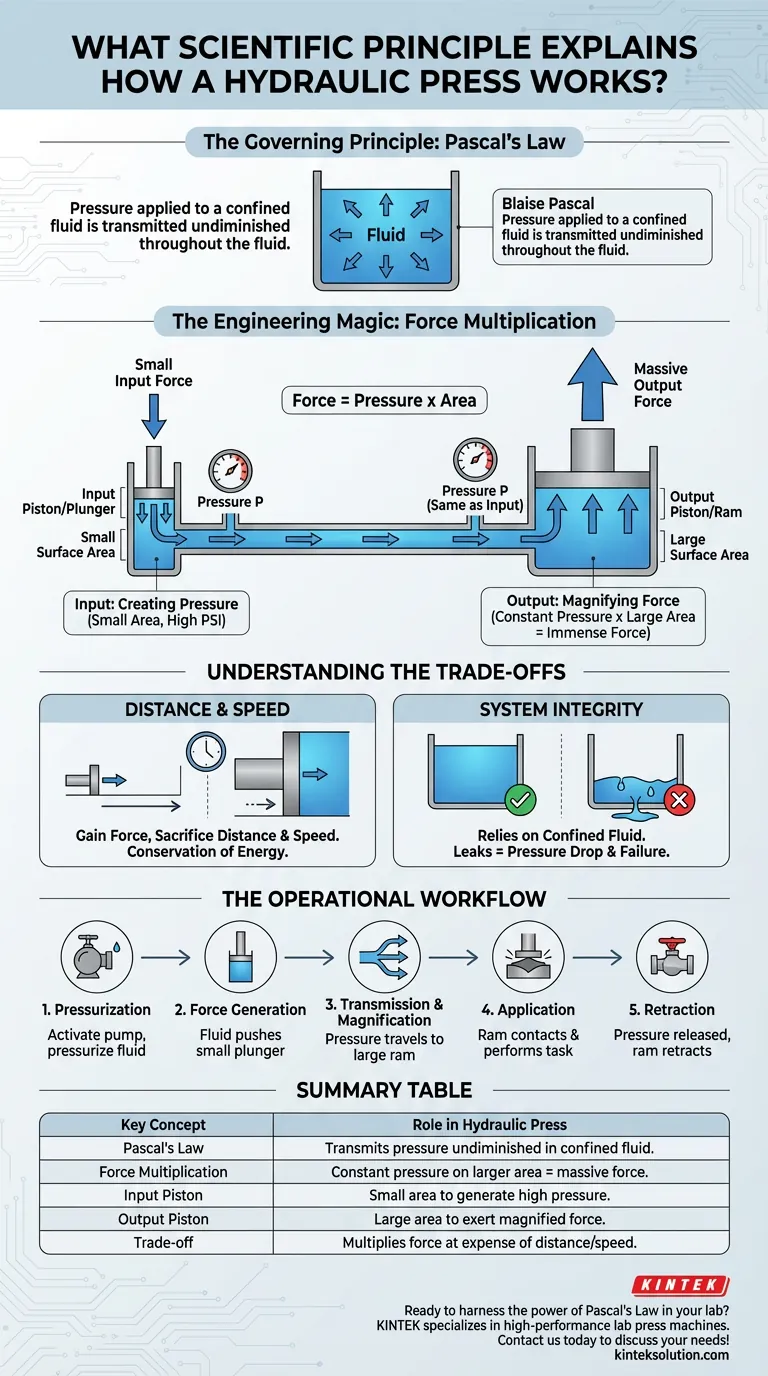
The governing scientific principle of a hydraulic press is Pascal’s Law. Discovered by French philosopher Blaise Pascal, this principle states that when pressure is applied to a confined fluid, that pressure change is transmitted undiminished throughout the entire fluid in all directions. In a hydraulic press, this allows a mechanical force to be transmitted from an input point to an output point without a loss of pressure.
The Core Insight: While Pascal's Law dictates that pressure remains constant within the system, the engineering magic lies in force multiplication. By applying that constant pressure against a piston with a much larger surface area, a hydraulic press transforms a small input effort into a massive output force capable of heavy industrial tasks.
How Pascal’s Law Generates Power
To understand why a hydraulic press is effective, you must distinguish between pressure and force. Pascal's Law ensures the pressure stays the same, but the machine is designed to manipulate surface area to change the force.
The Closed System
For a hydraulic press to function, the fluid (usually oil) must be entirely enclosed.
If there are no leaks, the fluid acts as a solid rod for transmitting energy. When you push on one end, the energy is instantly transferred to every other part of the container.
The Input: Creating Pressure
The cycle begins with a pump or a small piston (plunger).
When a small force is applied to this small surface area, it generates internal pressure within the fluid. Because the area is small, it does not require much effort to create significant pressure (PSI).
The Output: Magnifying Force
This is the critical application of Pascal's Law. The pressurized fluid pushes against a second, larger piston (the ram).
Because the pressure is constant, but the surface area of the ram is much larger, the total force exerted increases proportionally. If the output piston is 10 times larger than the input piston, the output force is 10 times greater.
Understanding the Trade-offs
While hydraulic presses offer immense power, the laws of physics dictate that energy is conserved. You cannot multiply force without paying a price elsewhere.
The Distance Trade-off
To gain force, you must sacrifice distance.
To move the large, heavy-lifting ram just one inch, the small input piston must move many inches. The work done (Force $\times$ Distance) remains roughly equal on both sides, minus friction losses.
Speed Limitations
Because of the volume of fluid required to move the large ram, hydraulic presses are generally slower than mechanical presses.
The small pump must cycle many times to displace enough fluid to extend the large ram, resulting in a slower, albeit more powerful, operation.
System Integrity Dependencies
Pascal’s Law relies entirely on the fluid being confined.
Any breach in the seals or valves causes an immediate drop in pressure. Unlike mechanical systems which might grind or jam, a hydraulic system with a leak loses its capacity to transmit force entirely.
The Operational Workflow
Based on the standard mechanics of these machines, the process follows a distinct five-step cycle.
1. Pressurization
The operator activates the hydraulic pump. This begins the process of pressurizing the fluid within the reservoir and lines.
2. Force Generation
The fluid is directed toward a small plunger. As the fluid pushes against this restricted area, the initial mechanical force is generated.
3. Transmission and Magnification
The pressure travels through the fluid to the larger ram. This is where the physical expansion of force occurs, leveraging the larger surface area.
4. Application
The ram extends to contact the workpiece. It performs the requisite task, such as forging, molding, or crushing, using the magnified force.
5. Retraction
Once the task is complete, the pressure is released (often via a release valve). The fluid returns to the reservoir, and the ram retracts to its starting position.
Making the Right Choice for Your Goal
Understanding Pascal's Law helps you evaluate if a hydraulic system is the right tool for your specific engineering challenge.
- If your primary focus is Maximum Force: Utilize a system with the largest possible ratio between the input plunger and the output ram; this maximizes the mechanical advantage.
- If your primary focus is Precision and Control: Leverage the hydraulic nature of the machine, which applies force evenly and consistently, unlike the jarring impact of a mechanical flywheel.
- If your primary focus is Speed: Acknowledge that a standard hydraulic press may be too slow; you would need high-volume pumps to compensate for the distance trade-off.
The utility of a hydraulic press comes from its ability to turn the physics of fluids into a customizable lever for heavy industry.
Summary Table:
| Key Concept | Role in Hydraulic Press |
|---|---|
| Pascal's Law | Pressure applied to a confined fluid is transmitted undiminished throughout the fluid. |
| Force Multiplication | Constant pressure applied to a larger piston surface area generates immense output force. |
| Input Piston (Plunger) | Small surface area where initial force is applied to generate high pressure. |
| Output Piston (Ram) | Large surface area where pressurized fluid exerts magnified force on the workpiece. |
| Trade-off | Force is multiplied at the expense of distance/speed; energy is conserved. |
Ready to harness the power of Pascal's Law in your lab? KINTEK specializes in high-performance lab press machines, including automatic lab presses, isostatic presses, and heated lab presses. Our hydraulic systems deliver precise force control and uniform pressure for your most demanding applications. Contact us today to discuss how our lab press solutions can enhance your research and development workflows!
Visual Guide
Related Products
- Automatic High Temperature Heated Hydraulic Press Machine with Heated Plates for Lab
- Manual Heated Hydraulic Lab Press with Integrated Hot Plates Hydraulic Press Machine
- Heated Hydraulic Press Machine with Heated Plates for Vacuum Box Laboratory Hot Press
- Laboratory Hydraulic Press 2T Lab Pellet Press for KBR FTIR
- Laboratory Hydraulic Press Lab Pellet Press Machine for Glove Box
People Also Ask
- Function of a Laboratory Hydraulic Press with Heated Platens in SSE? Enhance Battery Density & Conductivity
- How does a laboratory heated hydraulic press facilitate PBN sample prep for WAXS? Achieve Precise X-Ray Scattering
- What are the requirements for electrode pressing with high-viscosity ionic liquids like EMIM TFSI? Optimize Performance
- What are the industrial applications of heated hydraulic presses? Master Heat & Force for Precision Manufacturing
- Why is a laboratory hydraulic press with heating plates required for PLA/TEC films? Achieve Precise Sample Integrity



















