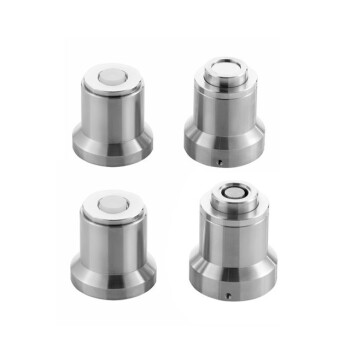
The structural design of a mechanical compression cell mold safeguards electrochemical testing by enforcing continuous, stable stacking pressure across the battery layers. This screw-driven mechanism forces the cathode, electrolyte, and anode into tight physical contact, neutralizing the physical instabilities inherent in solid-state systems.
By applying constant mechanical pressure, these molds prevent the delamination of battery layers caused by material expansion and contraction. This ensures that the data collected—specifically impedance and cycle life—reflects true battery chemistry rather than structural failure.
The Critical Challenge of Solid-State Interfaces
Mitigating Material Expansion
Electrode materials naturally change volume during charge and discharge cycles. In solid-state batteries, this expansion and contraction creates significant mechanical stress within the cell stack.
Preventing Interfacial Peeling
Without external restraint, volume changes lead to "interfacial peeling." This is where the layers physically separate, breaking the ionic pathway required for the battery to function.
Safeguarding Layer Contact
The primary function of the mold is to mitigate this risk. It acts as a rigid clamp, maintaining the structural integrity of the cell even as the internal materials attempt to shift.
How Mechanical Compression Ensures Integrity
Bridging the Contact Gap
Unlike liquid electrolytes, solid electrolytes cannot flow to fill voids or gaps. Tight physical contact is the only way to ensure ions can move between the ceramic cathode, the electrolyte layer, and the lithium metal anode.
Utilizing Screw-Driven Stability
The screw-driven design mentioned in standard molds provides a specific technical advantage: tunable, consistent force. This allows researchers to apply the precise amount of pressure needed to flatten interface irregularities without crushing the components.
Stabilizing the Electrolyte Layer
The mold is particularly critical for the electrolyte layer. By compressing this layer between the electrodes, the mold ensures uniform ionic conductivity across the entire surface area.
The Impact on Data Accuracy
Validating Impedance Spectra
If layers separate even slightly, the internal resistance of the cell spikes artificially. The mold ensures that impedance spectra readings reflect the actual material properties, rather than artifacts caused by poor contact or delamination.
Securing Cycle Life Data
Long-term testing requires structural durability. By preventing early mechanical failure (peeling), the mold allows researchers to acquire accurate cycle life data, revealing the true chemical longevity of the battery.
Understanding the Trade-offs
The Risk of Over-Compression
While pressure is vital, it must be calibrated carefully. Excessive force applied via the screw mechanism can crack brittle ceramic electrolytes or squeeze soft lithium metal anodes, potentially causing short circuits.
Complexity vs. Throughput
Mechanical compression molds are generally bulkier than standard coin cells. This structural robustness often limits the number of cells that can be tested simultaneously in a temperature chamber, trading high throughput for higher data fidelity.
Optimizing Your Testing Setup
To maximize the value of a mechanical compression cell mold, align your usage with your specific testing objectives:
- If your primary focus is Cycle Life Analysis: Ensure the screw mechanism is locked firmly to maintain pressure over weeks of expansion and contraction cycles.
- If your primary focus is Impedance Spectroscopy: Use the mold to standardize contact pressure, eliminating "contact noise" so you can observe the true resistance of the solid interfaces.
The mechanical compression mold is not just a passive holder; it is an active control variable that standardizes the physical environment of your solid-state battery.
Summary Table:
| Technical Feature | Safeguard Provided | Impact on Data Accuracy |
|---|---|---|
| Screw-Driven Mechanism | Enforces tunable, continuous stacking pressure | Prevents impedance spikes from contact loss |
| Rigid Clamp Design | Mitigates material expansion & contraction stress | Ensures cycle life reflects chemistry, not failure |
| Active Compression | Neutralizes interfacial peeling & layer separation | Maintains uniform ionic conductivity |
| Controlled Interface | Flattens irregularities without crushing components | Validates true material impedance spectra |
Precision Compression for Superior Battery Research
Are physical instabilities undermining your solid-state battery data? KINTEK specializes in comprehensive laboratory pressing solutions designed to eliminate interfacial peeling and ensure consistent data fidelity. Our diverse range—including manual, automatic, heated, multifunctional, and glovebox-compatible models, as well as cold and warm isostatic presses—is engineered to meet the rigorous demands of advanced battery research.
Don't let structural failure mask your material breakthroughs. Contact KINTEK today to find the perfect pressing solution for your lab and achieve the precise mechanical control your electrochemical testing requires.
References
- Steffen Weinmann, Kunjoong Kim. Stabilizing Interfaces of All‐Ceramic Composite Cathodes for Li‐Garnet Batteries. DOI: 10.1002/aenm.202502280
This article is also based on technical information from Kintek Solution Knowledge Base .
Related Products
- Lab Button Battery Tablet Press Sealing Mold
- Carbide Lab Press Mold for Laboratory Sample Preparation
- Lab Button Battery Disassembly and Sealing Mold
- Lab Cylindrical Press Mold for Laboratory Use
- Lab Infrared Press Mold for Laboratory Applications
People Also Ask
- How does a sealed battery mold facilitate the assembly and testing of asymmetric supercapacitors using VO2?
- Why use standardized CR2032 components & high-precision presses? Ensure reliability in lithium metal battery research.
- Why is a laboratory battery sealing press essential for desolvation energy testing? Ensure Reliable Kinetic Data
- What is the function of specialized battery molds and sealing consumables? Optimize Your In-situ XRD Testing Today
- What role does a laboratory sealing press play in thermal analysis of solid dispersion films? Ensure Data Integrity