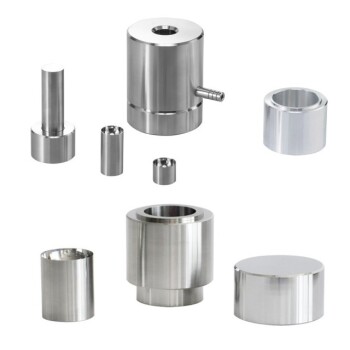
High-precision laboratory presses are the gatekeepers of material data integrity. By providing a uniform and controllable pressure environment, these machines ensure the full rearrangement of powder particles into high-density standard specimens. This process is critical for eliminating internal density gradients and micro-cracks, ensuring that subsequent mechanical testing reveals the material's intrinsic properties rather than defects caused by poor specimen preparation.
Accurate material characterization relies on the elimination of variables; precise pressure control is the only way to isolate true material performance from manufacturing anomalies, particularly when comparing traditional powder metallurgy with modern additive manufacturing.
The Foundation of Reliable Data
Eliminating Structural Bias
The primary role of a high-precision press is to remove the "noise" from your data. Without precise pressure-holding control, specimens often suffer from internal density gradients.
These gradients create weak points that fail prematurely during testing. A high-precision press ensures the specimen is uniform throughout, so failure data reflects the material chemistry, not the molding process.
Ensuring Particle Rearrangement
To achieve a valid "green compact" (the pressed powder before sintering), particles must be rearranged completely.
Automatic lab presses apply specific force to lock particles together tightly. This prevents the formation of micro-cracks that would otherwise propagate during sintering or mechanical testing.
The Role in Additive Manufacturing (AM)
Healing Printing Defects
Metal additive manufacturing, such as Laser Powder Bed Fusion (L-PBF), involves violent thermal stresses. This often results in interlayer pores, grain boundary segregation, or lack-of-fusion (LOF) defects.
High-precision equipment, specifically Hot Isostatic Pressing (HIP), is required to correct these issues. By applying simultaneous high temperature and isostatic pressure, the equipment induces plastic flow and diffusion bonding to close these internal voids.
Enhancing Fatigue Performance
For AM parts to compete with traditional forged components, density is key. The post-processing densification provided by HIP significantly improves toughness.
This allows the fatigue life of 3D-printed parts to approach, and sometimes exceed, that of traditionally manufactured counterparts.
Comparative Studies and Standardization
Creating a Control Group
To evaluate the efficiency of a new additive manufacturing process, researchers need a perfect standard for comparison.
Isostatic presses allow for the creation of high-density reference specimens (such as Ti-6Al-4V blocks) via traditional powder metallurgy. These serve as the baseline, allowing researchers to objectively compare density gradients and compressive strengths against printed samples.
Studying Sintering Kinetics
High-precision pressing is essential for fundamental research into how powders behave under heat.
By creating consistent green compacts, researchers can accurately study sintering kinetics and phase transformation characteristics. This data is vital for optimizing both traditional and additive production lines.
Understanding the Trade-offs
Equipment Complexity vs. Throughput
While Hot Isostatic Pressing (HIP) offers superior densification, it introduces significant process complexity compared to standard hydraulic pressing.
It requires the management of high-pressure gas alongside high temperatures. This increases the cycle time and cost per part, making it less suitable for low-value rapid prototyping but essential for critical aerospace or medical applications.
Initial Density vs. Final Properties
A standard hydraulic press is excellent for achieving high initial density in green bodies, such as sludge-based bricks. However, it cannot "heal" internal defects in the same way HIP does.
Researchers must distinguish between the need for shape consolidation (hydraulic pressing) and microstructural healing (isostatic/HIP). Using the wrong method will yield misleading data regarding the material's ultimate strength.
Making the Right Choice for Your Goal
To select the correct equipment for your laboratory, verify your primary research objective:
- If your primary focus is establishing material baselines: Use a standard automatic lab press to create defect-free green compacts that ensure your mechanical testing data is chemically intrinsic.
- If your primary focus is optimizing Additive Manufacturing parts: Prioritize Hot Isostatic Pressing (HIP) to eliminate printing defects like porosity and ensure fatigue performance matches forged standards.
- If your primary focus is comparative process analysis: Use an isostatic press to create high-density reference blocks that serve as the "control" against which new manufacturing methods are measured.
Ultimatelty, the precision of your press dictates the credibility of your material data.
Summary Table:
| Equipment Type | Primary Function | Core Benefit in Material Research |
|---|---|---|
| Automatic Lab Press | High-precision force application | Eliminates structural bias and ensures particle rearrangement |
| Isostatic Press | Uniform multi-directional pressure | Creates high-density reference specimens for baseline data |
| HIP (Hot Isostatic Pressing) | Simultaneous heat and pressure | Heals internal voids, pores, and defects in AM parts |
Elevate Your Material Research with KINTEK Precision
Don't let inconsistent specimen preparation compromise your research data. KINTEK specializes in comprehensive laboratory pressing solutions designed for the rigorous demands of battery research, powder metallurgy, and additive manufacturing.
Our extensive range includes:
- Manual & Automatic Lab Presses for precise force control.
- Heated & Multifunctional Models for complex material behavior studies.
- Glovebox-Compatible & Isostatic Presses (Cold and Warm) for specialized environments.
Whether you need to establish material baselines or heal internal defects in 3D-printed parts, our experts are ready to help you select the perfect pressing solution.
Contact KINTEK Today to Optimize Your Lab
References
- Thermal formulation of singular regions for orthotropic and isotropic materials. DOI: 10.36717/ucm19-15
This article is also based on technical information from Kintek Solution Knowledge Base .
Related Products
- Lab Round Bidirectional Press Mold
- Lab Polygon Press Mold
- XRF KBR Plastic Ring Lab Powder Pellet Pressing Mold for FTIR
- Lab XRF Boric Acid Powder Pellet Pressing Mold for Laboratory Use
- Square Bidirectional Pressure Mold for Lab
People Also Ask
- What is the purpose of incorporating cartridge heaters into a lab press mold for MLCC block compression? Optimize Results
- What is the function of a pressing tool in thermoplastic panels? Master Precision Shaping & Fusion Bonding
- Why is precise cooling management of the lab press mold necessary? Protect Core Integrity in Thermoforming
- Why is a high-performance laboratory molding press critical for in-situ electrolyte formation? Unlock Battery Success
- How do the design and geometric precision of pressing molds and mandrels affect the quality of PTFE composite samples?