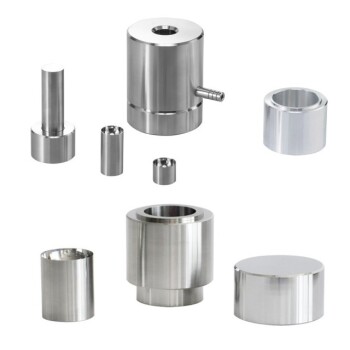
High-strength stainless steel is the non-negotiable standard for metal powder molding because the process relies on containing immense forces to fuse loose particles. Uni-axial pressing generates extreme pressures, often reaching hundreds of Megapascals (MPa), requiring a mold that acts as an immovable constraint carrier. Without this specific material grade, the tool would deform under load, compromising the geometric precision, density, and structural integrity of the resulting "green compact."
The fundamental role of the mold is to force loose powder to reduce in volume and bond closely. High-strength stainless steel provides the necessary hardness and structural rigidity to withstand massive compressive stress without yielding, ensuring precise dimensional accuracy.
The Physics of Confinement
Managing Extreme Pressure
Metal powder molding is not a gentle process; it involves subjecting materials to compressive stresses that can exceed 100 MPa. The mold must absorb this energy without flexing or expanding. If the mold material lacks sufficient strength, the applied pressure will deform the tool rather than densify the powder.
The Role of the Constraint Carrier
The mold acts as a rigid "constraint carrier" for the loose powder. It forces the material to reduce its volume within a strictly defined space. This geometric constraint is what compels the particles to bond effectively, achieving the specific initial density required for the part to hold together.
Critical Material Characteristics
Resistance to Deformation
To achieve precise geometric dimensions, such as exact diameters and thicknesses, the mold must possess high structural rigidity. Pre-hardened stainless steel is often selected specifically for this capability. It maintains its shape absolutely, ensuring that the dimensions of the final part mirror the design of the tool exactly.
High Hardness and Wear Resistance
Beyond resisting pressure, the mold surface must exhibit high hardness. This property allows the mold to withstand repeated mechanical impacts during high-volume production cycles. It also ensures the mold can facilitate accurate measurements of lateral displacement without degrading over time.
Ensuring Surface Quality
The hardness of the steel directly influences the finish of the molded part. A high-strength steel mold resists scratching and pitting, which transfers a smooth surface finish to the green compact. This reduces the need for extensive post-processing or machining of the fragile pressed part.
Understanding the Operational Trade-offs
The Risk of Brittle Failure
While high hardness is essential for maintaining shape, it can make the steel less ductile. If the mold is subjected to lateral forces it wasn't designed for, or if the press alignment is off, the mold may crack rather than bend. Operators must ensure that pressures remain within the rated limits of the specific steel grade to prevent catastrophic tool failure.
Cost vs. Longevity
High-strength, pre-hardened stainless steels are more difficult and expensive to machine into complex shapes than softer metals. However, using a softer, cheaper mold material will lead to rapid wear and loss of dimensional tolerance. The initial investment in high-strength steel is a necessary trade-off for consistency and tool longevity in powder metallurgy.
Making the Right Choice for Your Goal
To select the correct tooling strategy for your specific application, consider the following:
- If your primary focus is Dimensional Precision: Prioritize steel grades with the highest possible structural rigidity to prevent even microscopic deformation under peak loads.
- If your primary focus is High-Volume Production: Select pre-hardened steel with exceptional wear resistance to withstand the mechanical impact of thousands of cycles.
- If your primary focus is Surface Finish: Ensure the mold material has high hardness to maintain a smooth interface and prevent surface defects on the green compact.
The mold is not just a container; it is the primary instrument that dictates the physical reality of the final component.
Summary Table:
| Key Property | Technical Requirement | Impact on Final Product |
|---|---|---|
| Structural Rigidity | High Resistance to Yielding | Maintains precise geometric dimensions |
| Hardness | Pre-hardened Steel Grade | Prevents surface scratching and pitting |
| Pressure Handling | 100+ MPa Stress Tolerance | Facilitates particle bonding and density |
| Wear Resistance | Durability for High Cycles | Extends tool life in mass production |
Optimize Your Powder Metallurgy Results with KINTEK
Don't let tool deformation compromise your research or production quality. KINTEK specializes in comprehensive laboratory pressing solutions, offering a full range of manual, automatic, heated, and multifunctional models, as well as specialized cold and warm isostatic presses.
Whether you are working on advanced battery research or high-precision industrial parts, our high-strength molding solutions ensure your green compacts achieve the perfect density and finish every time.
Ready to elevate your lab's performance? Contact our specialists today to find the ideal pressing solution for your application.
References
- Suresh K.R, L Avinash. Influence of Powder Composition & Morphology on Green Density for Powder Metallurgy Processes. DOI: 10.15680/ijirset.2015.0401037
This article is also based on technical information from Kintek Solution Knowledge Base .
Related Products
- XRF KBR Steel Ring Lab Powder Pellet Pressing Mold for FTIR
- Square Bidirectional Pressure Mold for Lab
- Lab Round Bidirectional Press Mold
- Lab Anti-Cracking Press Mold
- XRF KBR Plastic Ring Lab Powder Pellet Pressing Mold for FTIR
People Also Ask
- What considerations are important regarding the die size of an XRF pellet press? Optimize for Your XRF Spectrometer and Sample
- Why are pellets used in XRF analysis, and what is their limitation? Boost Accuracy and Speed in Your Lab
- What is the general process for preparing a sample pellet for XRF? Master Consistency for Accurate Analysis
- What are the differences between manual and automatic XRF pellet presses? Choose the Right Press for Your Lab's Needs
- What are the primary factors to consider when deciding between a manual and an automatic XRF pellet press? Optimize Your Lab's Efficiency